

On this page
If your electric scooter gives you less range than its brochure promised, it is probably fine. The claimed figure comes from a standard test, and your ride is not that test. Class 11 physics explains the gap.
How is electric scooter range measured in India?
The method is set by AIS-040, Electric Power Train Vehicles: Method of Measuring the Range, a standard printed by ARAI for the Ministry of Road Transport and Highways. For L-category vehicles, which include electric scooters, it uses the Indian Driving Cycle (IDC) from the Central Motor Vehicle Rules, run on a chassis dynamometer: a set of rollers in a lab.
The test, per the standard and its amendments:
Charge the battery fully, at an ambient temperature between 20 °C and 30 °C.
Repeat the driving cycle with the headlamp (or, on some vehicles, daytime running lamps) on. Up to three breaks are allowed, totalling no more than 15 minutes.
Stop when the scooter can no longer follow the target speed curve (for L-category vehicles, 85% of the cycle's or the vehicle's maximum speed can be used), or when the on-board instruments tell the rider to stop.
The distance covered, rounded to the nearest whole kilometre, is the certified range.
The cycle itself is gentle. A 2013 paper by Sanjeev Sinha (NIT Patna) and Ravindra Kumar (CRRI) notes that the IDC leaves out speeds above 42 km/h and accelerations above 0.65 m/s², and that it was developed assuming a road with zero gradient.
Why does an electric scooter's real range differ from the claimed range?
A battery stores a fixed amount of energy (1 kWh = 3.6 MJ). On a flat road at steady speed, the motor spends it against two forces, set out on this UBC Physics page on energy use in vehicles:
Rolling resistance: F = μ m g, where μ is the rolling coefficient, so it grows with the total mass.
Air drag: F = ½ ρ C A v², where ρ is air density (about 1.2 kg/m³), so it grows with the square of speed.
NASA's Glenn Research Center puts it plainly: drag depends on the square of the velocity. Since work is force times distance, the energy used per metre, in joules, equals the resisting force in newtons. Ride twice as fast and the energy lost to drag on every kilometre quadruples.
Not all battery energy reaches the wheel: for electric cars, the US Department of Energy's fueleconomy.gov estimates that 60% to 66% of the energy taken from the grid reaches the wheels in city driving and 71% to 73% on the highway, before counting regenerative braking. Every climb costs m g h. And every start from rest costs ½ m v², only part of which comes back when you brake. Our post on why a machine's efficiency is always less than 100% explains where the rest goes.
How much range do speed, load and hills cost?
A worked example, with round, assumed numbers:
Battery: 3 kWh, with 80% reaching the wheel, so 2.4 kWh = 8.64 MJ of useful work.
Scooter plus one rider: 180 kg. Rolling coefficient μ = 0.015, the UBC page's value for an ordinary car tyre.
Drag area C A = 0.6 m² (assumed), ρ = 1.2 kg/m³.
Range is useful energy divided by total force:
Rolling force: 0.015 × 180 × 9.8 = 26.5 N.
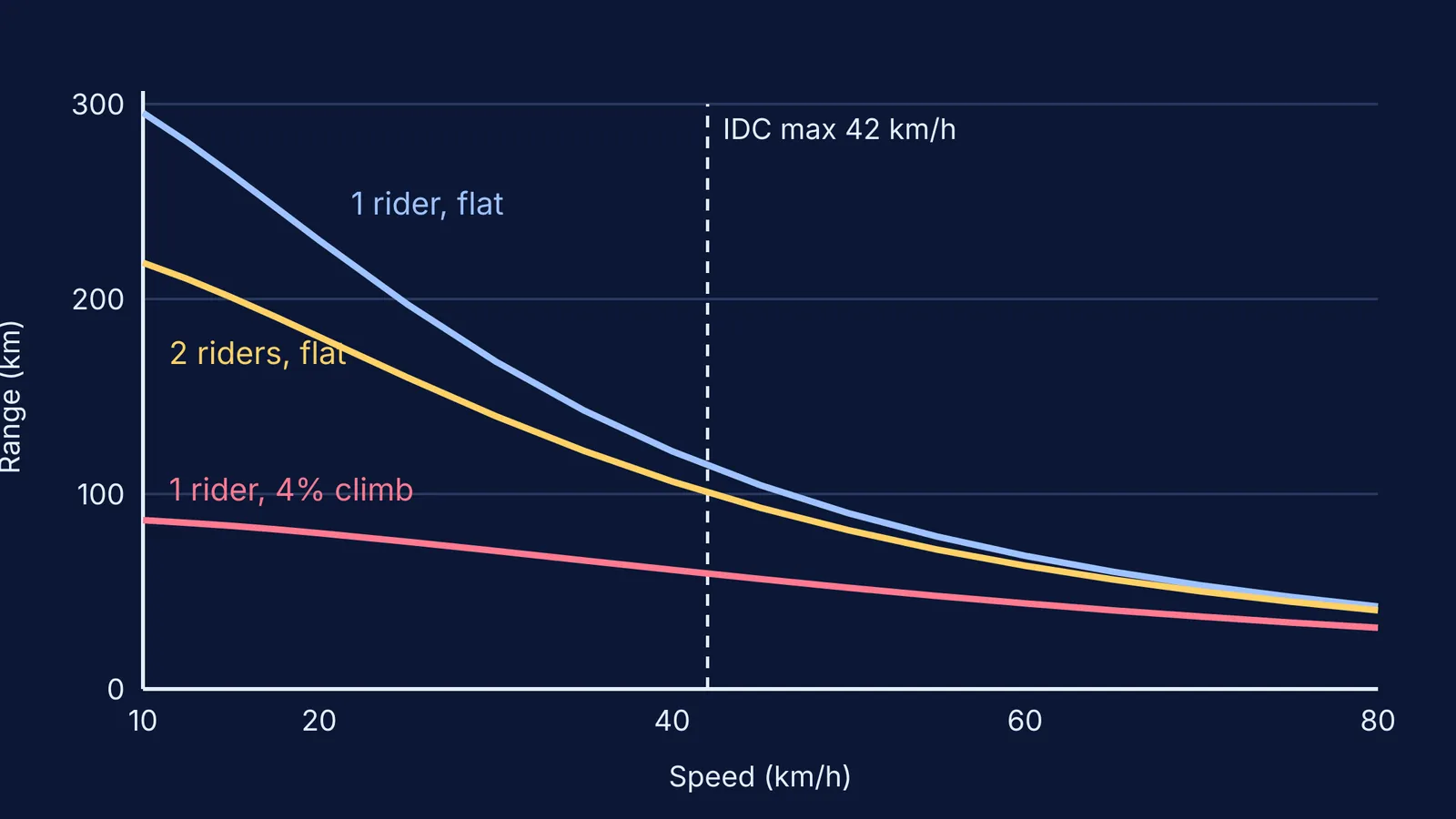
At a steady 40 km/h (11.1 m/s), drag is ½ × 1.2 × 0.6 × 11.1² = 44.4 N. Total 70.9 N, so range = 8.64 MJ ÷ 70.9 N ≈ 122 km.
At a steady 60 km/h, drag is 100 N. Total 126.5 N, range ≈ 68 km.
Two riders (250 kg) at 40 km/h: rolling force rises to 36.8 N, range ≈ 106 km.
One rider climbing a 4% slope at 40 km/h: the slope adds 180 × 9.8 × 0.04 = 70.6 N, range ≈ 61 km while climbing.
Stop-start: each start to 40 km/h needs ½ × 180 × 11.1² ≈ 11 kJ, so 100 starts use about 13% of the 8.64 MJ before regenerative braking gives any back.
For the history, see how Gustave Eiffel measured air resistance with his tower. If v² still feels abstract, the Fermi Simulation Lab has interactive simulations for the ideas that are easier to see than to read.
How can you work out your own scooter's real range?
Note the battery capacity in Wh from the spec sheet.
Charge fully, reset the trip meter and ride your normal routes for a few days.
When the battery shows about 40%, note the kilometres ridden.
Energy per km = capacity × fraction used ÷ km. For example, 3000 Wh × 0.6 ÷ 45 km = 40 Wh/km.
Real range ≈ capacity ÷ energy per km: 3000 ÷ 40 = 75 km.
This is the same arithmetic as working out how long a phone battery lasts from its mAh rating and load, with distance in place of time. For more practice, the Fermi Problem Library has worked problems with a step-by-step solver that explains the reasoning rather than printing an answer.
Next time someone asks why the scooter falls short, you can show them on paper.


