

On this page
Shine a bright lamp on an earthworm and it soon pulls back into its burrow, though it has no eyes. Charles Darwin noticed this in his 1881 book The Formation of Vegetable Mould through the Action of Worms. Worms, he wrote, "are destitute of eyes", yet worms left before a paraffin lamp or candle "invariably retreated into their burrows within from five to fifteen minutes". Candlelight focused through a lens onto the head end usually made them withdraw at once.
Where are an earthworm's light-sensing cells?
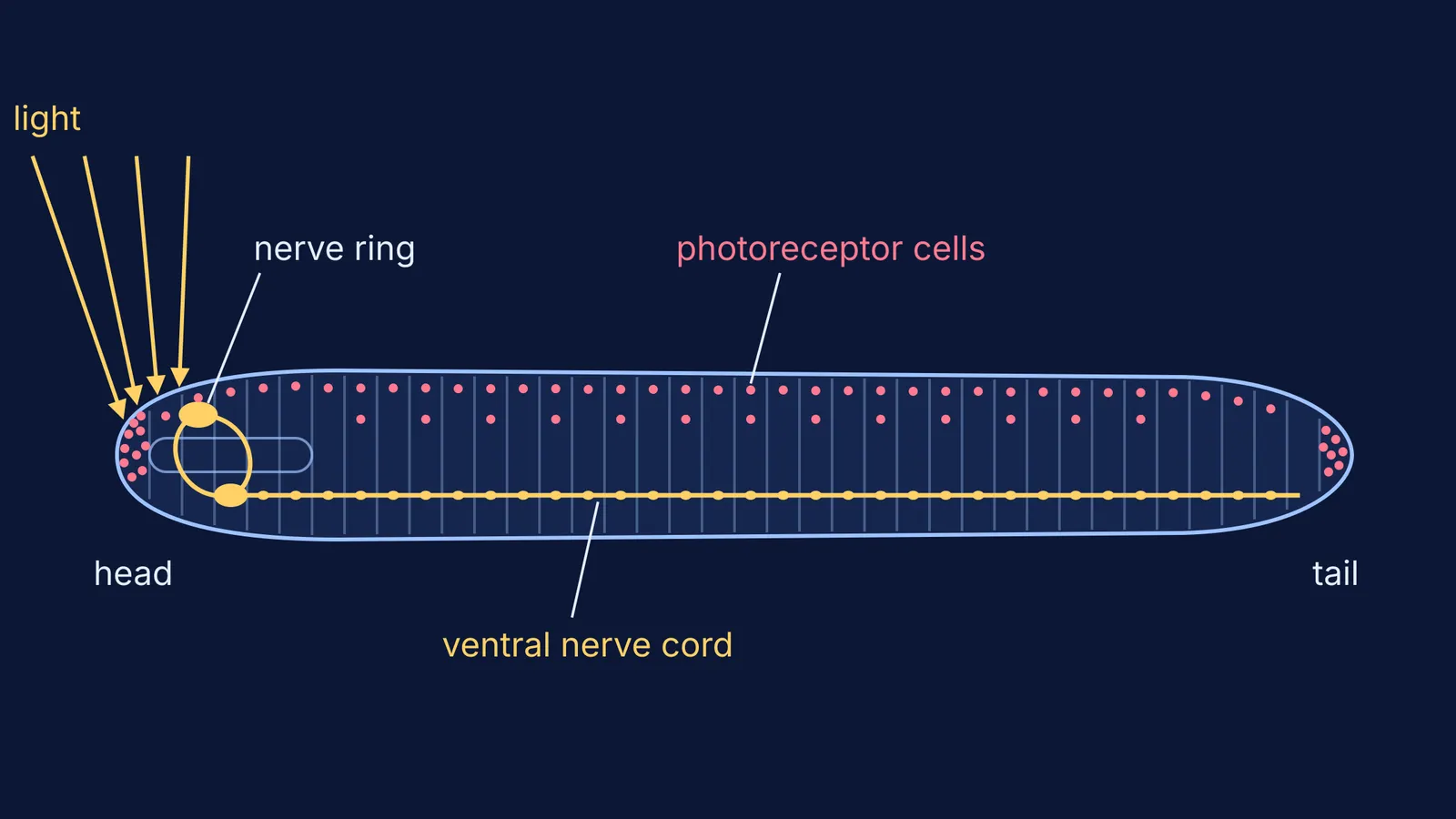
They sit in the skin. A photoreceptor is a cell that turns light into a nerve signal. In 1925 Walter Hess mapped them in the common earthworm, *Lumbricus terrestris*, in the Journal of Morphology. He found single light cells in the skin of every segment, plus clusters in nerve swellings at the head lobe (the prostomium) and the last segment. The grooves between segments and most of the underside had none.
Each light cell holds a clear central "lens" wrapped in a net of nerve fibrils, the retinella, and the lens focused light onto that net from any direction. Nerves supplied every cell.
Richard Fox's invertebrate anatomy notes at Lander University say these photoreceptors are most abundant on the prostomium, which fits Darwin's head-end results.
A 2022 study from Manonmaniam Sundaranar University, Tirunelveli, in Molecular Biology Reports found a gene called ARRDC active in the skin and nerve cord of the earthworm *Eudrilus eugeniae*; silencing it affected the worms' light avoidance. The authors present its role in light sensing as a hypothesis.
What do the chemoreceptor and touch cells do?
Fox's notes say the body surface, especially the head, carries receptor cells for taste, touch, light and apparently vibration. A chemoreceptor is a cell that responds to chemicals; taste cells are chemoreceptors.
In 1971, Knapp and Mill at the University of Leeds found three types of sensory cells in the earthworm body wall. Two sit in small grouped sense organs, with cilia poking through the cuticle; the third is scattered singly, with cilia lying flat along the skin. Their exact roles remain open. Darwin judged touch, "including in this term the perception of a vibration", the most developed sense, and smell "feeble".
How do signals travel through the nerve ring and ventral nerve cord?
In Fox's account, the brain is a pair of cerebral ganglia above the pharynx in segment 3. A connective runs down each side of the pharynx to the subpharyngeal ganglion below it, closing a nerve ring around the gut. From there a double ventral nerve cord runs to the tail, with a ganglion in each segment.
Giant axons in the cord carry fast signals. Charles Drewes and colleagues, recording from intact worms in the Journal of Experimental Biology, found the medial giant fibre conducts head to tail at a mean 32.2 m/s. Two or more of these spikes came with contraction of the long muscles, which shortens the worm.
Worked example: a 10 cm worm is 0.10 m long, so the signal crosses it in 0.10 / 32.2 = 0.003 s, about 3 milliseconds. So when Darwin's worms took minutes to leave a lamp, the delay was probably not in the giant fibres; Darwin put it down to the worm's attention.
A simplified path:
Light reaches a photoreceptor in the skin.
A nerve carries the signal to a segmental ganglion or the cerebral ganglia.
Signals pass along the ventral nerve cord.
The long muscles contract and the worm pulls back.
Why sense cells crowd at the front is the story of cephalization in animals; box jellyfish also handle light with a nerve ring. The current NCERT Class 11 animal-organisation chapter covers the frog, not the earthworm, so check your syllabus. If the ring and cord still blur together, the Fermi Concept Library gives each biology concept its own lesson and its place in the map.
How can you safely test an earthworm's light response?
Darwin found worms ignored dim light and reacted more slowly to heat than to bright light, so use a cool LED torch and short flashes.
After rain, take one worm from damp soil and keep it on a wet paper towel in a tray.
Darken the room and let it settle for 2 minutes.
From about 30 cm, shine a phone torch on the head end (the end that leads when it crawls) for at most 5 seconds, shading the rest with a card.
Score it: 0 for nothing, 1 for lifting or swinging the head, 2 for pulling back.
Rest 1 minute, then test the tail and the middle.
Do 5 rounds, changing the order. As a control, switch the torch on with the card blocking the beam.
Return the worm to shady soil and wash your hands.
Darwin predicts a response only at the head; Hess's map suggests head and tail beating the middle.
Cutting does not make two worms, as the research on cutting an earthworm in half shows. If you are unsure how to turn your scores into a conclusion, Fermi's AI tutor can work out what you already know and build a plan for the session.


