

On this page
Box jellyfish are cnidarians, the same group as Hydra and sea anemones, yet they swim like small fish and weave between mangrove roots. A 2007 study in the Journal of Experimental Biology describes them as having 24 eyes of four types, two of which are camera-type eyes with spherical, fish-like lenses. They have no brain. So where does the seeing actually happen?
Where are a box jellyfish's 24 eyes?
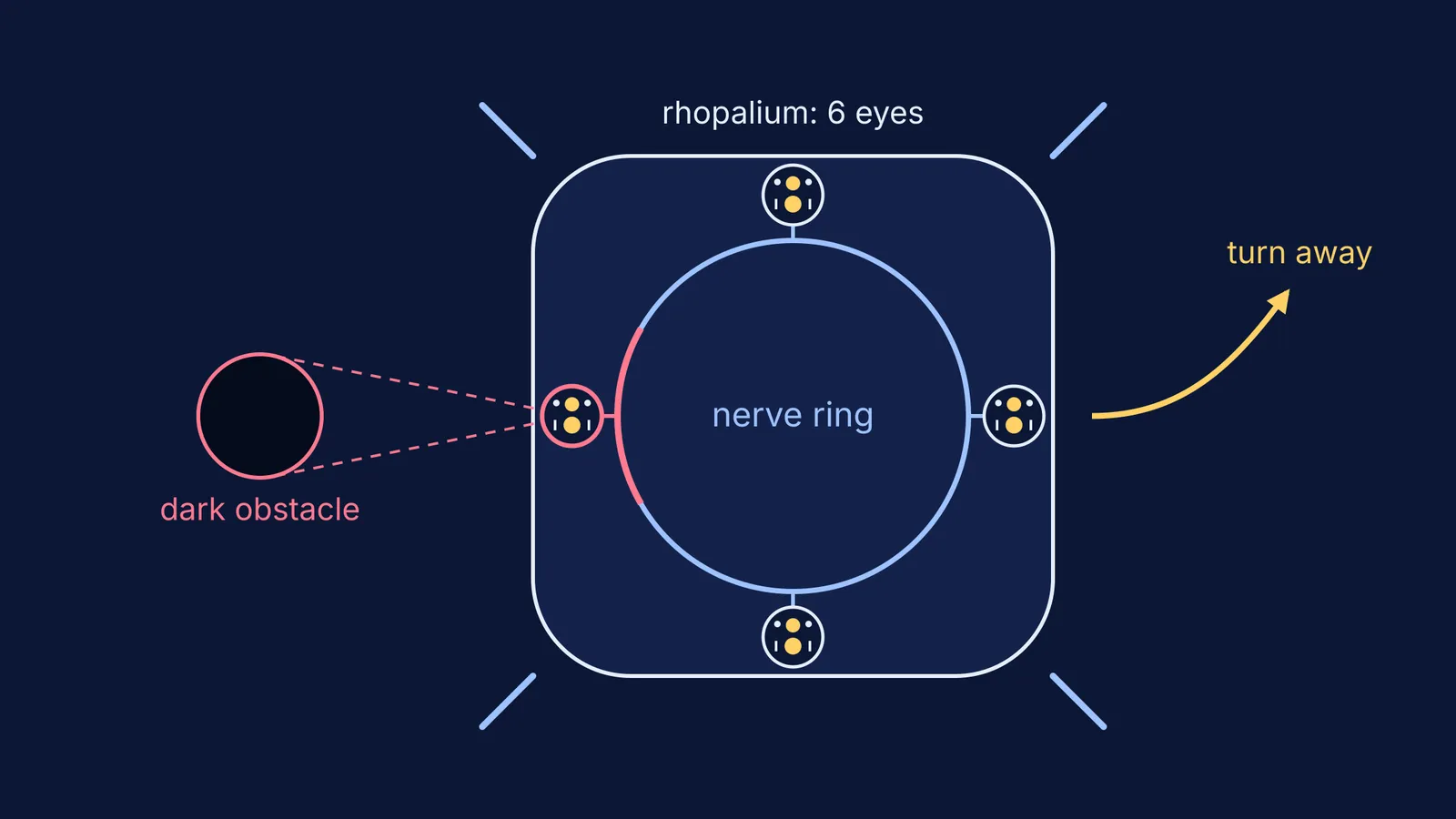
The eyes sit on four sensory clubs called rhopalia, one on each side of the box-shaped bell, as Nilsson and colleagues reported in Nature in 2005. That makes six eyes per club. A 2010 paper on Tripedalia cystophora lists the four types on every club:
One upper lens eye and one lower lens eye, the camera-type eyes.
Pit eyes, which hold a single cell type and are probably just light meters.
Slit eyes, which have a weak lens-like structure and may resolve detail in only one plane, according to the same study.
The lenses are surprisingly good. Nilsson's team found a finely tuned refractive index gradient that gives nearly aberration-free images, the same trick that lets a fish's ball-shaped eye lens focus sharply. The twist: the retina sits away from the sharp focus, so each photoreceptor sees a wide, blurred patch. The authors argue that this may suit an eye built for one job rather than for detailed pictures.
In 2011, Garm, Oskarsson and Nilsson showed that the upper lens eye is hung so it always looks straight up, whatever the jellyfish's tilt, and peers through the water surface at the mangrove canopy to steer back to the lagoon edge.
How can box jellyfish see without a brain?
The answer is that processing is spread out. In box jellyfish, the central nervous system sits in two places: a ring nerve running around the bell and the four rhopalia, joined by stalks. The same 2006 study found no clustering of synapses in the stalks, which suggests visual processing is spread through the system, and concluded that the ring and clubs form one coherent central nervous system.
Each club also keeps time. The rhopalia send out a swim pacemaker signal that matches the bell's contractions one to one, and a sudden drop in light makes that pacemaker fire faster.
How does one dodge work, step by step?
Suppose a dark prop root appears on the jellyfish's left. Pieced together from the studies above:
The root fills enough of the view. Avoidance starts when an obstacle takes up a certain angle in the visual field, and the response tends to be stronger when the contrast is higher.
The left club registers the darkening and its pacemaker speeds up (Garm and Bielecki, 2008).
The signal reaches the ring nerve, which continues into each club's stalk and links all four clubs.
The bell responds in three ways recorded by Petie, Garm and Nilsson in 2011: faster pulses, an uneven velarium (the flap that narrows the bell's outlet), and a delayed contraction on one side.
The off-centre jet turns the animal away from the dark area.
This network can even learn. A 2023 Current Biology study used the obstacle-avoidance response to show that box jellyfish learn by operant conditioning. It found that the rhopalial nervous system is the learning centre, challenging the idea that associative learning needs complex circuitry.
How is this different from Hydra's nerve net?
Hydra has no eyes, and its nervous system is traditionally described as a simple nerve net, which we explain in how Hydra's nerve net works with no brain. When Dupre and Yuste recorded essentially every neuron in Hydra vulgaris, they found three major networks spanning the whole body, each tied to a behaviour, one of them to stretching out in response to light, plus a fourth near the mouth.
The contrast to remember:
Sensing: Hydra responds to light without eyes; a box jellyfish has 24 eyes on four clubs.
Integration: Hydra's networks run through the whole body; a box jellyfish routes signals through four clubs and one ring.
Output: Hydra contracts, stretches or nods; a box jellyfish aims its jet and changes direction.
How do you write this up in an exam answer?
When a question asks how an animal responds without a brain, use the same three boxes every time: sensor, integrator, effector. For a box jellyfish: lens and light-meter eyes on the rhopalia; the ring nerve and rhopalial pacemakers; the bell and velarium. Then add one sentence on why it works, such as "processing is distributed, so no central brain is needed".
If nerve nets and central nervous systems still blur together, the Fermi Concept Library gives each biology concept its own lesson and shows where it sits on the map, so you can see how the two connect.


