

On this page
You have probably met this as a one-line question: if the earthworm is a hermaphrodite, why does it need a partner? The short answer is timing and position.
First, check your syllabus: the current NCERT Class 11 chapter Structural Organisation in Animals (reprint 2026-27) uses only the frog as its example animal. If your course or older study material still covers Pheretima, here is what to get right.
Where are the earthworm's male and female organs?
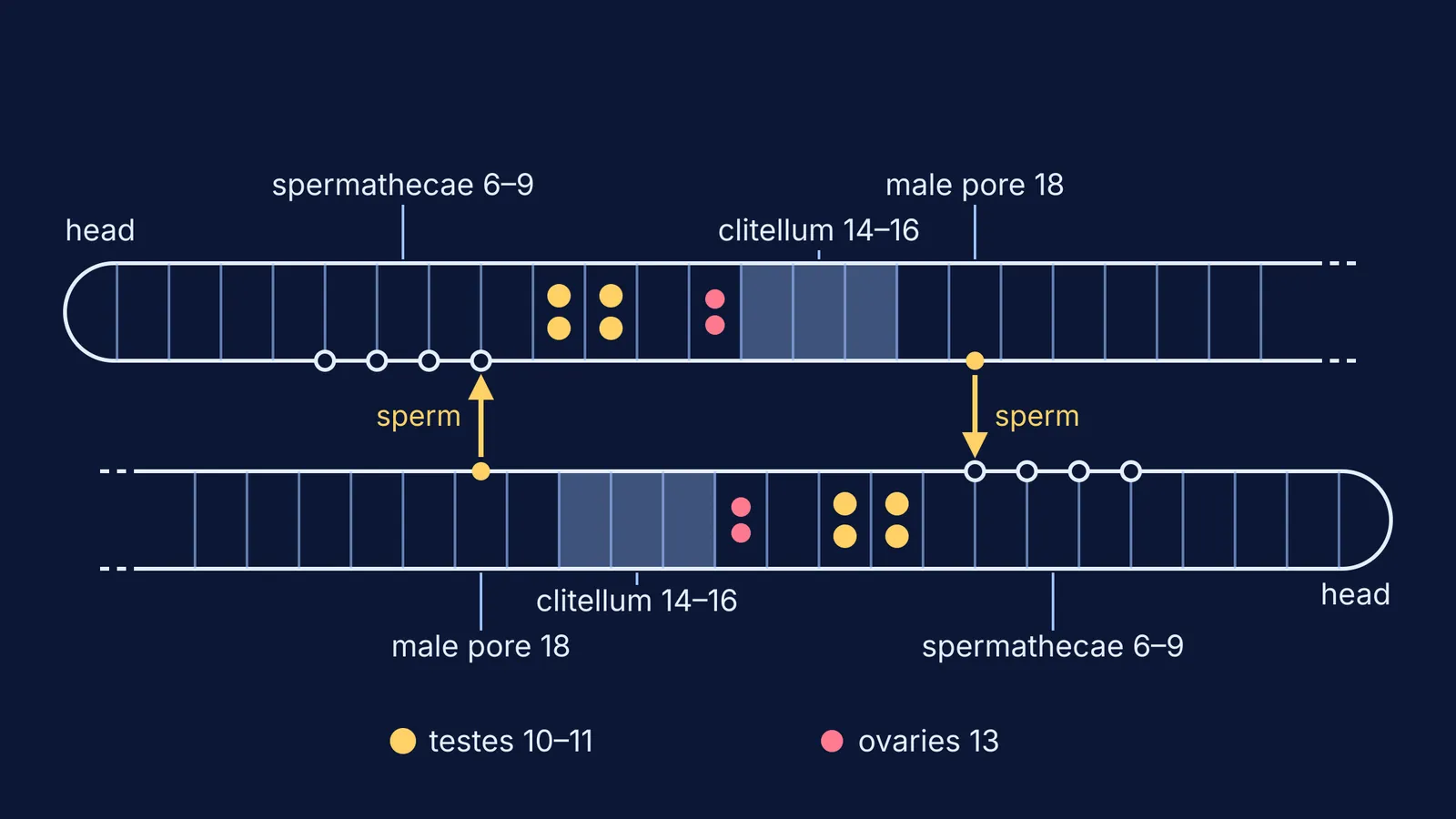
The Indian earthworm in most textbooks is Pheretima posthuma (also written Metaphire posthuma). These college zoology notes on Pheretima and the anatomy figure in a 2025 review in the Journal of Environmental Biology place its organs in fixed segments:
Spermathecae: 4 pairs in segments 6 to 9, opening through pores in the grooves 5/6 to 8/9. They store sperm received from another worm.
Testes: 2 pairs, enclosed in testis sacs in segments 10 and 11.
Ovaries: 1 pair, in segment 13.
Female genital pore: a single pore on segment 14.
Clitellum: the glandular band over segments 14 to 16.
Male genital pores: 1 pair, on segment 18.
For the outside of the body, see what each earthworm segment, seta and the clitellum does.
Why can't an earthworm fertilise itself?
Earthworms generally cross-fertilise because their testes mature before their ovaries, according to the 2025 review by P.S. Chaudhuri and A. Dey of Tripura University. This is protandry: a worm's own sperm and eggs are not ready at the same time.
The review gives a second reason: the relative position of the male and female openings prevents self-fertilisation. Sperm leaves through the male pores on segment 18, well behind the worm's own spermathecae (segments 6 to 9) and female pore (segment 14). The spermathecae take in a partner's sperm, which is why the Pheretima notes call them seminal receptacles.
Other hermaphrodites solve this differently; compare why sponges and tapeworms mate differently.
How do two earthworms exchange sperm?
The Pheretima notes place mating in the rainy season, July to October, at night or before dawn. With the Chaudhuri and Dey review, they describe this sequence:
Two worms lie ventral (under) side to ventral side, heads in opposite directions.
Each worm's male pores line up with the other's spermathecal pores.
Accessory-gland secretions and the setae hold the pair together.
In Pheretima, the male pores first meet the hindmost pair of spermathecal openings and discharge sperm and prostatic fluid; each worm then moves backwards to fill the next pair.
The exchange is mutual, and copulation lasts about an hour.
No egg is fertilised yet; each worm leaves carrying its partner's sperm.
How does the clitellum form the cocoon?
Once the ovaries mature, glands in the clitellum secrete a sticky girdle plus albumen to feed the embryo, the Pheretima notes say. Then:
The worm wriggles backwards, so the girdle slides forward along its body.
At the female pore (segment 14), the girdle collects the worm's own eggs.
At the spermathecal pores, it collects the partner's stored sperm.
It slips off over the head and its ends close: that is the cocoon.
Fertilisation happens inside the cocoon, not during mating. Stored sperm is not released all at once, so one mating can give several cocoons. In Pheretima usually only one embryo develops per cocoon, and the young worm emerges in about 2 to 3 weeks with no larval stage. The review notes that development time varies between species.
How do you write this answer in an exam?
Take a typical question: Earthworm is a hermaphrodite, yet cross-fertilisation occurs. Explain. A four-point answer, using the segment numbers from the Pheretima notes:
Pheretima bears testes (segments 10 and 11) and ovaries (segment 13) in one body.
It is protandrous: the testes mature before the ovaries, so its own sperm and eggs are not ready together.
Its male pores (segment 18) lie far from its own spermathecal pores (grooves 5/6 to 8/9) and female pore (segment 14), so sperm goes to a partner during mating.
Eggs and the partner's stored sperm meet inside the cocoon secreted by the clitellum (segments 14 to 16).
Two slips cost marks:
Saying the spermathecae store the worm's own sperm. They store the partner's.
Saying fertilisation happens during copulation. It happens later, in the cocoon.
To remember the order, read the body front to back: receive sperm (6 to 9), make sperm (10, 11), make eggs (13), release eggs (14), build the cocoon (14 to 16), release sperm (18). For the wider phylum, see Annelida vs Arthropoda, feature by feature.
If you can recite the segments but still mix up which organ does what, the Fermi Concept Library gives every biology concept its own lesson and its place in the map. Fermi's AI tutor works out what you already know and checks understanding as it goes, so a gap like this shows up before the exam does.
Write the four-point answer from memory tonight, then check it against the segment list.


