

On this page
If you are revising Class 11 zoology, three animals keep coming back: the earthworm (Pheretima), the cockroach (Periplaneta americana) and the frog (Rana tigrina). Learn them as one table, not three separate stories, and many questions become a lookup.
The current NCERT chapter, Structural Organisation in Animals (reprint 2026-27), describes only the frog. The earthworm and cockroach sections appear in the 2020-21 reprint of the same chapter, archived on the Internet Archive, and every earthworm and cockroach fact below comes from that text. The NEET-UG 2026 biology syllabus, as reproduced by Careers360, lists the “digestive, circulatory, respiratory, nervous and reproductive” systems “of an insect (Frog)”, wording that mixes up the two animals, so check with your teacher which animals your own exam expects.
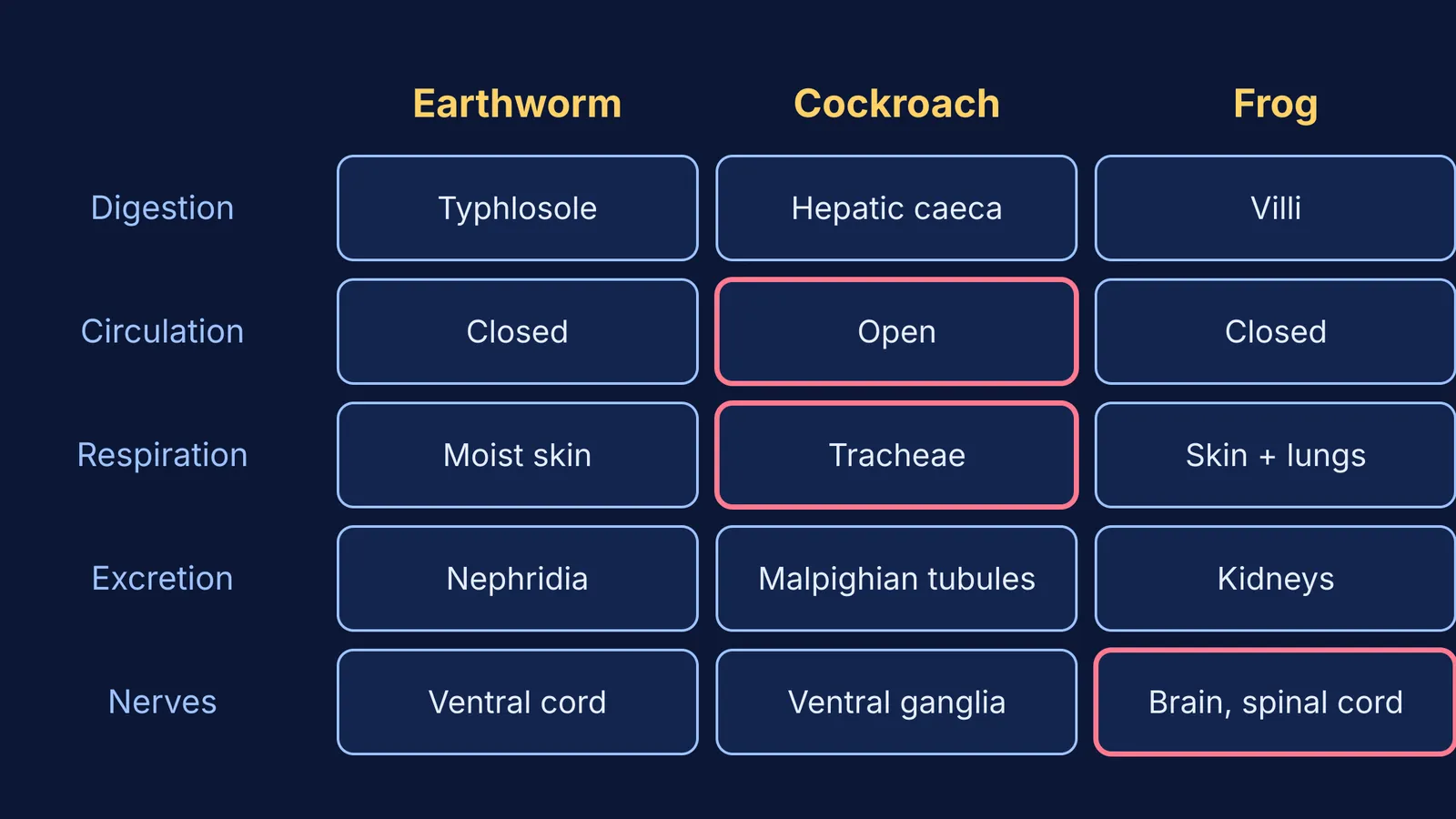
How do earthworm, cockroach and frog compare, system by system?
Earthworm and cockroach facts are from the 2020-21 NCERT chapter; frog facts are from the current NCERT chapter.
Digestion. Earthworm: a straight tube from the first to the last segment, a muscular gizzard in segments 8-9, and a typhlosole that increases the absorbing area of the intestine. Cockroach: foregut, midgut and hindgut, with a crop, a gizzard bearing six chitinous teeth, and 6-8 hepatic caeca at the foregut-midgut junction. Frog: a short alimentary canal ending in the cloaca, with liver, gall bladder and pancreas; villi and microvilli absorb the digested food.
Circulation. Earthworm: closed, with blood vessels, capillaries and heart; blood glands in segments 4-6 make blood cells and haemoglobin. Cockroach: open; colourless haemolymph bathes the organs in the haemocoel, and a tubular heart with funnel-shaped chambers and ostia pumps it forward. Frog: closed, with a three-chambered heart (two atria, one ventricle), a lymphatic system and nucleated RBCs.
Respiration. Earthworm: no special breathing organs; gases pass through the moist body surface. Cockroach: tracheae that open through 10 pairs of spiracles, with gas exchange at the tracheoles. Frog: skin in water; skin, buccal cavity and lungs on land; skin alone during aestivation and hibernation.
Excretion. Earthworm: segmentally arranged nephridia of three types, septal, integumentary and pharyngeal. Cockroach: 100-150 Malpighian tubules at the midgut-hindgut junction, which turn nitrogenous waste into uric acid, so it is uricotelic. Frog: a pair of kidneys made of nephrons, with ureters, urinary bladder and cloaca; it excretes urea, so it is ureotelic.
Nerves. Earthworm: ganglia on a ventral paired nerve cord, which splits around the pharynx and joins the cerebral ganglia as a nerve ring. Cockroach: fused ventral ganglia, three in the thorax and six in the abdomen, with a supra-oesophageal ganglion as the brain. Frog: a brain inside the cranium, a spinal cord inside the vertebral column, ten pairs of cranial nerves, plus peripheral and autonomic systems.
Which five differences should you learn first?
Several of these five turn up in the chapter's own exercises. The 2020-21 NCERT exercises ask where Malpighian tubules are found, what nephridia do and how many types there are, to match terms such as “open circulatory system” and “typhlosole”, and to describe the earthworm's circulation. The frog's ureters and digestive system appear in the current chapter's exercises.
Open or closed. Only the cockroach has an open circulatory system. Earthworm and frog are closed.
Where gas exchange happens. Moist skin (earthworm), tracheae and spiracles (cockroach), skin plus lungs (frog).
Excretory organ and waste. Nephridia, Malpighian tubules, kidneys. The cockroach is uricotelic; the frog is ureotelic.
The special part of the gut. Typhlosole for absorption (earthworm), hepatic caeca that secrete digestive juice (cockroach), villi (frog).
Where the nerve cord runs. Earthworm and cockroach have a ventral nerve cord with ganglia; the frog's spinal cord sits inside the vertebral column.
How should you revise this comparison in 20 minutes?
Write the three animals across the top of a blank page and the five systems down the side. Fill every cell from memory before you look.
Mark each cell you got wrong in a second colour. Those cells are your revision list.
Say each row aloud as one line: “closed, open, closed”; “skin, tracheae, skin plus lungs”.
Cover one column and recite it. Then cover one row and recite that.
The next day, redo step 1 cold and compare.
If one term keeps slipping, such as what a nephridium actually does, look it up as a concept instead of rereading the whole chapter. The Fermi Concept Library covers every concept in biology, each with its own lesson and its place in the map, so you can fix one idea at a time.
Where can you go deeper on each animal?
For the frog's organs in detail, read our walkthrough of Structural Organisation in Animals with the frog explained. To stretch the excretion row to flatworms and other groups, use nephridia, flame cells and Malpighian tubules matched to each animal. For the counts examiners like to test, see cockroach organ numbers in NCERT.
When you move to practice questions and keep choosing the wrong option, the Fermi Problem Library has worked problems with a step-by-step solver that explains the reasoning rather than printing an answer.


