

On this page
Your blood is red because of red blood cells. An earthworm's blood is red too, but no red cells do that job. The pigment is still haemoglobin; it just sits somewhere else.
Why is earthworm blood red if it has no RBCs?
Colour comes from the pigment, not from the cell. In the earthworm, the oxygen-carrying protein is freely dissolved in the blood rather than packaged in cells, as a 2000 PNAS paper by William Royer and colleagues on annelid erythrocruorin describes it. So the plasma itself is red.
The molecule is called erythrocruorin. The RCSB PDB-101 Molecule of the Month puts it simply: unlike our haemoglobin, it is not packaged inside a blood cell.
This works because the earthworm has a closed circulatory system. Annelids such as earthworms are among the first invertebrates with a fully closed circulation, according to this Brigham Young University-Idaho biology text, so the red plasma stays inside vessels, pumped by muscular aortic arches.
How big is earthworm haemoglobin compared with ours?
A small protein dissolved in blood could be lost through tissue membranes. The earthworm's answer is an enormous molecule.
Earthworm erythrocruorin has a molecular weight of about 3.6 MDa and a diameter of about 30 nm, per Elmer and Palmer (2012).
Human haemoglobin has a molecular weight of 0.064 MDa and a diameter of 5 nm, in the same Elmer and Palmer paper.
One erythrocruorin is built from 144 oxygen-binding haemoglobin chains and 36 linker chains, per Royer and colleagues.
Divide 3.6 by 0.064 and you get about 56: one earthworm molecule outweighs a human haemoglobin molecule roughly 56 times.
Why so big? A 2019 study in Genome Biology and Evolution notes that the large size of these extracellular haemoglobins correlates with their location in the blood and prevents their excretory loss through tissue membranes. Our red blood cells solve the same problem differently, by keeping small haemoglobin molecules locked inside a cell.
The giant molecule still does its job well. Elmer and Palmer report that its oxygen affinity (a P50 of about 28 mm Hg) is almost the same as that of human blood (about 26 mm Hg), in their 2012 paper.
How does earthworm blood compare with human and insect blood?
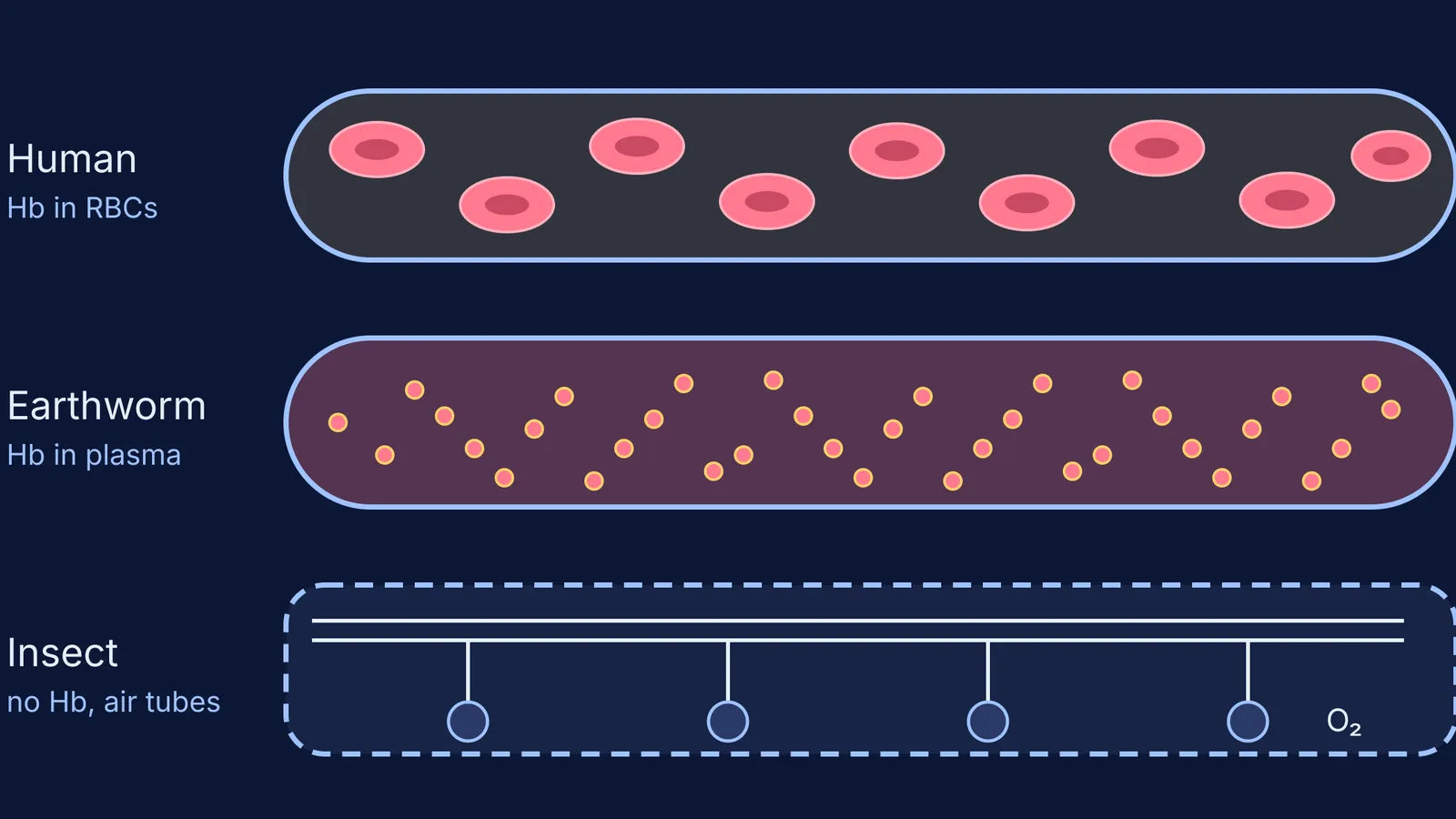
Ask three questions of each: is there a red pigment, where is it, and does the blood carry oxygen at all?
Human: haemoglobin is packed inside red blood cells. A healthy adult man has about 5 to 5.5 million RBCs per cubic millimetre, a healthy person has 12 to 16 g of haemoglobin in every 100 mL of blood, and the plasma itself is straw coloured, per NCERT Class 11 Biology, Chapter 15. The circulation is closed. Blood is red because of the cells.
Earthworm: giant haemoglobin (erythrocruorin) is dissolved in the plasma, with no red cells carrying it (Royer and colleagues). The circulation is closed. Blood is red because of the plasma.
Insect: with the exception of a few aquatic midges, insect haemolymph contains no haemoglobin and no red blood cells; it is usually clear, sometimes greenish or yellowish, and oxygen travels through the tracheal system instead, per NC State University's General Entomology notes. The circulation is open. Blood is not red because it does not need a pigment.
We go further into the insect row in our explainer on why insect blood is not red. And for a human case where the plasma itself carries extra oxygen, read about how hyperbaric oxygen raises the oxygen dissolved in plasma.
How do you write this in an exam answer?
A two or three mark question usually reads like the target question itself: "Earthworm blood is red though it lacks RBCs. Why?" A clear answer has three moves.
State the pigment: the red colour is due to haemoglobin (erythrocruorin).
State the location: it is dissolved in the plasma, not enclosed in corpuscles as in vertebrates.
Add the reason it works: the molecule is very large, which helps prevent its loss from the blood, and the circulation is closed.
A model answer: "Earthworm blood is red because its respiratory pigment, haemoglobin (erythrocruorin), is dissolved in the plasma instead of being carried in red blood cells. The pigment is a very large molecule, which prevents its loss from the closed blood vessels."
One textbook note: the current NCERT Class 11 Chapter 7, Structural Organisation in Animals, now describes only the frog. If your notes still cover the earthworm, treat this as a comparison question and ask your teacher what your exam expects.
Questions like this link blood, breathing and animal diversity. If one of those links is shaky, the Fermi Concept Library has every concept in biology with its own lesson and its place in the map, so you can see where haemoglobin sits alongside circulation and respiration. And for the earthworm's other oxygen trick, read why earthworms breathe through moist skin.
Next time you see a worm after rain, remember: its red is in the plasma, not in a cell.


