

On this page
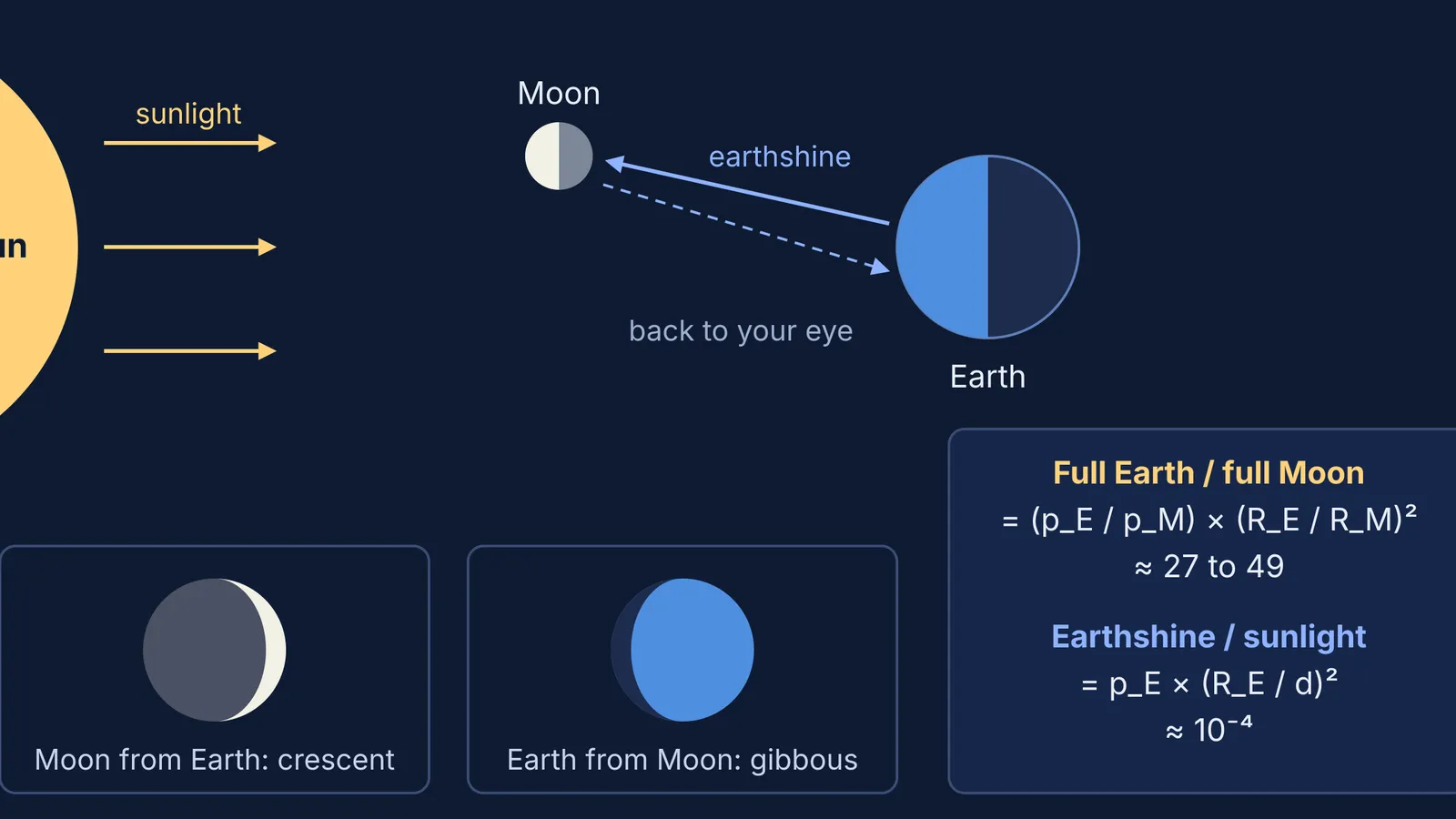
Look at a thin crescent Moon in the west just after sunset, two or three days after new Moon. Next to the bright sliver you can often see the rest of the disc, faint and ash-grey. That glow is earthshine. Sunlight hits Earth, bounces off our clouds and oceans, crosses 384,400 km to the Moon, lights its night side, and bounces back to your eye. You can estimate how bright it is with nothing more than reflection, areas and the inverse-square law.
Why does the dark part of a crescent Moon glow?
The phases of Earth and Moon are complementary. When you see a thin crescent, the Moon sits nearly between Earth and the Sun. Seen from the Moon, Earth then lies almost opposite the Sun, so Earth's sunlit face points straight at the Moon. Someone standing on the Moon's night side would see a nearly full Earth high in a black sky. A crescent Moon means a gibbous Earth; a full Moon means a "new" Earth. If you want to work through the geometry of the phases themselves, see why the Moon has phases and how to predict all eight.
That nearly full Earth is the lamp. Its light falls on the half of the Moon that faces us but gets no sunlight, which is exactly the dark part of the crescent.
The idea is old. A NASA article on Leonardo da Vinci's notebook describes how he sketched and explained the glow in the Codex Leicester around 1510, about a century before Galileo turned a telescope on the Moon. Leonardo thought Earth's oceans did the reflecting; NASA points out that clouds do most of it. Earthshine is also different from the bright points Galileo saw just beyond the line between day and night on the Moon. Those are mountain peaks catching direct sunlight, covered in how Galileo measured mountains on the Moon.
How much brighter is a full Earth than a full Moon?
A sphere of radius R, lit by sunlight of irradiance S, sends you an irradiance at full phase of
E = p × S × (R/D)²
where D is your distance from it and p is its geometric albedo: how bright the sphere looks face-on compared with a flat, perfectly white disc of the same size. Earth and Moon are at the same distance from the Sun, so S is the same for both, and an observer on the Moon looking at Earth is the same distance away as you looking at the Moon. Almost everything cancels.
Worked example: full Earth against full Moon
Write the ratio. E(Earth seen from Moon) / E(Moon seen from Earth) = (p_E / p_M) × (R_E / R_M)².
Radii. From the NASA Earth fact sheet R_E = 6,371 km, and from the NASA Moon fact sheet R_M = 1,737.4 km. The ratio is 3.67, and its square is 13.4. Earth shows 13.4 times the area.
Albedos. NASA lists the Moon's geometric albedo as 0.12 and Earth's as 0.434. A 2026 analysis by Tyler Robinson in The Planetary Science Journal (arXiv preprint) combined many ground and spacecraft observations and found 0.242, up to 30 to 40% below earlier, widely quoted values.
Multiply. With NASA's value: (0.434 / 0.12) × 13.4 = 49. With Robinson's: (0.242 / 0.12) × 13.4 = 27.
State the answer. A full Earth in the lunar sky is roughly 30 to 50 times brighter than a full Moon in ours. The "about 40 times" you sometimes read sits inside that range.
Check the size too. Earth's angular diameter from the Moon is 2 × arctan(6,371 / 384,400) = 1.90°, against 0.52° for the Moon seen from Earth.
Which albedo should you use?
There are two different albedos, and mixing them is a common slip. The Bond albedo is the fraction of all incoming sunlight reflected in every direction. It decides energy balance, and it is the 0.30 used in estimating Earth's temperature from radiation balance; NASA lists 0.294. The geometric albedo only describes how bright a body looks face-on at full phase, so it is the one to use for brightness.
How bright is earthshine compared with sunlight?
Now compare the light reaching the Moon from a full Earth with direct sunlight. Using the formula above with D = d = 384,400 km:
E / S = p_E × (R_E / d)²
With p_E = 0.434: 0.434 × (6,371 / 384,400)² = 1.2 × 10⁻⁴.
With p_E = 0.242: 6.6 × 10⁻⁵.
So earthlight at the Moon is about one ten-thousandth of sunlight: 1,361 W/m² × 10⁻⁴ is roughly 0.1 W/m². That matches a detailed model by Glenar and colleagues in Icarus (2019), which found about 0.15 W/m² from Earth near full phase, with reflected sunlight and Earth's own infrared glow contributing comparable shares.
The same lunar soil reflects both lights, so the earthlit part of the disc looks about 10⁴ times fainter than the sunlit crescent. In magnitudes that is 2.5 × log₁₀(10⁴) = 10. Treat this as an order of magnitude. You see the sunlit crescent at a steep angle, which dims it, while you see the earthlit part almost along the direction the light came from, where lunar soil reflects strongly. The real contrast is somewhat smaller.
For comparison, a full Moon gives Earth 0.12 × (1,737.4 / 384,400)² = 2.5 × 10⁻⁶ of sunlight. The ratio of the two, 10⁻⁴ against 2.5 × 10⁻⁶, is the same 27 to 49 as before, as it must be.
When is earthshine easiest to see?
Earthshine is strongest when Earth, seen from the Moon, is fullest, which is near new Moon. At new Moon itself, though, the Moon is lost in the Sun's glare. The clearest views come 2 to 5 days either side: an evening crescent after sunset or a morning crescent before sunrise. As the Moon waxes, Earth wanes in the lunar sky, earthshine fades, and the growing sunlit part dazzles your eye so the grey disc disappears.
Clouds matter. A NASA Earth Observatory note explains that changes in earthshine brightness are mainly caused by changes in cloudiness, so a cloudier Earth gives brighter earthshine. The Earthshine Project at Big Bear Solar Observatory has used this since the late 1990s to measure Earth's overall reflectance, about 0.3, and a 2021 paper by Goode and colleagues reported a small decline in it from 1998 to 2017.
If you want to see how the Moon's phase and Earth's phase trade off as the Moon goes round, the Fermi Simulation Lab has interactive simulations for ideas that are easier to see than read.
What mistakes do students make with earthshine?
Thinking the Moon has a faint light of its own. It has none; the glow is twice-reflected sunlight.
Using the radius ratio (3.67) instead of the area ratio (13.4).
Plugging in Bond albedo for a brightness question.
Expecting earthshine to be easiest to see exactly at new Moon.
Quick checklist
Crescent Moon from Earth means nearly full Earth from the Moon.
Full Earth / full Moon = (p_E/p_M)(R_E/R_M)², about 27 to 49 with current albedos.
Earthshine / sunlight = p_E(R_E/d)², about 10⁻⁴, or 10 magnitudes.
Earth looks 1.90° wide from the Moon; the Moon looks 0.52° wide from Earth.
Cloud cover sets how bright earthshine is.


