

On this page
Your ear canal is a short tube, open at the outside and closed at the far end by the eardrum. That is exactly a closed organ pipe, and a closed pipe has a resonant frequency. Put in the numbers and the first resonance lands at about 3 to 3.5 kHz. That is close to where human hearing is most sensitive, and the match is not a coincidence. This post works out the resonance with the closed-pipe formula you already know, then shows where the simple model stops working.
How is the ear canal like a closed organ pipe?
In an adult, the ear canal is about 25 mm long and about 7 mm across, according to the Wikipedia article on the ear canal, and an AudiologyOnline article on ear acoustics treats it as roughly an inch-long, 25 mm tube. Both are typical values; real canals vary from person to person.
Sound enters at the outer opening, where the air is free to move. At the other end, the eardrum blocks the canal. So:
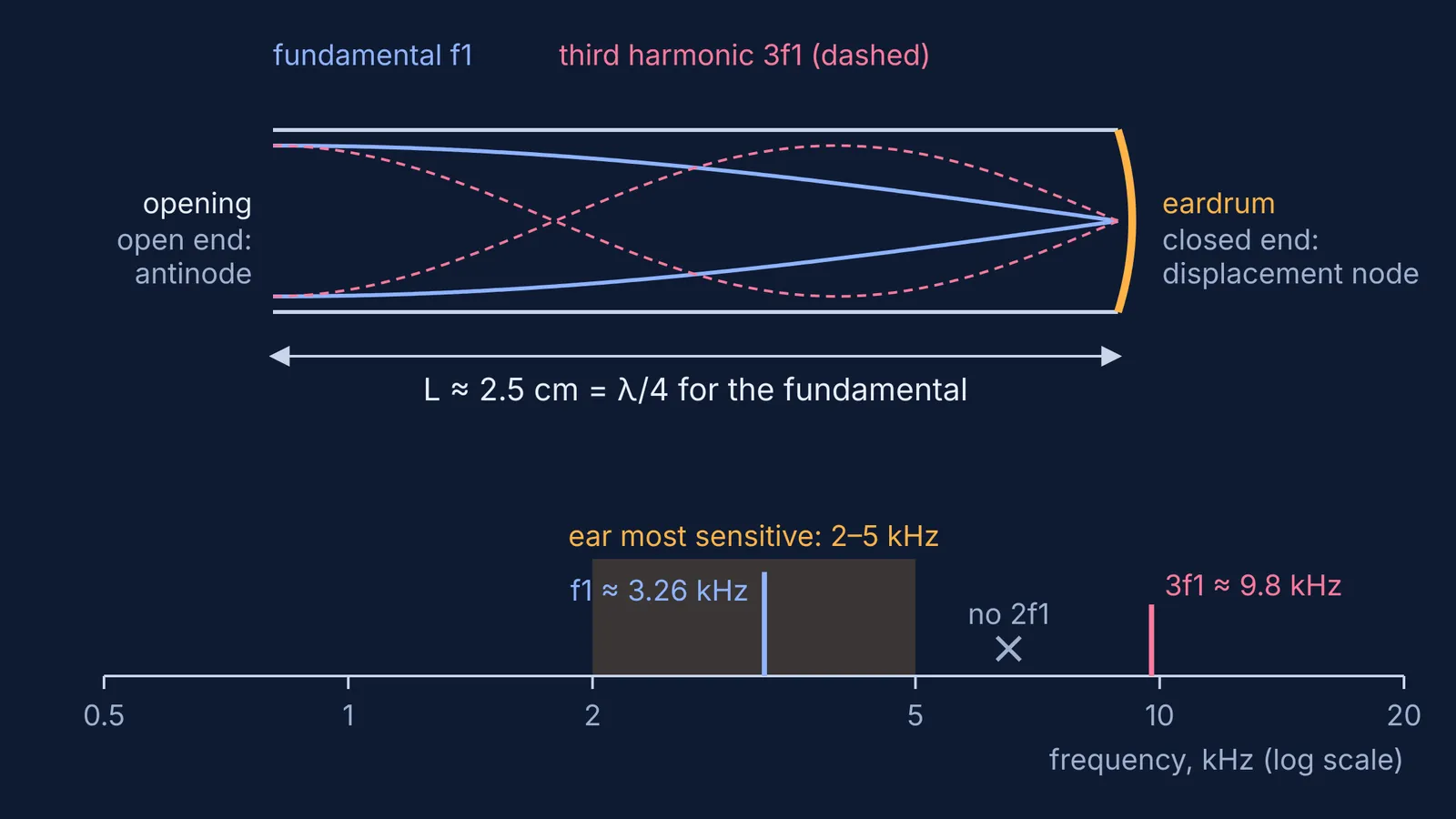
At the opening, the air can move freely: a displacement antinode.
At the eardrum, the air can hardly move: a displacement node.
The shortest standing wave that fits a node at one end and an antinode at the other is a quarter wavelength. So L = λ/4 and f₁ = v/4L. This is the same pipe you meet in the resonance tube experiment, and the full set of closed-pipe modes is shown in simulating open and closed organ pipe harmonics.
What is the resonant frequency of the ear canal? A worked example
Take L = 2.5 cm and a radius of 3.5 mm (half of 7 mm).
Simplest estimate, air at 20 °C. v = 343 m/s, so f₁ = 343 / (4 × 0.025) = 3430 Hz.
Correct the temperature. Air in the canal is close to body temperature, 37 °C or 310 K. The speed of sound scales as √T, so v = 331.3 × √(310/273) = 353 m/s, and f₁ = 353 / (4 × 0.025) = 3530 Hz.
Add the end correction. At an open end the antinode sits a little outside the tube. The usual correction for an unflanged end is 0.6r = 0.6 × 3.5 mm = 2.1 mm. The effective length is L_eff = 2.5 + 0.21 = 2.71 cm. The same idea is used in the resonance tube experiment with end correction.
Final estimate. f₁ = 353 / (4 × 0.0271) = 3257 Hz, about 3.3 kHz.
Next resonance. A closed pipe has only odd harmonics, so the next one is 3f₁ = 3 × 3257 = 9770 Hz, about 9.8 kHz. There is no resonance at 2f₁, about 6.5 kHz.
Units check. (m/s) ÷ m = s⁻¹ = Hz. The wavelength of the fundamental is 4 × 2.71 cm = 10.8 cm, much longer than the canal, as it should be for a quarter-wave mode.
So the simple model gives a first resonance between about 3.3 and 3.5 kHz, depending on whether you include the end correction.
How does the canal resonance show up in what you hear?
At its resonance, the canal builds up the sound pressure at the eardrum, so sounds near that frequency are louder at the eardrum than at the entrance of the canal. The threshold of hearing, the faintest sound you can detect at each frequency, has a clear dip in the range 2000 to 5000 Hz. HyperPhysics at Georgia State University puts peak sensitivity around 3500 to 4000 Hz and links it to the canal acting as a closed tube about 2.4 cm long, with a smaller second region of enhanced sensitivity at about 13.5 kHz, somewhat above the calculated third harmonic.
You can find your own sensitive band and your upper limit with the human hearing range tone test. It is also part of why some high, scratchy sounds feel so piercing, as described in why chalk squeaks on a blackboard.
Why is the resonance broad and not a sharp line?
An organ pipe has hard walls and a rigid closed end, so its resonance is sharp. The ear canal is different in several ways.
The eardrum is not rigid. It is a thin membrane built to move, and it absorbs energy from the wave. A soft, lossy end damps the resonance and spreads it over a wide band.
The canal is not a straight cylinder. It is curved, slightly oval and narrows along its length, and its skin-lined walls absorb some sound.
The eardrum is tilted. So the length of the canal is not the same along every path from the opening to the drum.
Because of this, measured values are lower and broader than the simple formula suggests. In an audiology column, Marshall Chasin writes that the ear canal resonance is typically around 2700 Hz in real-ear measurements, below the quarter-wave prediction for the same canal. Different sources quote figures from about 2.7 to 3.7 kHz, but they all land inside the band where hearing is most sensitive.
The canal is also not the only resonator. The bowl of the outer ear and the head itself change the sound before it enters the canal, so the extra sensitivity in this band should not be credited to the canal alone.
Does the resonance change for a child's ear?
The formula says a shorter tube resonates at a higher frequency. As an illustration only, a canal of 2.0 cm with no end correction would give f₁ = 353 / (4 × 0.020) = 4.4 kHz. Children's canals are shorter than adults', so the same physics predicts that their canal resonance sits higher. The exact value depends on the child's age and anatomy.
To revise standing waves, end corrections and the difference between open and closed pipes, the Concept Library covers every concept in physics, chemistry, biology, mathematics and computing.
Quick checklist
The ear canal is open at the outside and closed by the eardrum, so L = λ/4.
f₁ = v/4L: 3430 Hz at 20 °C, 3530 Hz at body temperature.
With the end correction 0.6r, L_eff = 2.71 cm and f₁ ≈ 3.3 kHz.
Only odd harmonics: the next resonance is about 9.8 kHz, with none near 6.5 kHz.
The soft eardrum and curved canal make the resonance broad; measured values are often lower, near 2.7 kHz.
The canal resonance falls inside the 2 to 5 kHz band where hearing is most sensitive.


