On this page
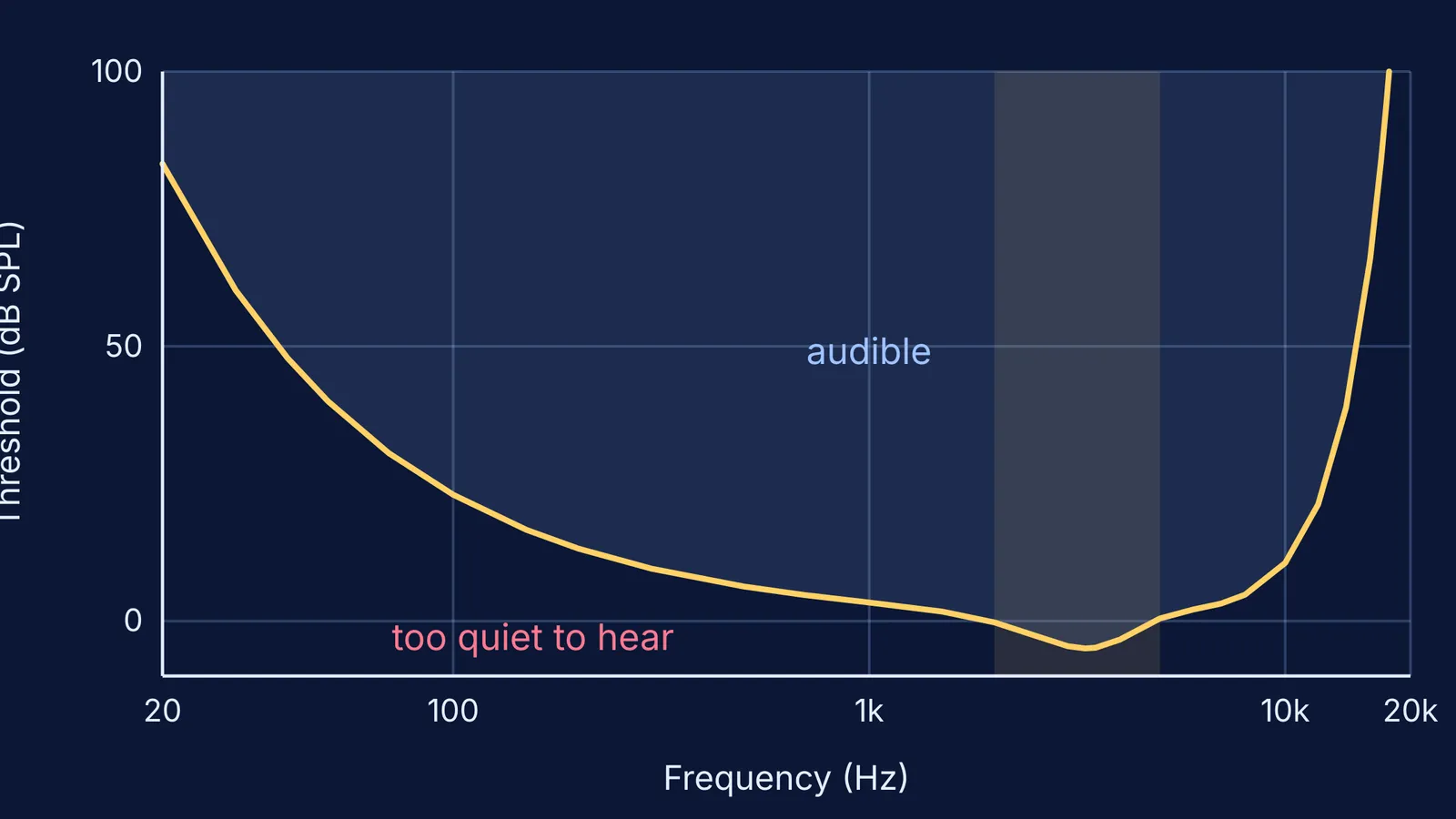
Normal human hearing covers frequencies from 20 to 20,000 Hz, according to OpenStax College Physics. Sounds below 20 Hz are called infrasound, and sounds above 20,000 Hz are ultrasound. A tone test lets you check that range yourself, and it works best if you predict the result first.
What is the human hearing range test?
You play one pure tone at a time, step the frequency up or down, and note the last tone you can still hear. OpenStax says the ear is most sensitive between 2000 and 5000 Hz, and that frequencies above 8000 Hz are rare in the environment and unnecessary for understanding conversation or appreciating music. That is one reason a loss at the top of the range can go unnoticed.
A home test is a demonstration, not a diagnosis: your phone does not know how loud each tone is at your eardrum, and cheap earphones may not play the extreme tones properly.
How do you run a tone test safely at home?
You need a free online tone generator, wired or good wireless headphones, a quiet room and a notebook.
Play a 1000 Hz tone and set a comfortable, low volume. Do not touch the volume again.
Before you play anything else, write down your predictions: the lowest tone you will hear, the highest, and which will sound loudest.
Go up in steps: 1, 4, 8, 10, 12, 14, 15, 16, 17, 18, 19 and 20 kHz, two or three seconds each.
Go down in steps: 500, 200, 100, 60, 40, 30 and 20 Hz. Very low tones may feel more like pressure than sound.
Write "last heard" for each direction, then repeat once in reverse order to check yourself.
Ask a parent or grandparent to do the same test on the same headphones at the same volume.
How do you read your results?
Suppose you write "last heard: 17 kHz" and your parent, on the same headphones, writes "14 kHz". The setup was identical, so the 3 kHz gap comes from the listeners. Did 4 kHz sound louder than 1 kHz at the same setting? That fits the ear's most sensitive band, though your headphones also shape what you hear. If both of you stop at the same frequency, suspect the headphones before your ears.
Why does the upper limit drop with age?
Inside the cochlea, sound is sorted by pitch. The US National Institute on Deafness and Other Communication Disorders (NIDCD) explains that hair cells near the wide end of the snail-shaped cochlea detect higher-pitched sounds, while those closer to the centre detect lower-pitched sounds.
The most common form of hearing loss comes with age, is called presbycusis, and is increasingly severe at higher frequencies, according to OpenStax. A Madrid study of 645 healthy people aged 5 to 90 tested hearing from 0.125 to 20 kHz and found that thresholds rose with both frequency and age (Rodríguez Valiente and colleagues, International Journal of Audiology, 2014).
The damage adds up because, as the NIDCD notes, human hair cells do not grow back once they are lost.
Does loud music damage your hearing range?
It can. The NIDCD says sounds at or below 70 dBA are unlikely to cause hearing loss even after long exposure, but long or repeated exposure at or above 85 dBA can. It lists music through headphones at maximum volume, sporting events and concerts at 94 to 110 dBA. The same page says that, in 2005–2006 US data, as many as 17 percent of teens aged 12 to 19 had hearing-test features suggestive of noise-induced hearing loss.
Noise damage has its own fingerprint: hearing loss caused by noise typically shows a dip near 4000 Hz, whatever the frequency that caused it (OpenStax).
The World Health Organization says over 1 billion young adults are at risk of permanent, avoidable hearing loss due to unsafe listening practices. Its safe listening standard with the ITU uses a reference of 80 dB for 40 hours a week for adults and 75 dB for 40 hours a week for children.
In India the loud moments are familiar: a wedding DJ, a festival speaker, earphones turned up over metro traffic. Three habits help:
Turn on your phone's headphone volume limit if it has one.
Step away from speakers at events; carry foam earplugs.
Give your ears quiet time after a loud evening.
Where to go next
To connect frequency with wavelength, see our post on the wavelength range of audible sound. For the basics, read frequency and time period of sound for Class 8, or see how noise-cancelling headphones work.
The Fermi Simulation Lab has interactive simulations for ideas that are easier to see than to read, and Fermi's AI tutor can work out what you already know and build a plan for the session.