

On this page
Most elimination questions in JEE and NEET are labelled E1 or E2. A third route, E1cB, appears whenever a carbonyl or nitro group sits next to the carbon that loses a hydrogen. Every time an aldol product is heated with base and turns into an α,β-unsaturated aldehyde or ketone, the water is lost by E1cB. This post explains what the letters mean, when the mechanism takes over from E2, and how to draw it step by step.
What does E1cB stand for?
E is elimination and 1 is unimolecular, as in E1. The new part, cB, means conjugate base. The conjugate base is the carbanion you get when a base pulls a proton off the substrate. "Unimolecular" describes the step where the leaving group goes: only the carbanion takes part in it.
The easiest way to remember E1cB is to compare the order in which the two bonds break:
E1: the leaving group goes first, giving a carbocation, then a proton is lost.
E2: the C–H and C–leaving group bonds break together, in one step.
E1cB: the proton goes first, giving a carbanion, then the leaving group is pushed out.
When does elimination go through a carbanion instead of E2?
You need two conditions at the same time.
The β-hydrogen is acidic. An electron-withdrawing group such as C=O, NO₂ or C≡N on the same carbon stabilises the negative charge by resonance. With a carbonyl, the carbanion is an enolate, and most of the charge sits on oxygen. That is why the α-hydrogen of a simple ketone has a pKa of about 19–20, while an ordinary alkane C–H is around 50. If this acidity is new to you, read why the alpha hydrogen of aldehydes and ketones is acidic first.
The leaving group is poor. Hydroxide (OH⁻) and alkoxide (RO⁻) are bad leaving groups. In E2 the bond to the leaving group must break in the same step as the C–H bond, so E2 needs a good leaving group such as Br⁻ or I⁻. With OH⁻ that concerted step is too hard. The base takes the easy proton first, and the leaving group goes only after the carbanion has formed.
A naming point that confuses many students: the hydrogen removed is called β with respect to the leaving group and α with respect to the carbonyl. It is the same hydrogen. The carbon bearing the leaving group is α in elimination language, so its neighbour is β.
How does E1cB work, step by step?
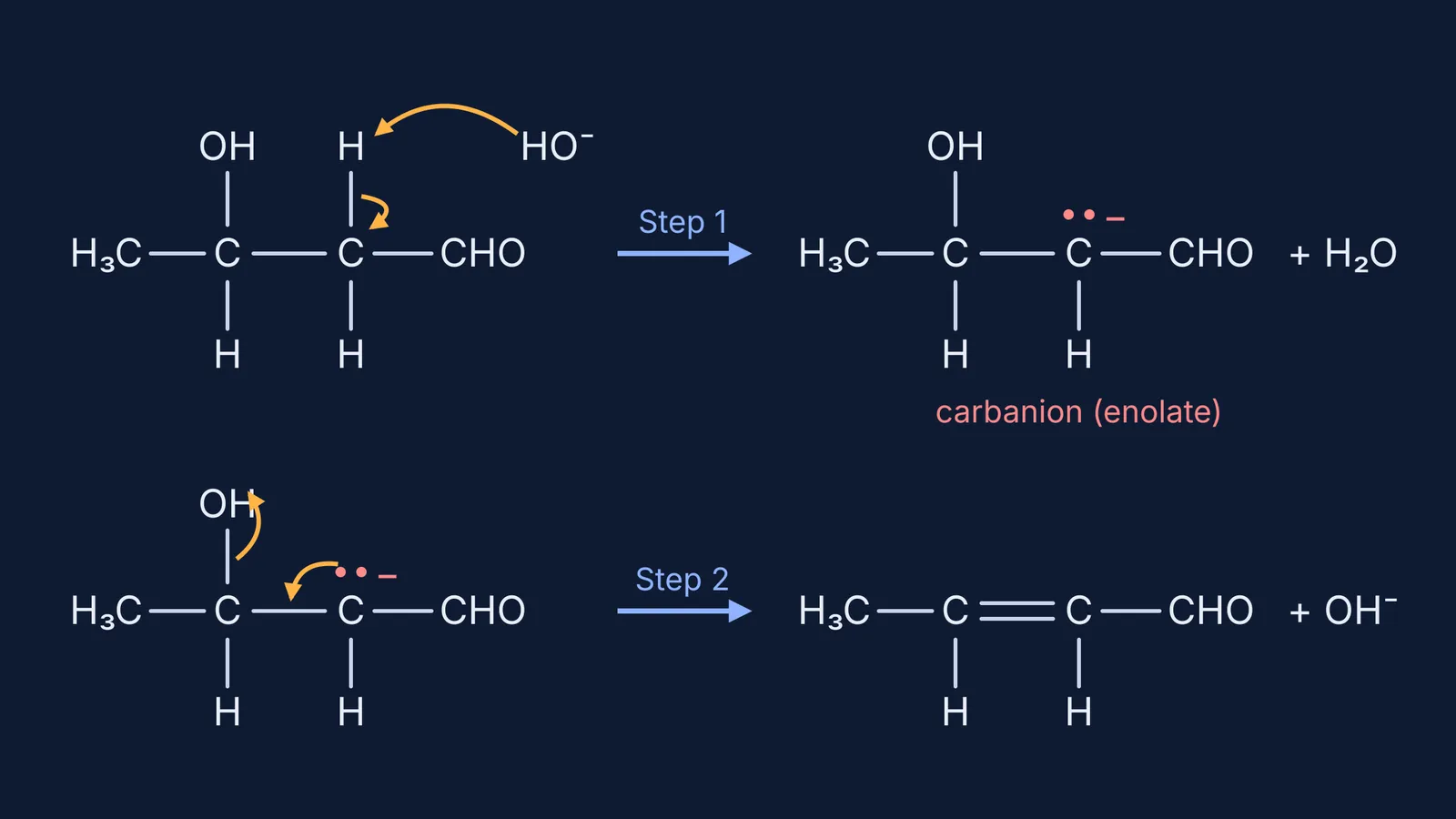
Take 3-hydroxybutanal, CH₃–CH(OH)–CH₂–CHO, the aldol formed from two molecules of ethanal. On warming with dilute NaOH it loses water. Number the chain from the aldehyde carbon: C1 is CHO, C2 is CH₂, C3 carries the OH.
Step 1: the base removes the acidic hydrogen. A lone pair on OH⁻ attacks a hydrogen on C2. The C–H bond electrons move onto C2. You get the enolate and a molecule of water:
CH₃–CH(OH)–CH⁻–CHO, with the charge shared with oxygen in the resonance form CH₃–CH(OH)–CH=CH–O⁻
Step 2: the carbanion pushes out the leaving group. The lone pair on C2 moves in to form a C2=C3 π bond. At the same time the C3–OH bond breaks, and both of its electrons leave with the oxygen as OH⁻. The product is CH₃–CH=CH–CHO, but-2-enal (crotonaldehyde).
Hydroxide is used in step 1 and given back in step 2, so the base is a catalyst. The new C=C is conjugated with C=O, which makes the product more stable than the aldol and drives the reaction. The E isomer, the more stable one, is the main product. For the full four-step aldol sequence that comes before this, see the aldol condensation mechanism with a worked example.
Under acid conditions the same dehydration happens by a different route, through the enol and a protonated OH. The E1cB pathway is the base-catalysed one.
How is E1cB different from E1 and E2?
Compare the three on intermediate, rate law and the kind of substrate that uses them.
E1: carbocation intermediate. Rate = k[substrate], first order. Typical of tertiary substrates with a good leaving group and a weak base. Rearrangements are possible.
E2: no intermediate, a single transition state. Rate = k[substrate][base], second order. Needs a strong base, a good leaving group and an anti-periplanar hydrogen. The overview of E1, E2 and Saytzeff's rule covers both in detail.
E1cB: carbanion intermediate. The slow step is usually the carbanion losing the leaving group, so rate = k[carbanion]. How much carbanion is present depends on how much substrate and base you have, so the measured rate law usually comes out as k[substrate][base].
That last point is the trap. An E1cB reaction can show the same second-order rate law as E2, so the order alone cannot tell them apart. The evidence for a carbanion is different. If the reaction is run with OD⁻ in D₂O, the starting material recovered before it has fully reacted has picked up deuterium on the β-carbon. The proton came off and went back many times before the leaving group finally left, which can only happen if a carbanion exists.
Some textbooks also describe a version where deprotonation itself is the slow step.
Worked example: what forms when propanal is heated with dilute NaOH?
Aldol addition. The base removes an α-hydrogen from propanal to give CH₃–CH⁻–CHO. This enolate attacks the carbonyl carbon of a second propanal. After protonation you get CH₃CH₂–CH(OH)–CH(CH₃)–CHO, 3-hydroxy-2-methylpentanal, C₆H₁₂O₂.
Find the acidic hydrogen. The OH is on C3. C2 carries one H, one CH₃ and the CHO. That hydrogen is α to the carbonyl and β to the OH, so it is the one removed.
E1cB step 1. OH⁻ takes the C2 hydrogen. The negative charge on C2 is shared with the aldehyde oxygen.
E1cB step 2. The C2 lone pair forms the C2=C3 bond and OH⁻ leaves from C3.
Product. CH₃CH₂–CH=C(CH₃)–CHO, 2-methylpent-2-enal. Check the formula: C₆H₁₂O₂ − H₂O = C₆H₁₀O, which matches.
The double bond forms between C2 and C3, not C3 and C4, because only C2 has an acidic hydrogen and only that position puts the C=C in conjugation with C=O. The same logic applies to β-nitro alcohols, which lose water to give nitroalkenes.
If you want more aldol and elimination questions to practise on, the Fermi Problem Library has worked problems with a step-by-step solver that explains the reasoning.
What mistakes cost marks on E1cB questions?
Drawing OH⁻ leaving first to form a carbocation. That is E1, and it does not happen in basic solution with such a poor leaving group.
Removing a hydrogen from the wrong carbon, such as the CH₃ at the far end, which is not activated by the carbonyl.
Putting the new double bond out of conjugation with C=O.
Forgetting to show the base regenerated at the end.
Quick checklist
E1cB: proton leaves first, leaving group second, carbanion in between.
Look for an acidic β-hydrogen next to C=O, NO₂ or C≡N, a poor leaving group such as OH⁻, and a base.
Draw two steps with two curly arrows in each.
A second-order rate law does not rule out E1cB; deuterium exchange is the evidence for the carbanion.
In aldol dehydration the C=C ends up between the α and β carbons, conjugated with C=O.
No hydrogen on the α carbon of the aldol means no dehydration.


