

On this page
A packet of double-fortified salt looks like ordinary iodised salt, but it holds two nutrients that react with each other. Iodine is added as potassium iodate, KIO₃, which is an oxidising agent. Iron is added as an iron(II) compound, and Fe²⁺ is a reducing agent. Add a little moisture and they react. This post works through that reaction with the Nernst equation and explains why manufacturers coat the iron.
What is double-fortified salt and what goes into it?
Double-fortified salt (DFS) is salt fortified with both iodine and iron. In India its composition is set by the FSSAI Food Safety and Standards (Fortification of Foods) Regulations. The compendium lists:
Iodine: 20–30 parts per million at manufacture and 15–30 ppm at retail, from potassium iodate.
Iron: 850–1100 ppm (as Fe), from ferrous sulphate or ferrous fumarate.
Permitted helpers: hydroxypropyl methyl cellulose, titanium dioxide, fully hydrogenated soybean oil and sodium hexametaphosphate.
That last list is a clue: a polymer, a white pigment and a fat coating are there because of what iron does to iodate. Why iodate is used and how it is measured is covered in the iodate titration for iodised salt.
Why do iron and iodate react with each other?
In acid, iodate oxidises iron(II) to iron(III) and is itself reduced to iodine:
2IO₃⁻ + 10Fe²⁺ + 12H⁺ → I₂ + 10Fe³⁺ + 6H₂O
Check it balances:
Atoms: 2 I, 6 O, 10 Fe and 12 H on the left; 2 I, 6 O, 10 Fe and 12 H on the right.
Charge: (−2) + (+20) + (+12) = +30 on the left; +30 on the right.
Electrons: each I goes from +5 to 0, gaining 5 electrons, so two iodates take 10. Ten Fe²⁺ each lose one.
Both products are bad news. A review of DFS technology by Diosady and colleagues puts it plainly: ferrous compounds react with potassium iodate to form elemental iodine, which sublimes, making the iodisation ineffective. The same paper notes that iron oxidised to the ferric form has a rust-like colour and is less well absorbed.
Worked example: at what pH does iodate start to oxidise Fe²⁺?
Use standard potentials at 25 °C and the Nernst factor 0.0592 V.
Write the two half-reactions. 2IO₃⁻ + 12H⁺ + 10e⁻ → I₂ + 6H₂O, E° = +1.195 V. Fe³⁺ + e⁻ → Fe²⁺, E° = +0.771 V.
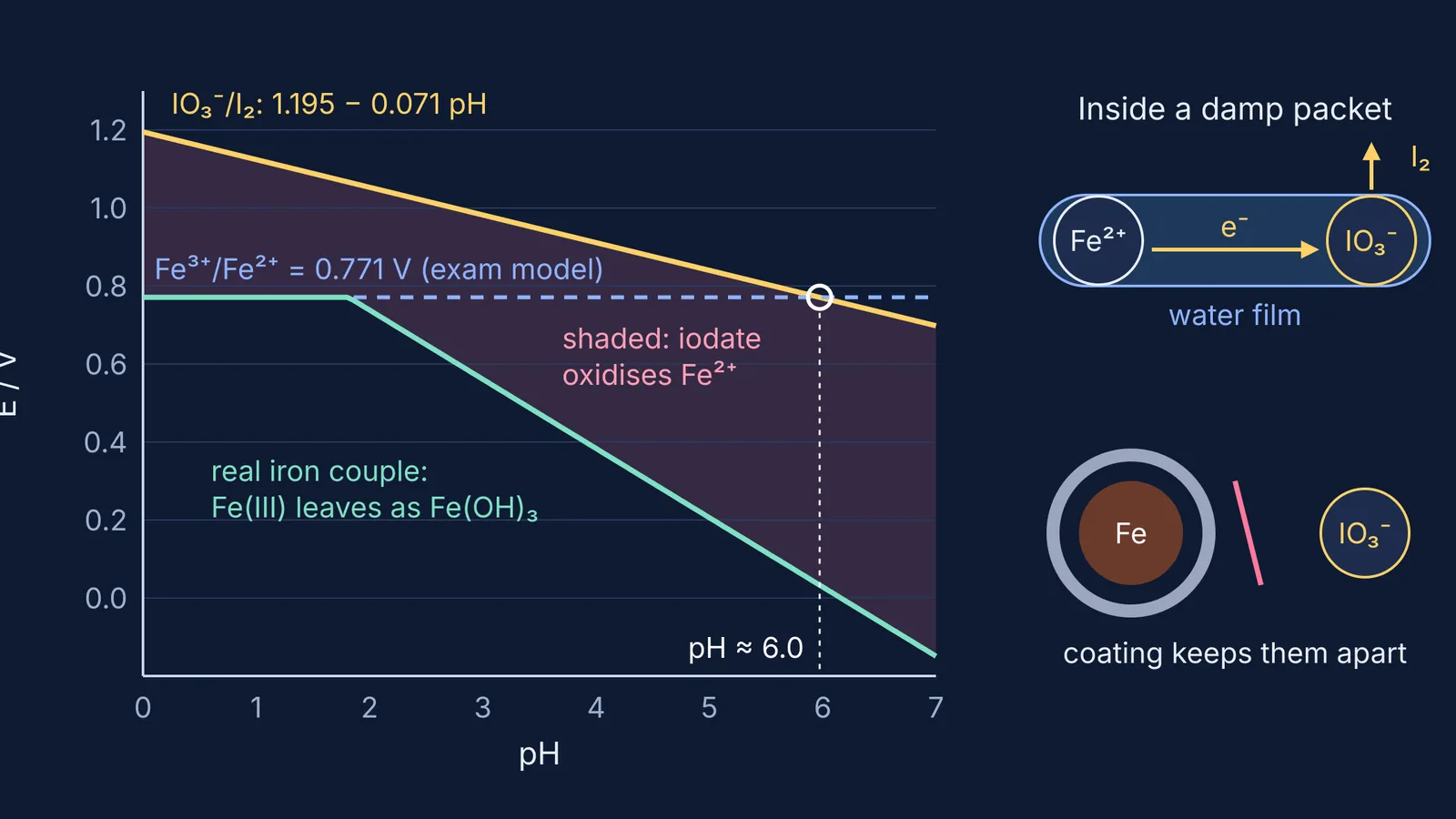
Apply the Nernst equation to the iodate couple. With iodate at 1 M and solid iodine, only H⁺ is left in the quotient: E = 1.195 − (0.0592/10) × log(1/[H⁺]¹²) = 1.195 − (0.0592 × 12/10) pH = 1.195 − 0.071 pH.
Note that the iron couple has no H⁺. With equal Fe³⁺ and Fe²⁺, E stays at 0.771 V at every pH.
Set them equal. 1.195 − 0.071 pH = 0.771, so pH = 0.424/0.071 ≈ 6.0.
Read the answer. Below about pH 6, iodate has the higher potential and oxidises Fe²⁺. Above it, this simple model says it does not.
If the pH term in a Nernst equation still feels new, calculating pH from a hydrogen electrode uses the same idea with one couple instead of two. To check each step of a calculation like this, the Fermi Problem Library has a step-by-step solver that explains the reasoning.
Why is the pH 6 answer too optimistic?
The crossover is a fair exam calculation, but only an estimate. It assumes standard concentrations and ignores iodine escaping, and three assumptions break down in a real packet.
Fe³⁺ is never at 1 M. At the start almost all the iron is Fe²⁺. If Fe²⁺ outnumbers Fe³⁺ by 1000 to 1, the iron potential drops by 3 × 0.0592 = 0.178 V to 0.593 V, and the crossover moves up to about pH 8.5.
Iron(III) does not stay dissolved. Fe(OH)₃ is extremely insoluble (Ksp roughly 10⁻³⁹; tables differ). With 0.01 M iron, it starts to precipitate above about pH 1.8. Removing Fe³⁺ pulls the Fe³⁺/Fe²⁺ potential down. Taking Ksp = 2.8 × 10⁻³⁹ and Fe²⁺ = 0.01 M, the iron couple falls to about −0.15 V at pH 7, while the iodate couple is still at +0.70 V. That is a gap of about 0.85 V in favour of the reaction. Neutral is not safe. This is the Pourbaix-diagram idea: precipitating the oxidised form makes the reduced form easier to oxidise.
The reaction makes its own acid. Iron(II) salt solutions are often said to be acidic because Fe²⁺ hydrolyses, but Fe²⁺ is only a very weak acid. The strong acid is Fe³⁺, which hydrolyses as Fe³⁺ + 3H₂O → Fe(OH)₃ + 3H⁺. Add that to the redox equation and you get the overall change:
2IO₃⁻ + 10Fe²⁺ + 24H₂O → I₂ + 10Fe(OH)₃ + 18H⁺
(Atoms: 2 I, 30 O, 10 Fe, 48 H on each side. Charge: +18 on each side.) The redox step uses 12 H⁺, but the hydrolysis releases 30, so the moisture film gets more acidic as the reaction goes.
Which nutrient loses out?
Do the stoichiometry for 1 kg of salt at 1000 ppm Fe and 30 ppm I:
Iron: 1.000 g ÷ 55.85 g mol⁻¹ = 17.9 mmol Fe.
Iodine: 0.030 g ÷ 126.9 g mol⁻¹ = 0.236 mmol, all as IO₃⁻.
One IO₃⁻ oxidises five Fe²⁺, so all the iodate could oxidise only 5 × 0.236 = 1.18 mmol Fe²⁺.
That is 1.18 ÷ 17.9 = 6.6% of the iron.
Iron outnumbers iodine about 76 to 1 by moles, so the iodine can be used up completely while most of the iron remains.
How do manufacturers keep iron and iodine apart?
Since thermodynamics favours the reaction, the fix is to keep the reactants dry and apart. A 2021 review of DFS production in the Journal of Nutrition describes the two main routes.
Ferrous sulphate with a stabiliser. The National Institute of Nutrition (NIN), Hyderabad, pioneered DFS using ferrous sulphate heptahydrate with sodium hexametaphosphate added as a colour stabiliser, at about 0.5% and 1% of the salt.
Encapsulated ferrous fumarate. Ferrous fumarate is formed into grains the size of salt crystals, bound with hydroxypropyl methyl cellulose, coated with titanium dioxide to hide its reddish colour, and sealed in a coat of hydrogenated soy fat, as described in the Diosady review. The fat coat is the barrier; it melts during cooking and releases the iron.
The coating does not change any E° value. It stops the ions meeting in a water film.
Why can DFS change colour in food?
The same review reports that producers have seen colour changes and dark specks in some DFS. Some cooks also notice food darkening. The chemistry is familiar. Any iron that reaches the Fe³⁺ state can bind to polyphenols, such as the tannins in tea and the phenolic compounds in some vegetables, forming dark iron–phenol complexes. That is the chemistry of iron-gall ink and the ferric chloride test for phenols. The change is cosmetic. Whether DFS improves iron status is a separate nutrition question, studied in its own trials.
Quick checklist
DFS in India: iodine as KIO₃, iron as ferrous sulphate or ferrous fumarate (FSSAI).
2IO₃⁻ + 10Fe²⁺ + 12H⁺ → I₂ + 10Fe³⁺ + 6H₂O; iodine escapes, iron turns ferric.
E(IO₃⁻/I₂) = 1.195 − 0.071 pH; the crossover with 0.771 V is at pH ≈ 6.0 (estimate).
Low Fe³⁺ and Fe(OH)₃ precipitation lower the iron potential, so the reaction is favoured at neutral pH too.
Coating and dryness are the fix, not pH.


