

On this page
Old letters, account books and music manuscripts in European archives are often written in a brown-black ink that has eaten through the paper along the pen strokes. That ink is iron-gall ink, and its chemistry is one you already know from the lab: the ferric chloride test for phenols. Gall extract supplies the phenol, green vitriol supplies the iron, and air does the rest, slowly, on the page.
What is iron-gall ink made of?
A traditional recipe has three or four parts:
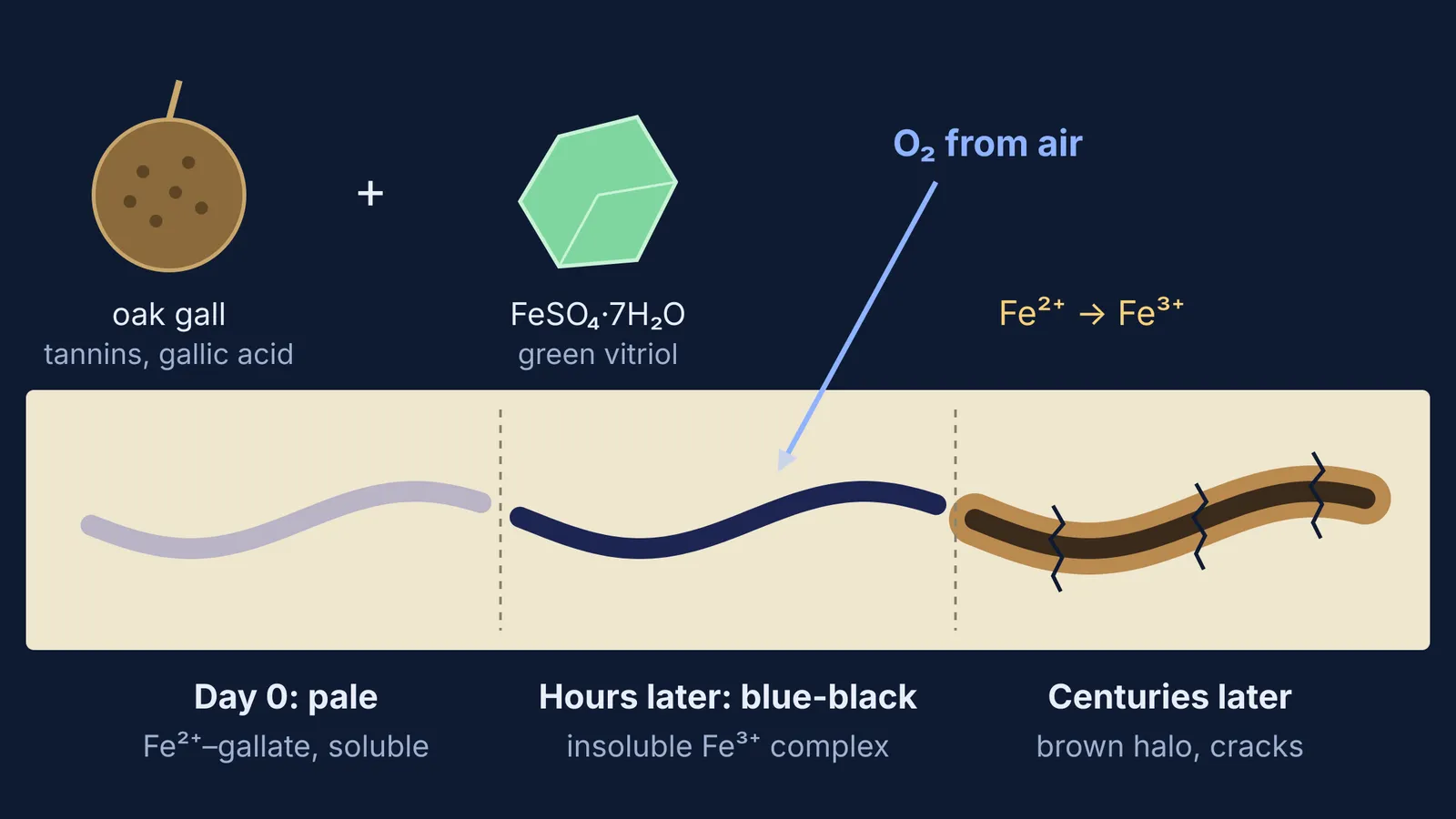
Galls. Oak galls are swellings that a tree grows around wasp eggs. They are rich in gallotannins, large esters of gallic acid (3,4,5-trihydroxybenzoic acid). Soaking or fermenting crushed galls frees some gallic acid.
Green vitriol. This is iron(II) sulphate heptahydrate, FeSO₄·7H₂O, the pale green crystals you may have seen in the salt analysis lab.
Gum arabic to thicken the ink.
Water, wine or vinegar as the liquid.
Recipes like this were used in Europe from roughly the early medieval period until the early twentieth century. Be careful not to over-generalise, though: most traditional Indian manuscript inks were carbon inks made from lampblack and gum, not iron-gall inks.
Why does iron-gall ink darken after writing?
Fresh iron-gall ink is pale, often a weak grey or violet. It darkens on the page over hours to days.
The reason is the oxidation state of the iron. In the bottle the iron is mostly Fe²⁺. Iron(II) forms complexes with gallic acid and tannins, but they are weakly coloured and stay dissolved, so the ink flows and soaks into the paper fibres. Once the ink is spread thin on paper, oxygen from the air oxidises the iron:
4Fe²⁺ + O₂ + 4H⁺ → 4Fe³⁺ + 2H₂O
Check the balance: 4 Fe, 2 O and 4 H on each side, and a charge of +12 on each side.
Iron(III) binds the phenolic –OH groups of gallate and tannin much more strongly. The product is an insoluble iron(III)–gallate/tannate complex that is a deep blue-black. Because it forms inside the fibres, it does not wash off easily.
The exact structure of the black pigment is still debated, with different studies proposing different Fe-to-gallate ratios and bridging patterns. So treat any single formula you see for it with caution. The safe statement is: the dark colour comes from Fe³⁺ bound to phenolate oxygens, not from Fe²⁺.
How is this the same as the neutral FeCl₃ test for phenols?
In the neutral ferric chloride test for phenol, Fe³⁺ binds phenoxide oxygens and gives an intensely coloured complex. The colour comes from ligand-to-metal charge transfer: electrons from the electron-rich phenolate oxygen are excited towards the Fe³⁺ centre. Simple phenol gives violet. Gallic acid and tannins, which carry three adjacent –OH groups on each ring, give blue-black, which is exactly the colour of iron-gall ink.
The difference is only the order of events:
In the test tube you add Fe³⁺ directly, so the colour appears at once.
In the ink you start with Fe²⁺, which gives little colour, and the air makes the Fe³⁺ for you on the paper.
That delay is useful. A pale, soluble ink penetrates the paper before the insoluble pigment forms, which is why iron-gall writing is so hard to erase. The Concept Library covers phenol acidity and coordination complexes if you want to revise either.
Why does iron-gall ink destroy paper over time?
The same ink that was prized for being permanent slowly damages the documents it is on. Conservators call this ink corrosion. Two reactions do the damage:
Acid hydrolysis. Green vitriol brings sulphate. As Fe²⁺ is bound and oxidised, the sulphate is left with H⁺, effectively sulphuric acid in the paper. Acid catalyses the hydrolysis of the glycosidic links between glucose units in cellulose, so the chains get shorter and the paper gets brittle.
Iron-catalysed oxidation. Free iron ions, especially Fe²⁺, catalyse the oxidation of cellulose, for example by reacting with traces of hydrogen peroxide to form very reactive hydroxyl radicals (Fe²⁺ + H₂O₂ → Fe³⁺ + OH⁻ + •OH).
The result is a brown halo, then cracks along the strokes. One common conservation treatment uses calcium phytate to bind the free iron, followed by a mild alkaline bath to neutralise the acid.
Worked example: how much iron is left free in an ink recipe?
Ink makers did not all agree on proportions, so the numbers below are illustrative. Take a recipe with 3.0 g of FeSO₄·7H₂O and 4.0 g of gallic acid.
Molar mass of green vitriol. FeSO₄·7H₂O = 55.85 + 32.06 + 4(16.00) + 7(18.02) ≈ 278 g mol⁻¹.
Moles of iron. 3.0 ÷ 278 = 0.0108 mol Fe.
Molar mass of gallic acid. C₇H₆O₅ = 7(12.01) + 6(1.008) + 5(16.00) ≈ 170 g mol⁻¹.
Moles of gallic acid. 4.0 ÷ 170 = 0.0235 mol.
Mole ratio. 0.0235 ÷ 0.0108 ≈ 2.2 gallate per iron.
Assume a binding ratio. Because the pigment structure is debated, suppose for this example that each Fe³⁺ ends up holding two gallates. Then 0.0235 mol of gallate can bind 0.0235 ÷ 2 ≈ 0.0118 mol Fe. That is slightly more than the 0.0108 mol present, so on this assumption all the iron is bound.
Now double the vitriol. With 6.0 g of FeSO₄·7H₂O you have 0.0216 mol Fe. The gallate can still bind only about 0.0118 mol, so about 0.0098 mol, roughly 45% of the iron, is left free in the paper to catalyse oxidation.
The acid. Whatever happens to the iron, each mole of FeSO₄ can leave up to one mole of H₂SO₄ behind. For the 3.0 g recipe that is at most 0.0108 × 98.1 ≈ 1.06 g of acid.
So inks with too much vitriol for the gall are the ones expected to corrode worst. For more practice turning grams into moles and limiting ratios, the Fermi Problem Library has a step-by-step solver that explains the reasoning.
Can you make iron-gall style ink at home or school?
Yes, with a simple version that works as a CBSE activity:
Brew strong black tea and let it cool. Tea is rich in polyphenols; see how tannins make tea bitter for what is in the cup.
Write on plain paper with a cotton bud or brush dipped in the tea. Let it dry.
Brush over the writing with dilute iron(II) sulphate solution (a pinch in a few spoons of water).
The writing turns dark grey to blue-black within minutes and keeps darkening as air oxidises the iron.
Wear gloves, keep the solution away from your eyes and mouth, and do not test it on any document you value. Compare this with how lemon juice invisible ink works: that one appears when heat chars sugars, while this one appears because a metal–phenolate complex forms.
The same iron–tannin chemistry turns up in rust converters, where tannic acid turns iron oxides on steel into a dark iron tannate layer.
Quick checklist
Iron-gall ink = gall tannins and gallic acid + FeSO₄·7H₂O + gum.
Fresh ink holds pale, soluble Fe²⁺ complexes; air makes Fe³⁺, and the Fe³⁺–polyphenol complex is the blue-black pigment.
It is the neutral FeCl₃ test for phenols, with a delay.
4Fe²⁺ + O₂ + 4H⁺ → 4Fe³⁺ + 2H₂O balances in atoms and charge.
Ink corrosion comes from leftover acid and free iron, not from rust.
Too much vitriol for the gall leaves free iron: check the mole ratio.


