

On this page
Writing a secret message with lemon juice is a classic science experiment that feels like magic. But the moment the paper is held near a warm iron or a light bulb, the invisible writing turns brown.
The secret lies in a series of chemical changes. By trying this at home, parents can help children understand how heat drives chemical reactions and changes the properties of everyday materials.
How does lemon juice invisible ink appear on heating?
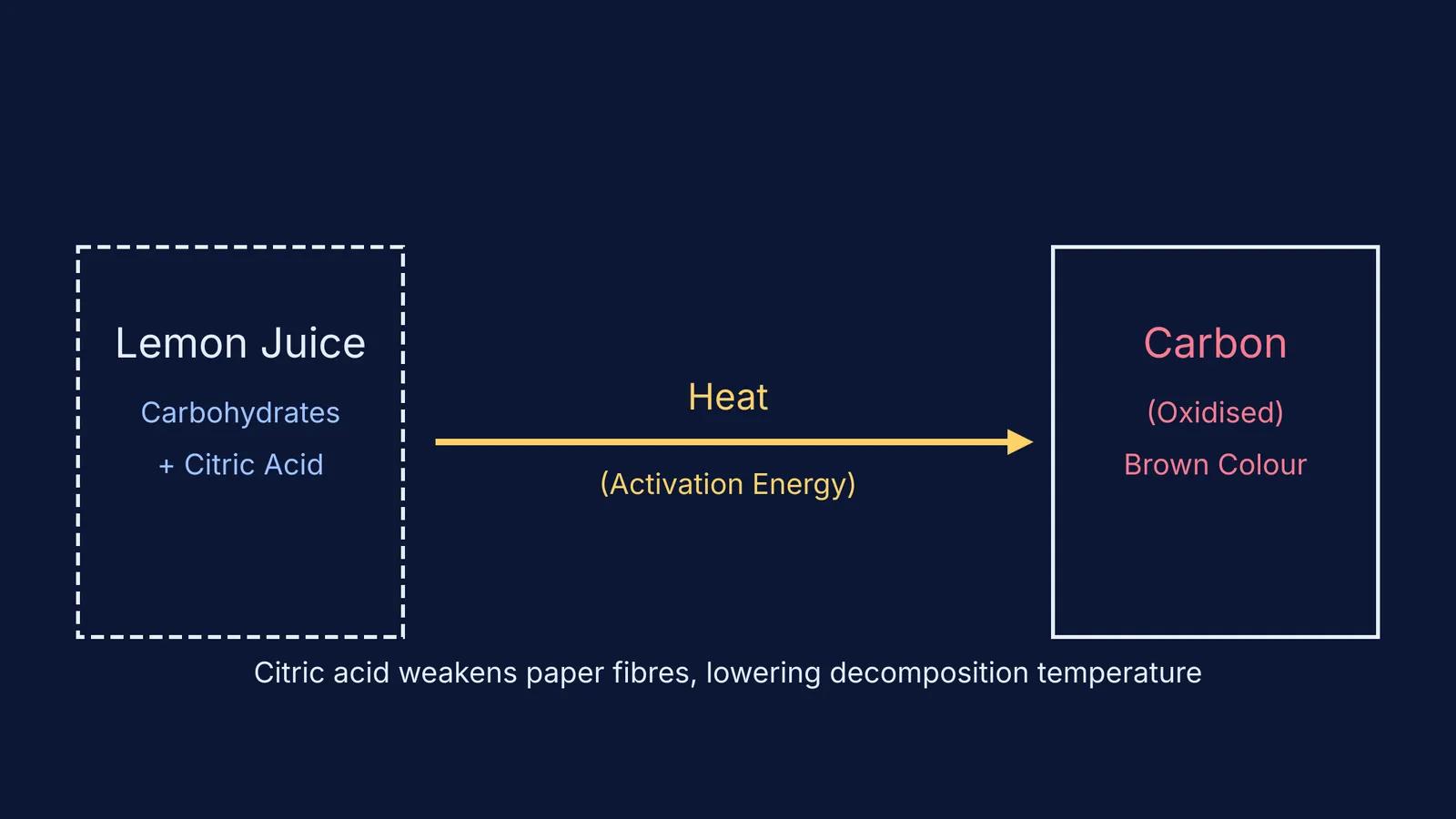
When you apply heat to dried lemon juice on paper, the carbon compounds in the juice break down and react with oxygen in the air, as explained by Science Buddies. This process, known as oxidation, turns the previously invisible compounds into a visible brown substance.
Lemon juice is primarily water, but it also contains carbohydrates (sugars) and a strong organic acid called citric acid. When you write your message, the juice is absorbed into the paper. As the water evaporates, the sugars and acid are left behind. They are colourless and sit invisibly among the paper fibres.
The heat provides the energy needed for a chemical change. The carbohydrates begin to carbonise, breaking their chemical bonds and releasing carbon. When this carbon meets the oxygen in the air, it oxidises and changes colour.
What is the chemistry of oxidation and carbonisation?
You have likely seen oxidation in your kitchen. When you slice an apple and leave it on the counter, it slowly turns brown as its enzymes react with oxygen.
With lemon juice, the oxidation is not enzymatic, and it requires energy to start. The heat from an iron or a bulb provides that activation energy. This is similar to caramelisation, where applying heat to sugar causes it to break down, release water, and form new, brown-coloured polymer molecules.
Because the chemical bonds have been broken and new substances formed, this is a permanent chemical change. You cannot cool the paper down to make the message disappear again. The original molecules have been transformed into something entirely new.
If a chemical reaction is hard to picture just from reading about it, your child can explore it in the Fermi Simulation Lab, which provides interactive simulations for the ideas that are easier to see than to read.
Why do some other liquids work as invisible ink?
Lemon juice is not the only fluid that reveals a hidden message when heated. Milk, honey, onion juice, and vinegar can also be used.
The underlying principle remains the same. These liquids all contain carbon-based compounds, such as sugars or organic acids, which are sensitive to heat. When exposed to a high temperature, their bonds break, and the resulting carbon reacts with oxygen to turn brown. Milk, for instance, contains lactose (a sugar) and proteins that undergo the Maillard reaction when heated, which is the same chemical process that gives a browned crust to baked bread.
How can you test this at home?
You can set up this active-learning experiment in your kitchen to see the oxidation firsthand. Adult supervision is essential when using heat sources.
You will need:
Half a lemon
A small bowl and a few drops of water
A cotton swab or a fine paintbrush
Plain white paper
A heat source (such as an iron, a hair dryer on a hot setting, or a bare light bulb)
Squeeze the lemon juice into the bowl and stir in a few drops of water to thin it out slightly.
Dip the cotton swab into the mixture and write a message on the paper.
Wait for the paper to dry completely. The message should disappear completely from view.
An adult should gently apply heat to the paper. If using an iron, turn off the steam setting and press it briefly over the paper for a few seconds at a time.
Watch as the brown letters slowly reveal the secret message.
What questions should you ask during the experiment?
A good experiment is about asking the right questions. To turn this activity into a study habit that builds scientific thinking, ask your child to predict what will happen before you apply the heat.
During the process, you can ask:
Why did we need to wait for the water to evaporate before heating it?
How do we know a chemical change has taken place? (The change in colour is a key sign, and the fact that the process cannot be reversed proves it is a chemical change, not just a physical one).
What do you think would happen if we used a liquid with no carbon, like plain water or saltwater?
Linking hands-on experiments to the theory they learn in school helps children remember the concepts. By seeing oxidation and carbonisation happen in front of them, they build a concrete understanding of how heat affects matter.
To read more about everyday chemical reactions, explore our guide on Physical or chemical change? A Class 7 guide with examples. You can also learn how oxidation affects metals and food in Corrosion and rancidity: everyday oxidation in Class 10 science, or dive deeper into sugar chemistry in Reducing and non-reducing sugars: why sucrose fails Tollens' test.


