

On this page
Look through the small viewer in a front door and you see the whole visitor, head to toe, plus a good part of the corridor, through a hole narrower than your finger. The trick is a strongly diverging lens on the outside that shrinks everything into a tiny upright image close to itself, and a converging eyepiece on the inside that lets your eye look at that image comfortably. Here is a two-lens model with numbers, why it never needs focusing, and why it is a telescope used backwards.
How does a door peephole work?
A door viewer is a short tube through the door with lenses at both ends.
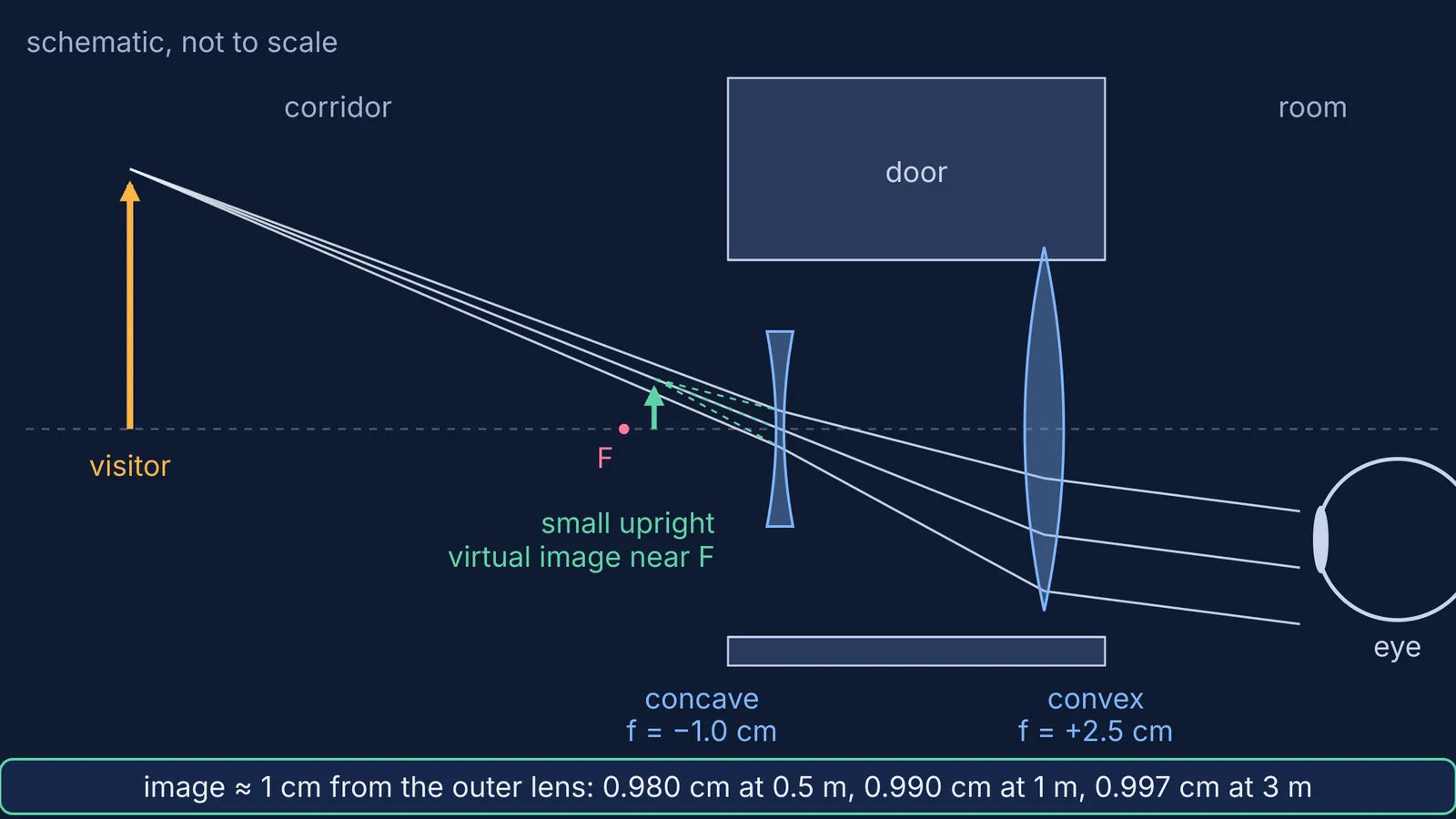
Outer lens (corridor side): strongly diverging, with a short focal length. It forms a small, upright, virtual image of whatever is in the corridor.
Eyepiece (room side): converging. It acts as a magnifier for that small image, so your eye sees it without strain.
We model each end as one thin lens. Real viewers use several elements, so this is a simplified model.
Sign convention. We use the Cartesian sign convention throughout: distances are measured from the lens, positive in the direction the light travels (from the corridor into the room), negative against it. The lens formula is 1/v − 1/u = 1/f and the magnification is m = v/u. A diverging lens has negative f.
Where does the outer lens form the image of the visitor?
For a diverging lens, a real object anywhere in front of it gives a virtual, upright, diminished image between the focal point F and the lens. That result is proved in where is the image formed by a diverging lens. A door viewer uses it in an extreme form: f is so short compared with the visitor's distance that the image always sits almost exactly at F.
Worked example: a 150 cm visitor 1 m from the door
Take the outer lens as f₁ = −1.0 cm. The visitor is 150 cm tall and stands 1.0 m away, so u = −100 cm.
Lens formula. 1/v = 1/f₁ + 1/u = 1/(−1.0) + 1/(−100) = −1 − 0.01 = −1.01 cm⁻¹.
Image distance. v = −1/1.01 = −0.990 cm. The minus sign means the image is on the corridor side, the same side as the visitor: it is virtual.
Magnification. m = v/u = (−0.990)/(−100) = +0.0099. Positive, so the image is upright.
Image height. 150 × 0.0099 = 1.49 cm. The whole visitor is squeezed into an image about 1.5 cm tall, 0.99 cm in front of the lens.
Now move the visitor.
At 3 m (u = −300 cm): v = −0.997 cm, m = 0.0033, image 0.50 cm tall.
At 0.5 m (u = −50 cm): v = −0.980 cm, m = 0.0196, image 2.9 cm tall.
The image grows and shrinks a lot, but its position barely moves. Between 0.5 m and 3 m it shifts by only 0.017 cm.
Why does a peephole never need focusing?
Because the image always lands within about 0.02 cm of F₁, an eyepiece set up for that one position works for every visitor. Put a converging eyepiece of f₂ = +2.5 cm at 1.51 cm behind the outer lens, on the room side. The image is 0.99 cm on the other side of the outer lens, so its distance from the eyepiece is 1.51 + 0.99 = 2.50 cm, exactly f₂. An object at the focus of a converging lens sends out parallel rays, so the final image is at infinity and your eye views it relaxed. A visitor at 0.5 m or at 3 m moves the image by a fraction of a millimetre, which the eye's own accommodation easily handles.
Why is a peephole a Galilean telescope used backwards?
With the object far away, the two lenses are separated by f₂ − |f₁| = 2.5 − 1.0 = 1.5 cm, which is the layout of a Galilean telescope: one converging and one diverging lens, separated by the difference of their focal lengths. In the usual telescope, light enters the converging objective first, and the angular magnification is f_o/f_e, greater than 1. That case is covered in Galilean telescope: magnifying power fo/fe and length fo − fe.
In a door viewer, light enters the diverging lens first. The angular magnification is |f₁|/f₂ = 1.0/2.5 = 0.4, and the image stays upright. Angles are shrunk, not enlarged. Check it with the example. At the outer lens the visitor subtends tan θ = 150/100 = 1.5. Through the eyepiece the eye sees the 1.49 cm image at the eyepiece's focus, so tan θ′ = 1.49/2.5 = 0.59. The ratio is 0.59/1.5 = 0.40. A wide scene is squeezed into a small cone that fits through your pupil.
Notice that 1.5 is a large angle, about 56°. The thin-lens formulas assume small angles, so this is where the simple model starts to strain.
How wide can a door viewer see?
Hardware shops sell door viewers labelled with fields of view up to 200 degrees, for example this 200-degree brass door viewer. A field above 180° means a half-angle of more than 90° from the axis, far outside what any small-angle model can describe. Real viewers get there with several strongly curved lens elements and accept a lot of distortion: straight walls bow outward, like a fisheye photograph. The two-lens model gets the image position, the upright image and the shrinking of angles right, but not the full field.
A convex mirror reaches a wide field by the same idea of making a small virtual image close to the optical element. See why convex mirrors are used as rear-view mirrors for the mirror version.
Why can't someone outside see into the room?
Light passes through the lenses both ways, so the one-way effect comes from geometry. From the corridor, an outsider looks into the diverging lens with the eyepiece behind it. The pair now acts as a forward Galilean telescope, which magnifies and so shows only a very narrow patch of the room. The outsider's eye also cannot get close to where the rays emerge, so the field shrinks further. What they see is a small, bright spot of light rather than a usable view. It is a strong effect, not an absolute one.
To trace rays through two lenses and see how the virtual image moves as the object moves, try the Simulation Lab, which has interactive simulations for ideas that are easier to see than read.
Quick checklist
Outer lens: strongly diverging (here f₁ = −1.0 cm); eyepiece: converging (here f₂ = +2.5 cm).
Use one sign convention throughout: 1/v − 1/u = 1/f, m = v/u, f negative for the diverging lens.
A 150 cm visitor at 1 m gives an upright virtual image 1.49 cm tall at v = −0.990 cm.
The image stays within 0.02 cm of F₁ from 0.5 m to 3 m, so no focusing is needed.
The system is a reversed Galilean telescope with angular magnification |f₁|/f₂ = 0.4.
Real viewers reach 180–200° with several elements; the thin-lens model is a simplification.


