

On this page
The wing mirror on a car, bus or scooter is often a convex mirror, and the bulge is deliberate: it shows more of the road behind. It also makes every vehicle in it look smaller, and so farther away, than it really is.
Here you will make predictions, check them with a worked example, then test them in a simulation.
Why are convex mirrors used as rear-view mirrors?
The NCERT Class 10 science chapter on light gives two reasons. Convex mirrors always give an erect, though diminished, image. And because they are curved outwards, they have a wider field of view, so the driver can see a much larger area than a plane mirror would show.
Its Table 9.2 adds that for any real object between infinity and the pole, a convex mirror forms a virtual, erect, diminished image between the pole and the focus, behind the mirror. No object position flips the image or enlarges it. Compare that with the six cases in our concave mirror guide for all six object positions.
What changes when you swap a plane mirror for a convex one?
Write down your guesses before you draw anything. Predicting first turns a simulation into an experiment.
Field of view: does the convex mirror show more of the road, less, or the same?
Image size: is the image of a car smaller, larger, or the same?
Image position: is the image farther behind the mirror than in a plane mirror, or closer?
Apparent distance: does the car look nearer or farther than it really is?
Now check prediction 1 with numbers. Take a mirror 20 cm wide, your eye 1 m in front of it, and a radius of curvature of 1.2 m. That radius is a realistic one: the US federal rule for passenger-side convex mirrors (49 CFR 571.111) requires an average radius of curvature between 889 mm and 1,651 mm.
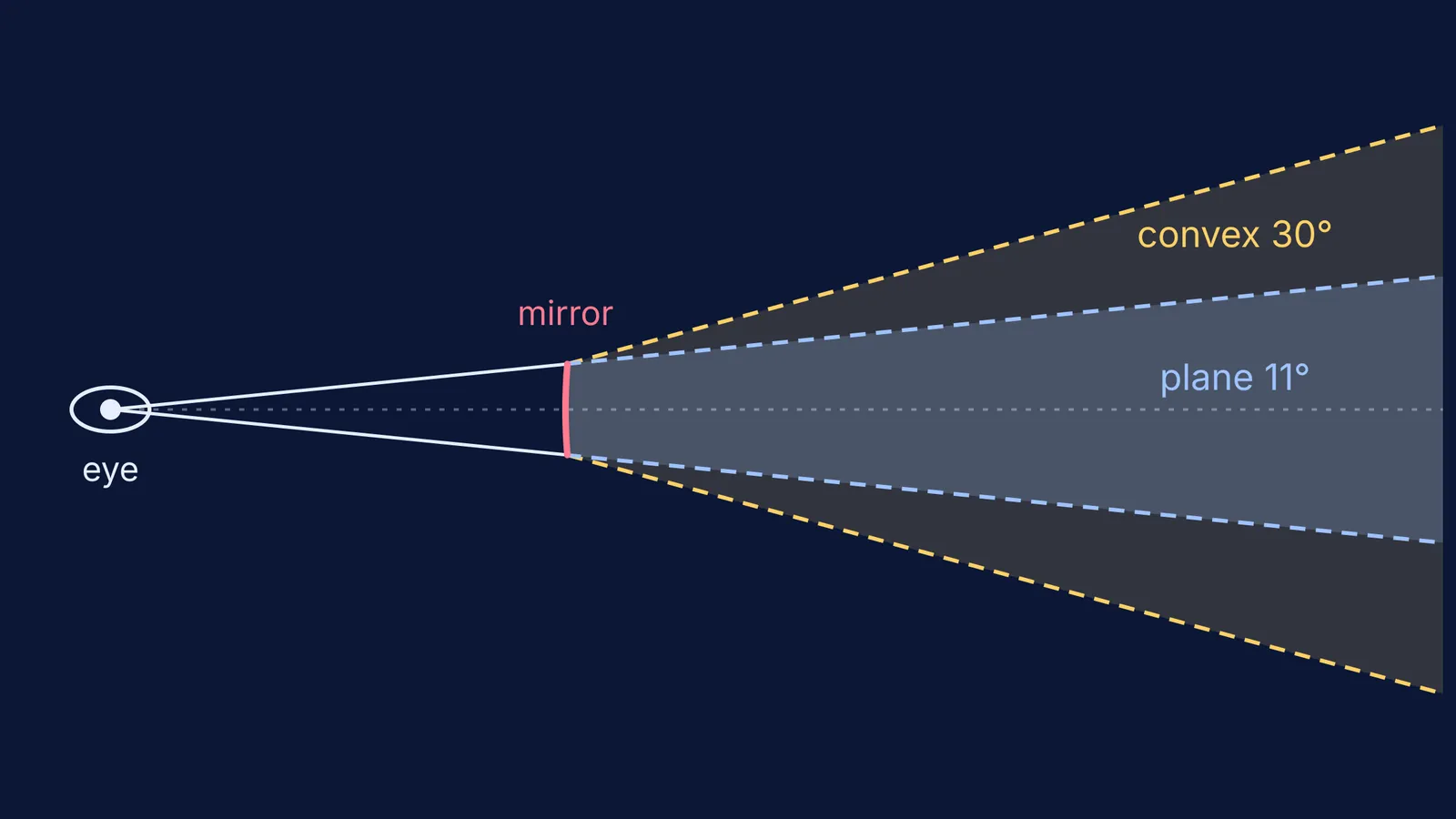
Plane mirror: the edges are 10 cm off-centre, so each edge ray from your eye makes about 5.7 degrees with the axis. The field of view is about 11 degrees.
Convex mirror: at the edge, the surface is tilted by about 4.8 degrees (the sine of the tilt is 0.1 m divided by 1.2 m). Reflection turns the ray by twice that tilt on each side, so each edge ray now leaves at about 15.2 degrees. The field of view is about 30 degrees, roughly 2.7 times wider.
Why do objects in a convex mirror seem farther than they are?
The surprise: the image is closer to you than the car, yet the car looks farther away.
Use the mirror formula 1/v + 1/u = 1/f with the NCERT sign convention. With R = 1.2 m, f = +0.6 m. A car 10 m behind the mirror has u = -10 m, which gives v = +0.57 m. The magnification m = -v/u is about +0.057, so the image is upright and under 6% of the car's height, sitting 57 cm behind the glass.
Your eye does not measure where the image is. It measures the angle the image fills. The Amherst College Physics Q&A on car mirrors shows that for a distant object this angular magnification is M = f/(E + f), where E is your eye's distance from the mirror. With E = 1 m and f = 0.6 m, M is about 0.38: the car fills under two-fifths of the angle it would if you looked straight at it.
Your brain reads small as far. By our estimate, the car 10 m back looks about as big as a car roughly 27 m away (the factor is 1 + E/f, about 2.7). That is why the same US rule requires the words "Objects in Mirror Are Closer Than They Appear" on the passenger-side convex mirror, in letters 4.8 mm to 6.4 mm high, as set out in 49 CFR 571.111.
How do you test this in a ray simulation?
A simulation lets you change one thing at a time and watch the rays respond. Our post on when simulations beat static diagrams looks at what studies found. Use this checklist:
Start with a plane mirror. Draw the two edge rays from the eye and note the angle between them.
Swap in a convex mirror of the same width. Say first whether the angle will grow or shrink.
Shrink the radius of curvature. The field of view should widen and the image shrink.
Move the object closer. The image should slide from the focus towards the pole and grow, but never turn upside down.
For each wrong prediction, write one sentence on which ray you misjudged.
If the ray picture is still hard to hold in your head, the Fermi Simulation Lab has interactive simulations for ideas like this that are easier to see than to read. For a related exam favourite, try our post on the minimum mirror height for a full-length image.
Next time you are in a car, compare a wing mirror with the flat inside mirror and see the trade-off yourself.


