

On this page
A jeweller's diamond tester looks like a fat pen with a metal tip. Touch the tip to a stone and a row of lights climbs to "diamond" or stays at "simulant". The tester heats its tip slightly and measures how fast the stone carries that heat away. Diamond conducts heat about a thousand times better than cubic zirconia, its most common imitation, so the difference is huge and easy to read. This post works out why, using one integral from Class 11 heat conduction, and explains why synthetic moissanite fools the same probe.
What does a diamond tester actually measure?
The probe has a tiny heater and a temperature sensor in its tip. When the hot tip touches a stone, heat flows from the tip into the stone. A good conductor drains heat fast and the tip stays cool; a poor conductor lets the tip stay hot. The meter turns that temperature into the row of lights.
Gemmologists call these instruments thermal probes or thermal inertia probes. In a short touch, the reading depends mainly on the stone's thermal conductivity k, with its density and specific heat playing a smaller part. If you need a refresher on what k means and why its unit is W/(m·K), see what thermal conductivity means and its SI unit.
Diamond is unusual because it is an electrical insulator that conducts heat better than copper. It has no free electrons to carry heat. Instead, heat travels as lattice vibrations (phonons), and diamond's light carbon atoms and very stiff bonds let those vibrations travel fast and far before they scatter.
How well do diamond, moissanite and cubic zirconia conduct heat?
The values we use, with sources:
Diamond: k ≈ 2,000 W/(m·K), a round value. High-purity single crystals reach up to 2,400 W/(m·K) at room temperature (Inyushkin et al., Physical Review B, 2018). Impurities such as nitrogen scatter phonons and lower the value in many natural stones, but it stays far above any simulant.
Synthetic moissanite (silicon carbide): k ≈ 320 W/(m·K). That is the modern room-temperature value for 6H-SiC along its c-axis. The older, widely quoted figure of 490 W/(m·K) dates from 1964 and has since been revised downward (Cheng et al., Nature Communications, 2022).
Cubic zirconia: k ≈ 2 W/(m·K), a round value. NIST measured about 2.3 W/(m·K) for a mostly cubic yttria-stabilised zirconia and found it nearly independent of temperature (Slifka, Filla and Stalick, NIST, 1999). Gem cubic zirconia is zirconia held in its cubic form by an additive such as yttria, and GIA notes its composition varies, so its k varies a little too.
So diamond conducts about 1,000 times better than cubic zirconia, but only about 6 times better than moissanite.
How do you find the heat flow from a probe tip into a stone?
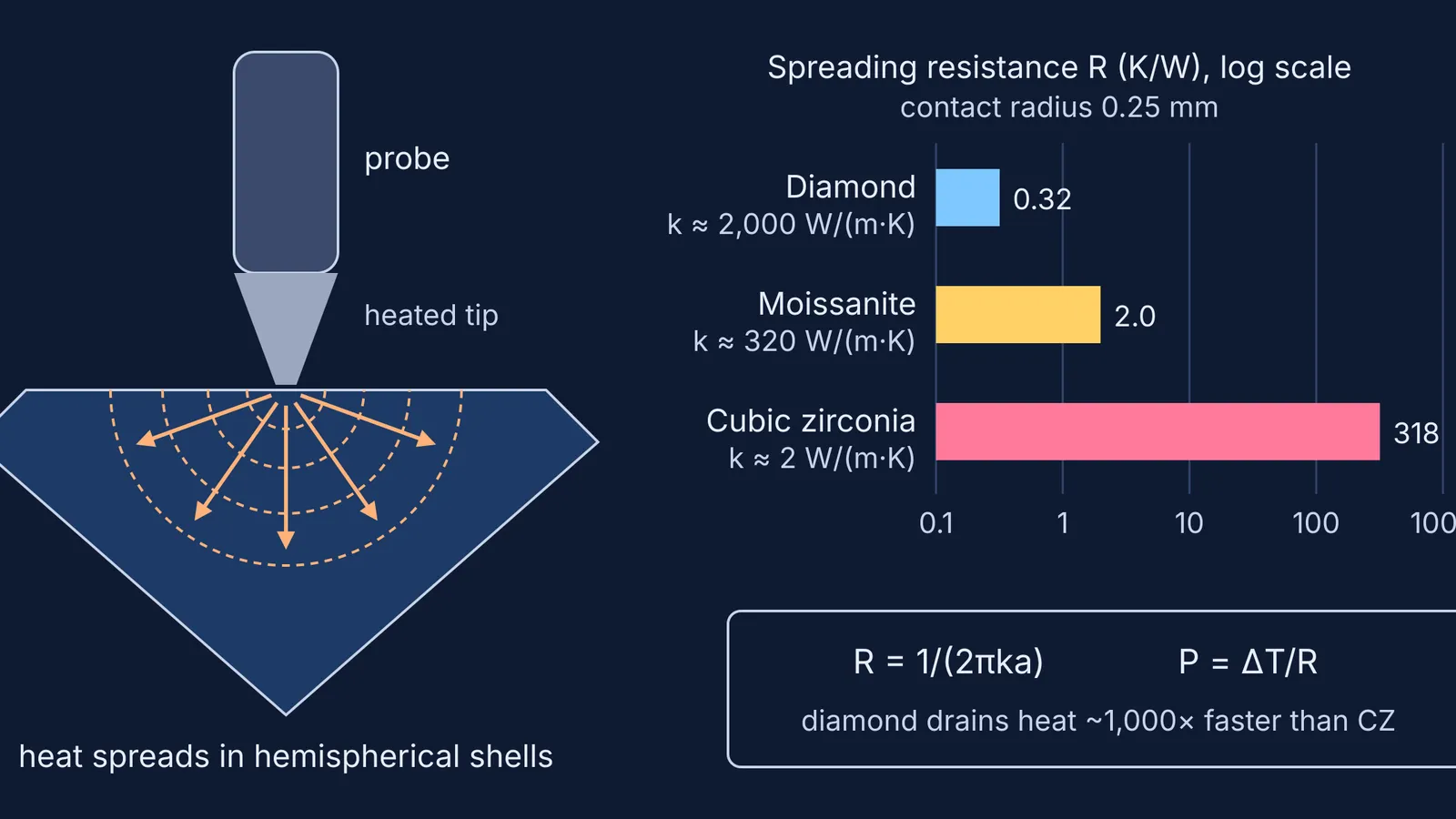
Model the contact as a small hemisphere of radius a pressed into a large block. Heat spreads out from the contact in hemispherical shells. This is the same idea as radial flow through a spherical shell, covered in radial heat flow through cylindrical and spherical shells, with two changes: half a sphere instead of a full one, and the outer radius going to infinity.
A thin hemispherical shell of radius r and thickness dr has area 2πr². Its thermal resistance is:
dR = dr ÷ (k × 2πr²)
The shells are in series, so add them from r = a out to infinity:
R = (1 ÷ 2πk) × ∫ dr/r² from a to ∞ = (1 ÷ 2πk) × (1/a) = 1 ÷ (2πka)
Units check: 1 ÷ (W m⁻¹ K⁻¹ × m) = K/W, which is a thermal resistance, as it should be. The heat flow for a temperature difference ΔT is P = ΔT ÷ R = 2πkaΔT.
Almost all of the resistance sits in the first few contact radii, because the shells near the tip are small. That is why a tester works on a small stone: the heat only "sees" a thin layer under the tip.
Worked example: diamond against cubic zirconia
Take a contact radius a = 0.25 mm (an illustrative value) and the conductivities above.
Diamond. R = 1 ÷ (2π × 2,000 × 0.25 × 10⁻³) = 0.32 K/W.
Moissanite. R = 1 ÷ (2π × 320 × 0.25 × 10⁻³) = 2.0 K/W.
Cubic zirconia. R = 1 ÷ (2π × 2 × 0.25 × 10⁻³) = 318 K/W.
Heat flow at ΔT = 50 K. Diamond: P = 50 ÷ 0.32 ≈ 157 W. Cubic zirconia: P = 50 ÷ 318 ≈ 0.16 W. The ratio is 1,000, the same as the ratio of the k values.
What the tip feels. A real probe has only a tiny heater, say 0.1 W (illustrative). The tip then rises above the stone by P × R: about 0.03 K on diamond, 0.2 K on moissanite and 32 K on cubic zirconia.
The 157 W is not a real power, only a measure of how strongly diamond drains heat. The model also ignores the tip's own resistance and the stone's finite size, so treat every number as a scale, not a measurement. The point survives: on cubic zirconia the tip stays tens of kelvin hot, on diamond it barely warms.
Why does moissanite fool a thermal probe?
On the numbers above, moissanite's resistance is 2.0 K/W against diamond's 0.32 K/W. Both are tiny next to cubic zirconia's 318 K/W, and a tip rise of 0.2 K and one of 0.03 K both sit at the "diamond" end of the scale. A probe designed to separate diamond from glass and cubic zirconia cannot tell the two apart.
GIA's researchers tested this when synthetic moissanite first appeared as a diamond substitute. In their study, every synthetic moissanite registered as "diamond" on every thermal probe they used (Nassau et al., Gems & Gemology, Winter 1997).
The same GIA paper explains the next physics clue. Silicon carbide is a semiconductor, while most near-colourless diamonds are electrical insulators, so many testers now add an electrical check. GIA found that 13 of its 23 moissanite samples showed some electrical conductivity, and that some light grey or blue diamonds also conduct. GIA therefore calls electrical conductivity "indicative" but never diagnostic, and states that no single test conclusively identifies moissanite. A lab-grown diamond is still diamond, so its conductivity, and its tester reading, are the same as a natural one's. Telling those apart is a job for a gem laboratory such as GIA.
If you want more practice with shell-conduction integrals like this one, the Fermi Problem Library has a step-by-step solver that explains the reasoning at each step. The reason a good conductor feels cold to your fingers is the same physics from the other side; see why a steel spoon feels colder than a wooden one.
Quick checklist
A diamond tester heats its tip and measures how fast the stone drains the heat.
Diamond conducts heat through lattice vibrations, not free electrons.
Spreading resistance from a hemispherical contact is R = 1/(2πka), from adding shells dr/(2πkr²).
Diamond (about 2,000 W/(m·K)) beats cubic zirconia (about 2) by a factor of about 1,000.
Moissanite (about 320) is close enough to diamond that thermal probes read it as diamond.
GIA treats electrical conductivity as indicative only; no single test identifies moissanite.


