On this page
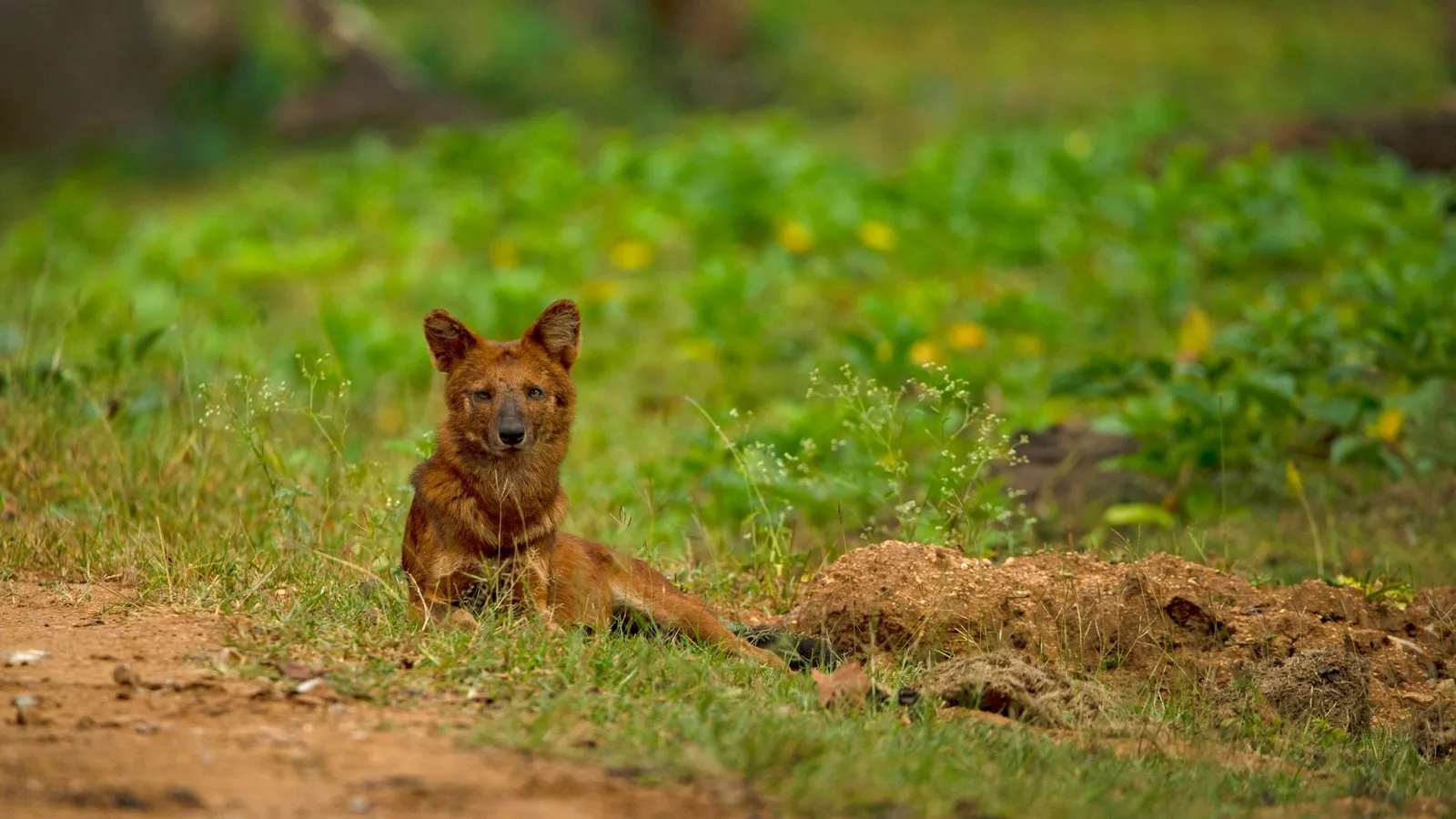
The dhole (Cuon alpinus), also called the Asiatic or Indian wild dog, is a reddish canid found in forests from the Western Ghats to Central India and the Northeast. Dholes typically weigh 12 to 20 kg, according to the IUCN Canid Specialist Group's species account by Durbin, Venkataraman, Hedges and Duckworth. Yet the prey they prefer most across Asia, the sambar deer, is many times heavier. The trick is teamwork.
How do dholes hunt in packs?
The same IUCN species account describes the hunt in detail. Dholes usually live in packs of 5 to 10 animals, and groups of 24 in Kanha and 25 in Mudumalai have been recorded regularly. Hunting groups are usually smaller than 10, though packs of over 30 have occasionally been reported.
The account records three tactics:
Ambush: some dholes may lie in ambush while others drive the prey towards them.
Water traps: dholes often drive deer into water, surround them and swim out to catch them.
Roles: it is common for particular individuals to lead the chase or take the first grab at the prey.
In central India, dholes rarely run prey to exhaustion; most chases cover less than a few hundred metres.
Why do dholes whistle?
Pack members communicate their whereabouts with whistles and yelps, the IUCN account notes, and a repeated whistle-like contact call may let scattered members identify one another and regroup. Whistle calls travel well at ground level, and their frequency and structure make the caller easy to locate.
Danger gets different calls: growls, growl-barks, chattering and screams warn pack-mates about humans or predators such as leopards and tigers.
People who live alongside dholes in the tea-estate landscape of Valparai, in the Western Ghats, describe the same behaviour. In a 2026 Ecology and Society study by Sharma, Vigneshwaran, Saravanan and Srivathsa, one resident told researchers: "The leader whistles and alerts their group, and they surround the prey."
How do dholes share a kill?
Fast, and mostly without fighting. According to the IUCN account, dholes eat up to 1 kg per dog in 4 minutes, with relatively little aggression except over small prey. One or more dholes often stand guard while the others feed on large prey, possibly watching for tigers, leopards or people.
Speed matters because other predators and people can steal kills. The same account notes that a dhole's stomach holds about 3 kg of meat, and that dholes can regurgitate small quantities at will. That lets them carry food back to the pups, the mother and other adults that stay at the den. Pups start receiving regurgitated meat at about three weeks old.
Why can small dholes kill large deer like sambar?
A 2014 review in the Journal of Zoology by Hayward, Lyngdoh and Habib pooled 24 studies from 16 sites, covering 8,816 scat and kill records. Sambar, chital and wild boar made up almost two-thirds of the food biomass dholes eat, and sambar was significantly preferred. The prey dholes can take ranges from 30 to 235 kg, with a preferred range of 130 to 190 kg, and larger packs took larger prey.
Sambar are big. They weigh 109 to 260 kg, and the largest males reach 185 to 260 kg, according to Animal Diversity Web.
Worked example: the arithmetic of a pack
Use numbers from the IUCN account and Animal Diversity Web, and take a middle-weight dhole of 16 kg.
A large sambar stag of 185 to 260 kg is about 12 to 16 times one dhole's weight (185 / 16 and 260 / 16).
At up to 1 kg per dog in 4 minutes, a pack of 10 dholes can eat about 10 kg in 4 minutes.
With about 3 kg in each stomach, those 10 dogs can hold roughly 30 kg of meat between them.
This is a rough model, not a measurement. The link between pack size and prey size comes from the review: larger packs took larger prey, though pack size did not change which prey dholes preferred.
How can you use the dhole in a biology answer?
For questions on cooperative behaviour or predator adaptations, use the dhole in five steps, drawn from the IUCN account and the Hayward review:
Name and size: Cuon alpinus, 12 to 20 kg.
Cooperation: ambush, driving prey into water, particular roles such as leading the chase.
Communication: whistles to regroup, separate alarm calls.
Sharing: fast eating, sentinels, regurgitation for pups.
Payoff: prey of 30 to 235 kg, with sambar significantly preferred.
To see how predators and prey keep each other in check over time, read our explainer on NCERT's prudent predator idea. For the opposite strategy, a lone sprinter, see the physics of a cheetah hunt.
If terms like predation, competition and population feel shaky, the Fermi Concept Library gives every biology concept its own lesson and its place in the map, so you can see how they connect.
Curious about studying animals like dholes for a living? Our guide to wildlife research careers maps the route from a life science degree.