

On this page
When the first eight cheetahs were released into Kuno National Park in Madhya Pradesh on 17 September 2022, it was seventy years after the animal was declared extinct in India in 1952, according to the Press Information Bureau. The cheetah's real weapon is how quickly it changes speed and direction, and both are Class 11 mechanics you can check with a calculator.
How fast can a cheetah accelerate?
A team led by Alan Wilson fitted five wild cheetahs in Botswana with collars combining GPS and inertial sensors and recorded 367 runs, most of them hunts (Nature, 2013). The top speed was 25.9 m/s, or 93 km/h, but most hunts involved only moderate speeds.
A follow-up study compared cheetahs with impala, lions and zebra in the same habitat (Nature, 2018). Its table of maximum (98th-percentile) stride values gives the cheetah these numbers:
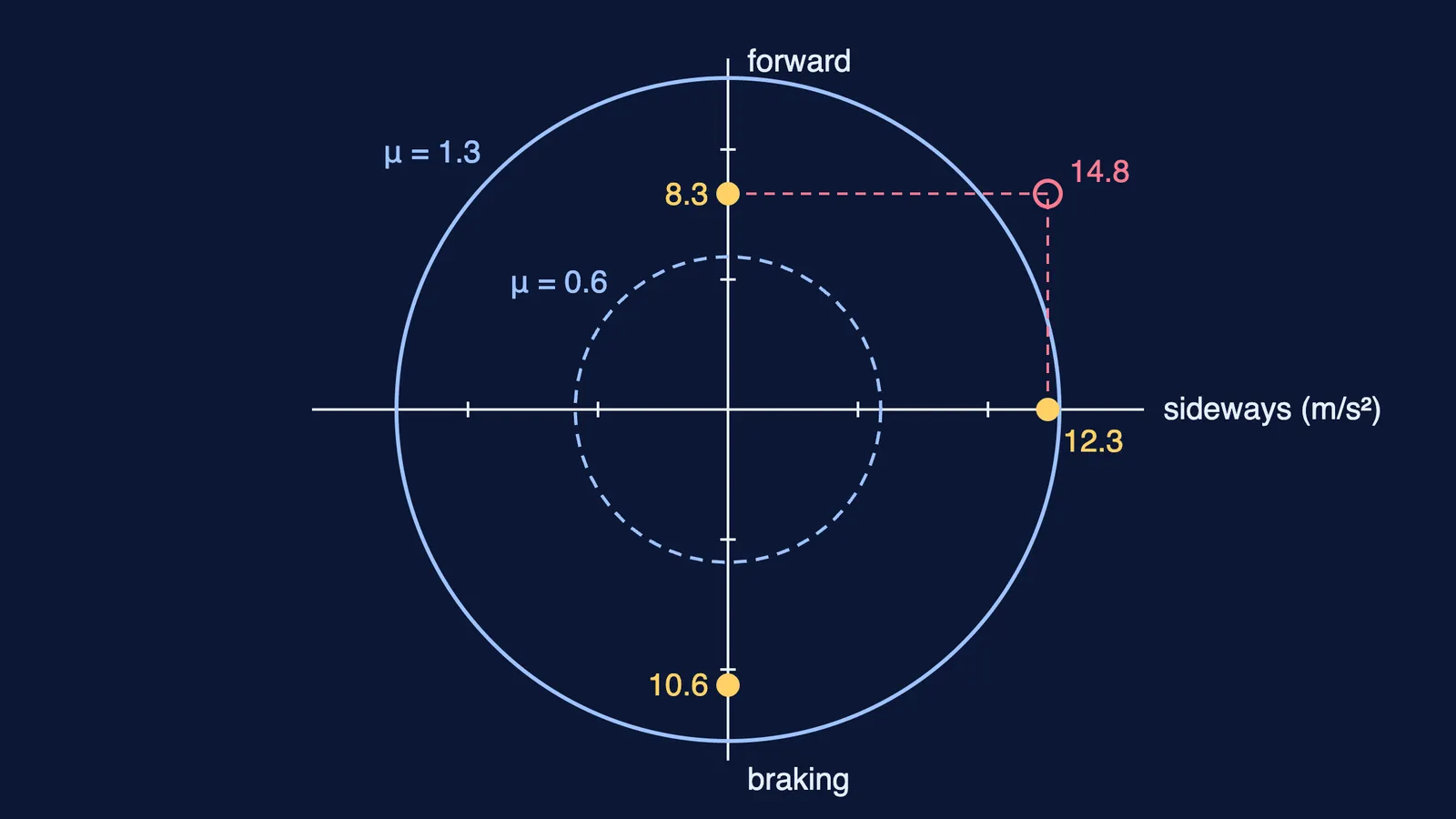
forward acceleration: 8.3 m/s², about 0.85 g
braking: 10.6 m/s², about 1.1 g
sideways acceleration in a turn: 12.3 m/s², about 1.25 g
speed: 19.9 m/s
The same study found that, within each predator-prey pair, predators had 37% greater acceleration and 72% greater deceleration capacity than their prey. For a cheetah, braking and turning matter as much as sprinting.
How hard can a cheetah turn without slipping?
Running round a curve of radius r at speed v needs an acceleration a = v²/r towards the centre. On flat ground only friction can supply it, and friction gives at most μmg. So the turn holds only while v²/r ≤ μg.
Put in the cheetah's 12.3 m/s² from the 2018 Nature study: μ must be at least 12.3/9.81, about 1.25. The paper's own turning plots draw limit lines for μ = 0.6 and μ = 1.3. A coefficient above 1 is possible when claws dig into soil; see can the coefficient of friction be greater than 1.
Friction has one budget for all horizontal force. If the cheetah speeds up at a_t and turns at a_c at the same moment, it keeps its grip only while √(a_t² + a_c²) ≤ μg: the friction circle in the diagram above. Full forward and full sideways together would need √(8.3² + 12.3²), about 14.8 m/s² or 1.5 g, beyond the μ = 1.3 line. So, in this simple model, the cheetah cannot do both at full strength at once; it has to share its grip between changing speed and turning. Cars face the same limit; see how a banked road changes the safe speed on a curve.
Worked example: a hunt in four lines
Take the 98th-percentile values from the Nature 2018 table and treat each as constant. That simplifies: the paper lists each maximum separately, not all reached at the same speed.
Braking from 19.9 m/s at 10.6 m/s²: time t = v/a, about 1.9 s; distance v²/2a, about 18.7 m.
Tightest turn at 19.9 m/s, if the cheetah could hold 12.3 m/s² at that speed: r = v²/a, about 32 m.
The same turn at 10 m/s: r is about 8.1 m. Halving the speed cuts the radius to a quarter, because r grows with v².
Back up to 19.9 m/s at 8.3 m/s²: at least 2.4 s.
Line 3 connects to what the study's hunt simulations showed: hunts at lower speeds enable prey to use their maximum manoeuvring capacity and favour prey survival. Speed buys the cheetah distance; it costs it turning room.
What does a cheetah's tail do in a turn?
Cheetahs swing their tails while turning or braking. A wind-tunnel study by Amir Patel and colleagues found that the fur nearly doubles the tail's effective frontal area without much extra mass, and that air drag adds to the turning effect of the tail, especially at the highest speeds (Biology Open, 2016).
When no outside torque acts, as during the moments all four feet are off the ground, the angular momentum of body plus tail stays fixed, so swinging the tail one way rotates the body the other way. The drag on a furry tail is an outside torque from the air, which acts like a small rudder. For the spine, legs and claws, read cheetah adaptations for speed.
How are the cheetahs at Kuno doing?
Twenty cheetahs came from Namibia and South Africa in 2022-23, and as of December 2025 India had 30 cheetahs, 19 of them born in India, according to a PIB release of December 2025.
Check it yourself
Use the stride values in the Nature 2018 table, where the impala's sideways figure is 10.9 m/s².
Find the smallest μ that lets an impala make its hardest turn.
Draw the friction circle for μ = 1.3 and mark the cheetah's three points.
If v²/r or the friction circle still feels shaky, Fermi's AI tutor can draw the figure, decide whether to explain, ask or show, and check your understanding as it goes. For ideas easier to see than read, try the interactive simulations in the Fermi Simulation Lab.


