

On this page
Every pressure gauge in a factory, a hospital oxygen line or a petrol pump has to be checked against something that is known to be right. The usual reference in a calibration lab is a dead-weight tester. It has no spring and no electronics to drift. It makes a pressure from three things you can measure very well: a mass, the area of a piston and the local value of g. The physics is the definition of pressure, p = F/A. Getting it right to 0.01% needs every small correction your textbook ignores.
What is a dead-weight tester and how does it work?
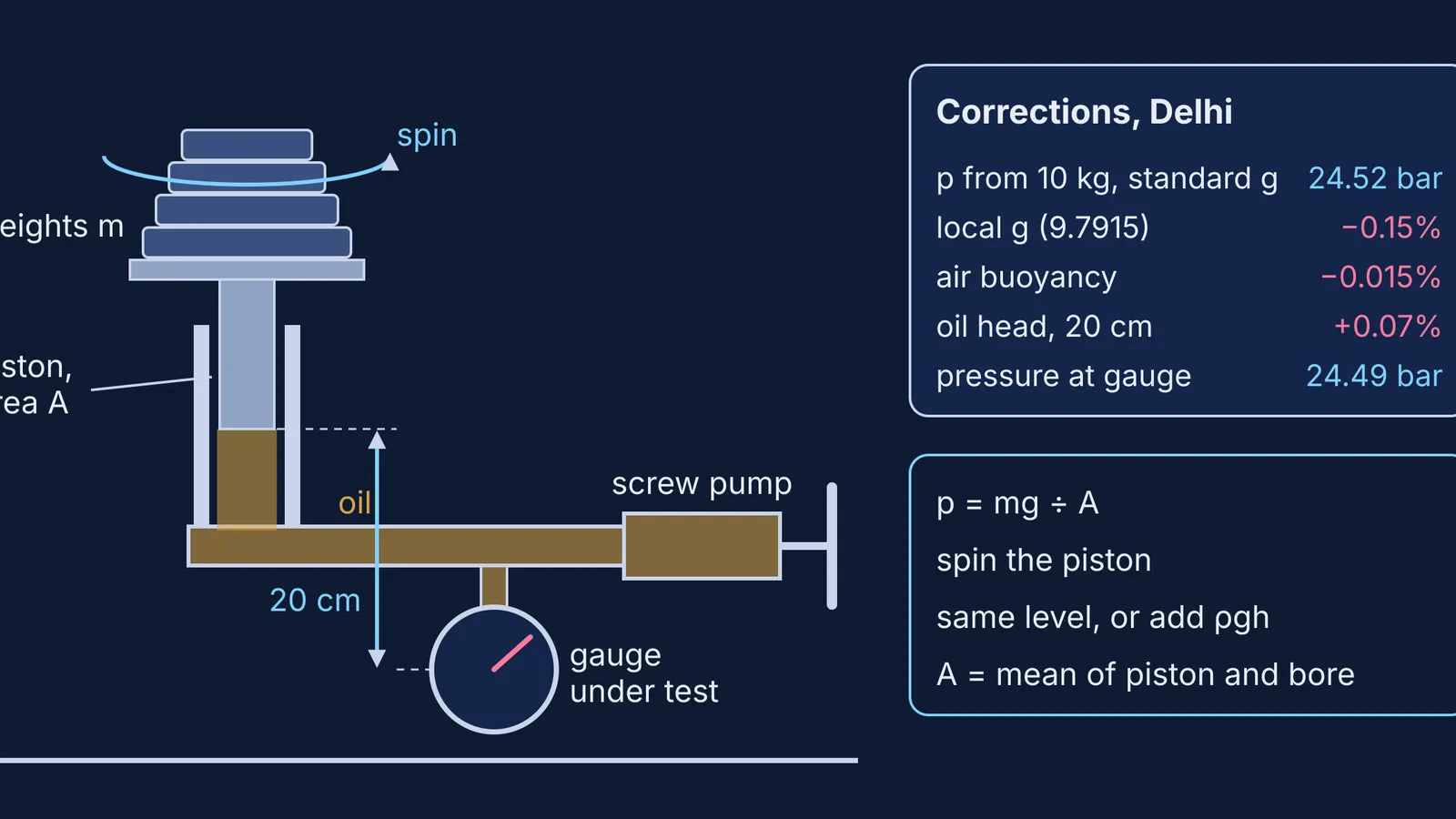
A dead-weight tester is a vertical piston that fits a cylinder with a gap of about a micrometre. The cylinder sits on a closed oil system. A screw pump pushes oil in, and the gauge under test is screwed into a side port on the same oil line.
You place calibrated disc weights on a carrier on top of the piston and wind the screw pump until the piston and its weights float, lifted clear of their stops. At that moment the piston is in equilibrium. The upward push of the oil on the piston's area balances the weight of the piston and discs:
p × A = m × g, so p = mg/A
By Pascal's law, the same pressure acts everywhere in the connected oil at that level, including at the gauge. You compare the gauge reading with mg/A, then change the discs for the next point.
This is the reverse of a hydraulic lift. In Pascal's law and hydraulic machines, a small force on a small piston becomes a large force on a large one. Here nothing is lifted. The point is that a known weight on a known area makes a known pressure.
How does 10 kg on 0.4 cm² make 24.5 bar?
Here is the worked example, with illustrative but realistic values.
Data. Piston plus discs: m = 10.000 kg. Piston area: A = 0.4000 cm² = 4.000 × 10⁻⁵ m². That is a piston about 7.14 mm across.
Force with standard gravity. g = 9.80665 m/s², so F = 10.000 × 9.80665 = 98.07 N.
Pressure. p = 98.07 ÷ (4.000 × 10⁻⁵) = 2.452 × 10⁶ Pa = 2.452 MPa.
In bar. 1 bar = 10⁵ Pa, so p = 24.52 bar.
Check units. kg × m/s² ÷ m² = N/m² = Pa.
Which pressure is this? The top of the piston is open to the room, so the atmosphere pushes down on it as well as up through the oil. Those cancel, and mg/A is the pressure above atmospheric: a gauge pressure. That is what an ordinary dial gauge reads, as explained in gauge pressure vs absolute pressure. To make absolute pressure, you would need a vacuum above the piston.
Why does a tester calibrated for standard gravity read wrong in Delhi?
The weights are certified as masses, but what pushes on the piston is their weight, mg. The value 9.80665 m/s² is a defined standard, not the gravity in any particular lab. Real g changes with latitude and height above sea level.
Fluke, a maker of these testers, notes that local gravity varies by up to about 0.5% around the world and is typically the largest environmental correction on a dead-weight tester. Where no gravity survey exists, it points users to online calculators such as Germany's national metrology institute's PTB g-Extractor, which uses the GRS80 normal gravity formula from latitude and height.
For New Delhi (about 28.6° N, 216 m above sea level) that formula gives g ≈ 9.7915 m/s². PTB states the relative uncertainty of this method as about 1 part in 10⁴, so treat the last digit as approximate. A measured value from a local survey would be better.
Ratio. 9.7915 ÷ 9.80665 = 0.99846.
Correction. The true pressure is 0.15% lower: 24.52 × 0.99846 = 24.48 bar.
Size. That is 3.8 kPa.
Makers handle this in two ways: they adjust the masses so the tester is correct at your local g, or they calibrate at standard g and you correct each reading by the ratio of local to standard g.
What other corrections does a dead-weight tester need?
Air buoyancy. The steel discs sit in air, which pushes up on them with a force equal to the weight of the air they displace. The fraction is the density of air divided by the density of steel, about 1.2 ÷ 7,900 = 0.015%. That lowers the pressure by about 0.37 kPa. This is the same effect as in why 1 kg of water reads 998.95 g on a balance, but much smaller here because steel is far denser than water.
Oil head. p = mg/A holds at the bottom face of the piston. If the gauge sits 20 cm lower, the oil column above it adds ρgh. With oil of density 870 kg/m³: 870 × 9.7915 × 0.20 = 1.70 kPa, which is +0.07%. If the gauge were above the piston, you would subtract it.
Effective area. Oil leaks up the tiny gap and drags on the piston, so the area that counts is neither the piston's nor the bore's. It lies between the two. A NIST paper on a dead-weight tester used as a primary standard takes the zero-pressure effective area as the mean of the piston and cylinder areas, measured dimensionally. For our 7.14 mm piston, a radial gap of just 1 µm makes the bore's area 0.056% larger than the piston's. Using the piston area alone would be off by about 0.028%, nearly twice the buoyancy correction.
Friction. Before each reading, the piston and weights are set spinning. Rotation keeps an even oil film all round the piston and turns any rubbing into a sideways drag, so friction does not hold the piston up or down.
How accurate is a real dead-weight tester?
Put all three corrections together for the Delhi lab:
Local g: 24.516 bar becomes 24.479 bar.
Air buoyancy: subtract 0.015%, giving 24.475 bar.
Oil head: add 0.017 bar, giving 24.492 bar.
So the gauge truly sees about 24.49 bar, 0.10% below the 24.52 bar you get from mg/A with standard g.
Is that difference worth chasing? A common hydraulic tester such as the Fluke P3100 is specified at ±0.015% of reading from 10% to 100% of its range, when used with the corrections on its calibration certificate. At 24.5 bar, 0.015% is 0.37 kPa. Ignoring local gravity would cause an error ten times larger than that, so the tester would no longer meet its own specification.
If you want to try more problems that combine p = F/A with a ρgh head, the Fermi Problem Library has a step-by-step solver that explains the reasoning at each stage.
Quick checklist
A dead-weight tester floats a piston on oil, so p = mg/A at the piston's base.
With the top open to air, it makes gauge pressure, not absolute pressure.
10.000 kg on 0.4000 cm² with standard g gives 2.452 MPa, 24.52 bar.
Use local g: in Delhi about 9.7915 m/s², 0.15% below standard.
Air buoyancy on steel weights: about −0.015%.
Gauge below the piston base: add ρgh; above it: subtract.
Effective area lies between the piston's and the bore's areas; spin the piston before reading.


