

On this page
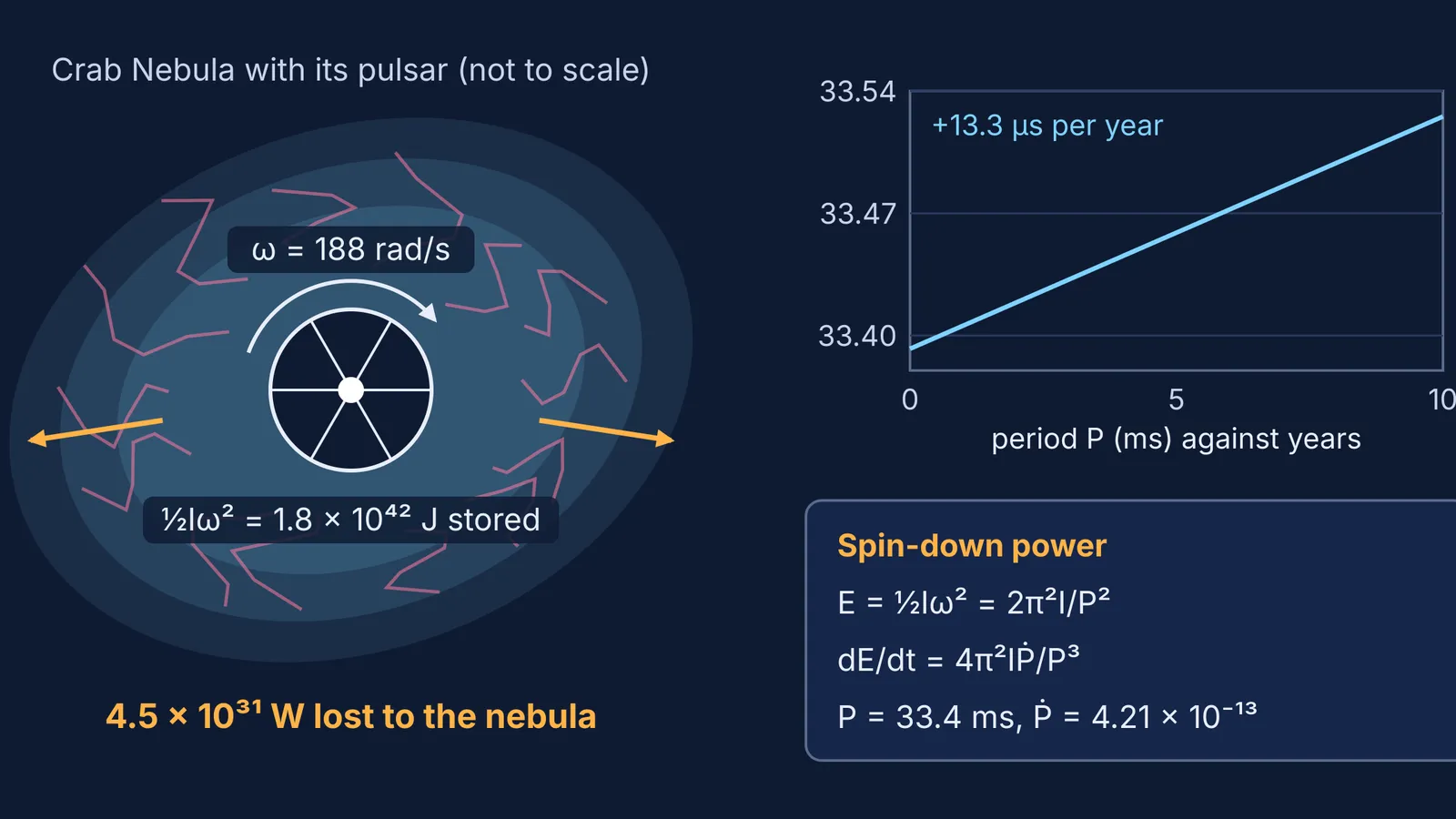
At the centre of the Crab Nebula sits a neutron star about 20 km across that spins 30 times a second. Each turn sweeps a beam of radio waves past Earth, so we see it as a pulsar. Its period gets longer by about 13 microseconds every year. That tiny slow-down, together with one formula from rotational mechanics, tells you how much power the star is losing: about 4.5 × 10³¹ W. This post works that number out and shows why it answered an old question about what keeps the whole nebula shining.
How fast does the Crab pulsar spin, and how do we know it is slowing?
The ATNF Pulsar Catalogue, the standard reference list of known pulsars kept by Australia's CSIRO, gives for the Crab pulsar (PSR B0531+21):
period P = 0.0333924 s, about 33.4 ms
period derivative Ṗ = 4.21 × 10⁻¹³ s per second
Ṗ is a rate: seconds of period gained per second of time, so it has no units. Multiply by the number of seconds in a year, 3.156 × 10⁷, and you get 1.33 × 10⁻⁵ s, or 13.3 µs gained every year. That is 0.04% of the period per year, small but easy to measure, because radio telescopes time each pulse very precisely. The same pulsar is used for a very different measurement in how pulsar dispersion reveals the electrons in space.
How much rotational energy does a neutron star store?
A spinning body stores kinetic energy E = ½Iω², the same formula used for a machine in how to calculate the energy stored in a flywheel. The hard part is the moment of inertia I.
Nobody has measured I for a neutron star. A uniform sphere of 1.4 solar masses (2.8 × 10³⁰ kg) and radius 10 km has I = (2/5)MR² = 1.1 × 10³⁸ kg m². Real neutron stars are denser at the centre, and the radius is uncertain, so astronomers use a round model value of 10³⁸ kg m². Treat every result below as good to perhaps a factor of two.
With ω = 2π/P = 2π/0.0333924 = 188 rad/s:
E = ½ × 10³⁸ × 188² = 1.8 × 10⁴² J.
That is what the Sun gives out in about 150 million years, stored as spin.
How do you get the spin-down power from P and Ṗ?
Write the energy in terms of the period. Since ω = 2π/P,
E = ½I(2π/P)² = 2π²I/P².
Differentiate with respect to time. P is the only thing that changes, and d(P⁻²)/dt = −2P⁻³Ṗ, so
dE/dt = −4π²IṖ/P³.
The minus sign says the star is losing energy. The power lost is 4π²IṖ/P³.
Worked example: the Crab pulsar's power
Write down the data. P = 0.0333924 s, Ṗ = 4.21 × 10⁻¹³, I = 10³⁸ kg m².
Numerator. 4π² × 10³⁸ × 4.21 × 10⁻¹³ = 39.48 × 4.21 × 10²⁵ = 1.66 × 10²⁷.
Denominator. P³ = 0.0333924³ = 3.72 × 10⁻⁵ s³.
Divide. 1.66 × 10²⁷ / 3.72 × 10⁻⁵ = 4.5 × 10³¹ W.
Check the units. (kg m²)(s/s)/s³ = kg m² s⁻³ = J/s = W. Good.
Compare. The Sun gives out 3.83 × 10²⁶ W, so the pulsar loses energy about 117,000 times faster than the Sun shines.
The catalogue lists the same figure, 4.5 × 10³⁸ erg/s, because it uses the same model value of I. In one year the star loses 1.4 × 10³⁹ J, only 0.08% of its stored spin energy, which is why the period changes so slowly.
Does that power really light the Crab Nebula?
The Crab Nebula is the remains of a star whose explosion was recorded in 1054. It glows by synchrotron radiation: very fast electrons spiralling in a magnetic field. Such electrons lose their energy within years to centuries, so something must keep supplying new energy, or the nebula would have faded long ago.
In 1967, before pulsars were found, Franco Pacini suggested that a spinning, magnetised neutron star could feed energy into the nebula. In 1968 Thomas Gold argued that pulsars are rotating neutron stars and that their periods should slowly grow. The Crab pulsar was found later in 1968, and its slow-down was soon measured.
A review by Jeff Hester in Annual Review of Astronomy and Astrophysics (2008) gives the nebula's glow as about 1.3 × 10³⁸ erg/s, which is 1.3 × 10³¹ W. That is about 30% of the 4.5 × 10³¹ W the pulsar loses. The rest goes into the magnetic field and fast particles that fill the nebula and push it outwards, so the two numbers are not supposed to be equal. What matters is that the spin-down power is more than enough. That is why the pulsar is accepted as the power source.
How the same star got its huge magnetic field, which is what couples the spin to the surrounding gas, is covered in why a neutron star's magnetic field reaches 100 million tesla.
What does the characteristic age P/2Ṗ tell you?
If the braking makes P × Ṗ stay constant, which is what a simple spinning magnet predicts, and the star was born spinning much faster than now, its age is
τ = P/(2Ṗ) = 0.0333924 / (2 × 4.21 × 10⁻¹³) = 3.97 × 10¹⁰ s = 1,260 years.
The true age is known from the historical record: about 972 years since 1054. The estimate is the right size but about 30% too large, because the real braking law is not exactly the simple one and the star was not born spinning infinitely fast. That is why astronomers call τ a "characteristic" age and treat it as an estimate.
One more number for scale: if the radius is 10 km, the equator moves at ωR = 188 × 10⁴ = 1.9 × 10⁶ m/s, about 1,880 km/s, or 0.6% of the speed of light.
If you want to see how ½Iω² changes as a body spins down, the Simulation Lab has interactive simulations for ideas that are easier to see than read.
Quick checklist
Rotational energy: E = ½Iω² = 2π²I/P².
Spin-down power: 4π²IṖ/P³, with P in seconds and Ṗ in s per s.
Crab pulsar: P = 33.4 ms, Ṗ = 4.21 × 10⁻¹³, about 13 µs longer each year.
With I ≈ 10³⁸ kg m², the star stores 1.8 × 10⁴² J and loses 4.5 × 10³¹ W.
The nebula radiates about 30% of that; the spin-down power is the energy source, not equal to the glow.
P/2Ṗ = 1,260 years is an estimate; the true age is about 972 years.


