

On this page
NCERT biology tells you that methanogens such as Methanobacterium live in the rumen of cattle. It does not say why, or why a cow on a grain-rich diet makes less methane than one fed mostly straw. The answer is Class 11 chemistry: balancing equations and counting electrons with oxidation numbers. Rumen microbes make hydrogen as a by-product, and methane is how the cow gets rid of it.
Where does the methane in a cow come from?
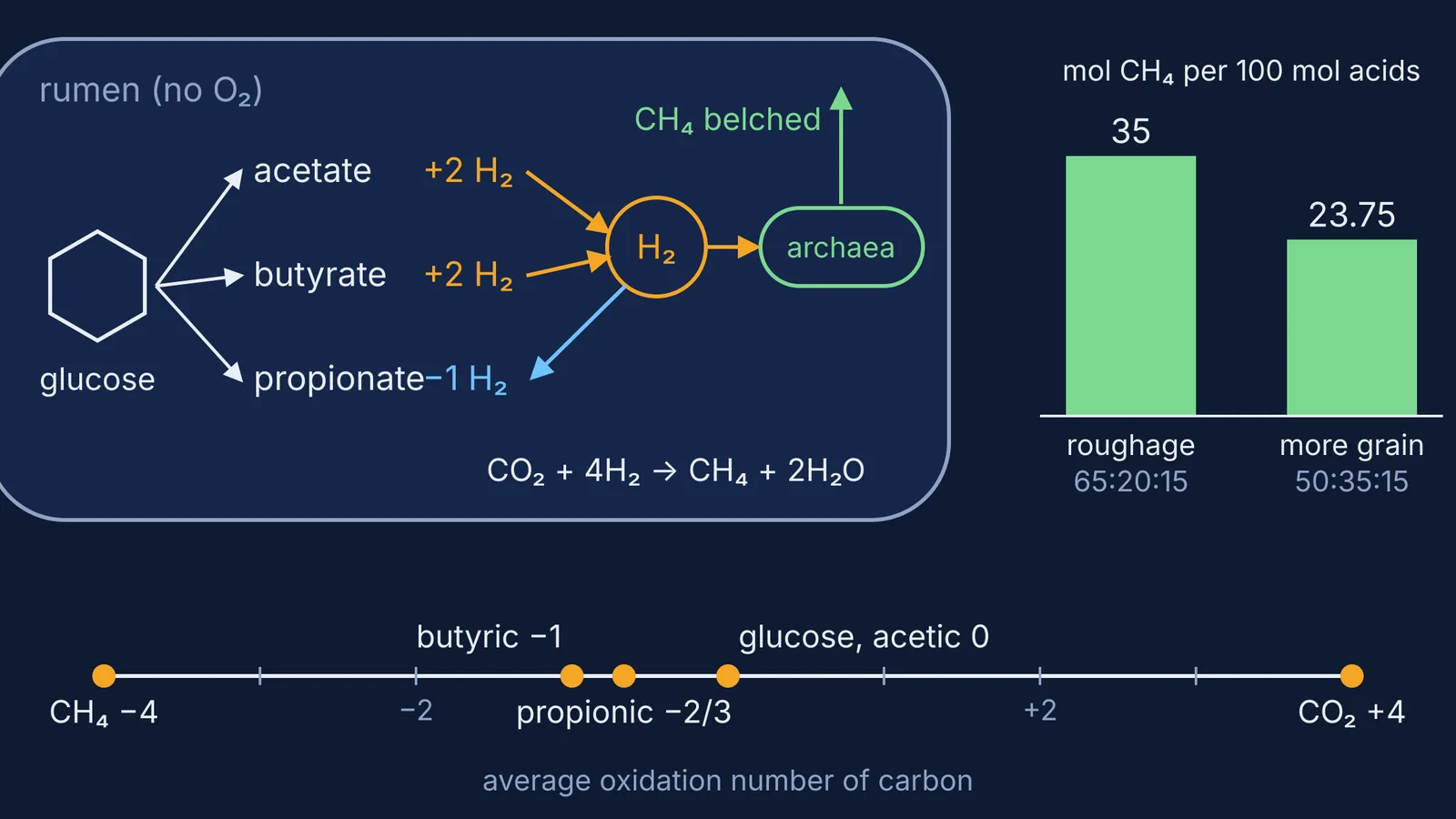
The rumen is a large, warm, oxygen-free fermentation vat. Bacteria, protozoa and fungi break cellulose from grass and straw down to glucose. They then ferment the glucose, not to carbon dioxide and water (there is no oxygen), but to three short-chain fatty acids, also called volatile fatty acids: acetic acid, propionic acid and butyric acid. The cow absorbs these acids through the rumen wall and uses them as its main fuel.
Some of these fermentations release hydrogen gas. If H₂ builds up, fermentation slows down, so it has to be removed. Methanogens, which are archaea, do this by using H₂ to reduce CO₂:
CO₂ + 4H₂ → CH₄ + 2H₂O
The methane is belched out. (In flooded rice fields, methanogens also split acetate directly; that route and the soil chemistry are in our post on why paddy fields release methane. In the rumen, the H₂ route is the main one: acetate-splitting methanogens grow too slowly to keep up with the flow of rumen contents, and the cow absorbs the acetate as food.)
How do you balance the rumen fermentation equations?
Write each fatty acid in its acid form, then balance C, H and O.
Acetate: C₆H₁₂O₆ + 2H₂O → 2CH₃COOH + 2CO₂ + 4H₂
Butyrate: C₆H₁₂O₆ → CH₃CH₂CH₂COOH + 2CO₂ + 2H₂
Propionate: C₆H₁₂O₆ + 2H₂ → 2CH₃CH₂COOH + 2H₂O
Check the acetate equation. Carbon: 6 = 4 + 2. Hydrogen: 12 + 4 = 16 on the left; 8 + 8 = 16 on the right. Oxygen: 6 + 2 = 8; 4 + 4 = 8. The other two check the same way.
Per mole of fatty acid, that is +2 H₂ per acetate, +2 H₂ per butyrate and −1 H₂ per propionate (propionate uses hydrogen).
Why do acetate and butyrate make hydrogen but propionate uses it?
Use the average oxidation number of carbon, worked out as in our guide to the oxidation state of carbon in organic compounds. Take H as +1 and O as −2, and share the total among the carbons.
Glucose, C₆H₁₂O₆: 6x + 12 − 12 = 0, so x = 0.
Acetic acid, C₂H₄O₂: 2x + 4 − 4 = 0, so x = 0.
Butyric acid, C₄H₈O₂: 4x + 8 − 4 = 0, so x = −1.
Propionic acid, C₃H₆O₂: 3x + 6 − 4 = 0, so x = −2/3.
CO₂: +4. CH₄: −4.
Now count electrons. Each H₂ formed from H⁺ carries away 2 electrons.
Acetate route: six carbons at 0 become four at 0 and two at +4. Total change: +8, so 8 electrons are released, which is 4 H₂.
Butyrate route: four carbons at −1 and two at +4 give a total of −4 + 8 = +4. That releases 4 electrons, or 2 H₂.
Propionate route: six carbons at −2/3 total −4. The carbons have gained 4 electrons, so 2 H₂ are taken up.
Propionic acid is more reduced than glucose, so making it soaks up electrons. Methanogenesis completes the books: carbon goes from +4 in CO₂ to −4 in CH₄, taking 8 electrons, which is why it needs 4H₂.
Worked example: how much methane per 100 mol of fatty acids?
This hydrogen balance is a model first set out by M. J. Wolin in 1960. It ignores hydrogen used for microbial growth and other minor sinks, but it shows the main effect clearly. The two diets below are illustrative. In real cattle, acetate is usually about 50–70% of the total, and grain-rich diets raise the propionate share (see the review by Bergman, 1990).
Diet 1, mostly roughage. Acetate : propionate : butyrate = 65 : 20 : 15.
H₂ made: 2 × 65 (acetate) + 2 × 15 (butyrate) = 160 mol.
H₂ used by propionate: 1 × 20 = 20 mol.
Net H₂: 160 − 20 = 140 mol.
Methane: 4 H₂ give 1 CH₄, so 140 ÷ 4 = 35 mol CH₄.
The same steps in one line give Wolin's equation: CH₄ = 0.5A − 0.25P + 0.5B, where A, P and B are moles of each acid. Here 32.5 − 5 + 7.5 = 35.
Check the carbon. Glucose used: 65/2 + 20/2 + 15 = 57.5 mol, which is 345 mol of carbon. Carbon out: 130 in acetate + 60 in propionate + 60 in butyrate + 60 in net CO₂ (95 made, 35 used by methanogens) + 35 in CH₄ = 345. It balances.
Diet 2, more grain. 50 : 35 : 15.
CH₄ = 0.5(50) − 0.25(35) + 0.5(15) = 25 − 8.75 + 7.5 = 23.75 mol CH₄.
That is 23.75 ÷ 35 = 0.68 of Diet 1, about one-third less methane for the same 100 mol of fatty acids.
How much energy leaves as methane? Both diets ferment 57.5 mol of glucose. Using approximate standard enthalpies of combustion, 2,803 kJ/mol for glucose and 890 kJ/mol for methane:
Energy in the glucose: 57.5 × 2,803 ≈ 161,000 kJ.
Diet 1: 35 × 890 = 31,150 kJ, which is about 19% of it.
Diet 2: 23.75 × 890 ≈ 21,100 kJ, which is about 13%.
That methane is energy the cow ate but could not use: wasted feed as well as a greenhouse gas.
The IPCC factor comes from the 2006 IPCC Guidelines, Volume 4 (Agriculture, Forestry and Other Land Use), chapter 10.
Why does diet change how much methane a cow makes?
Straw and dry fodder are mostly cellulose, which is fermented slowly and mainly to acetate. Grain is rich in starch, which is fermented faster, and the microbes that grow on it make more propionate. More propionate means more H₂ is used up inside the fermentation, so less is left for methanogens. Your worked example shows the size of the effect.
There is a limit. Very high-grain diets can make the rumen too acidic and harm the animal, so more grain is not a simple fix.
The numbers matter in India. The 20th Livestock Census (2019) counted about 192 million cattle and 110 million buffaloes, and every one of them carries a rumen. If balancing by oxidation number still feels slow, the Fermi Concept Library gives each chemistry concept its own lesson and shows where it fits.
Checklist
Rumen microbes ferment glucose to acetic, propionic and butyric acids.
Per mole: acetate +2 H₂, butyrate +2 H₂, propionate −1 H₂.
Average carbon oxidation numbers: glucose 0, acetic 0, butyric −1, propionic −2/3, CO₂ +4, CH₄ −4.
Methanogens remove H₂: CO₂ + 4H₂ → CH₄ + 2H₂O.
Wolin's model: CH₄ = 0.5A − 0.25P + 0.5B.
65 : 20 : 15 gives 35 mol CH₄; 50 : 35 : 15 gives 23.75 mol, about one-third less.
The 19% is a share of fermented glucose energy, not the IPCC's share of gross energy.


