

On this page
On a long flight you sit about 11 km up, above roughly three-quarters of the atmosphere. That air is what shields you from cosmic rays at ground level, so the radiation dose rate in the cabin is much higher than at home. How much higher, and what it adds up to over a 10-hour flight, follows from one idea from Class 11 physics: the mass of air above you per square metre.
Why are cosmic rays stronger at cruising height?
Cosmic rays are fast charged particles, mostly protons, arriving from space. When one hits a nucleus in the upper atmosphere it produces a shower of secondary particles: neutrons, protons, muons, electrons and gamma rays. Many of these are absorbed on the way down. Victor Hess found that radiation rises with height on his balloon flights, as told in how Victor Hess discovered cosmic rays.
What stops the particles is matter, so the useful measure of the shield is not its thickness in kilometres but its mass per unit area. A column of air of cross-section A above you has weight pA, where p is the pressure at your height. Its mass per unit area is therefore:
mass per unit area = p/g
Pressure falls with height for the reasons explained in why atmospheric pressure decreases with height, so the shield thins as you climb.
Worked example: how much shielding is left at 11 km?
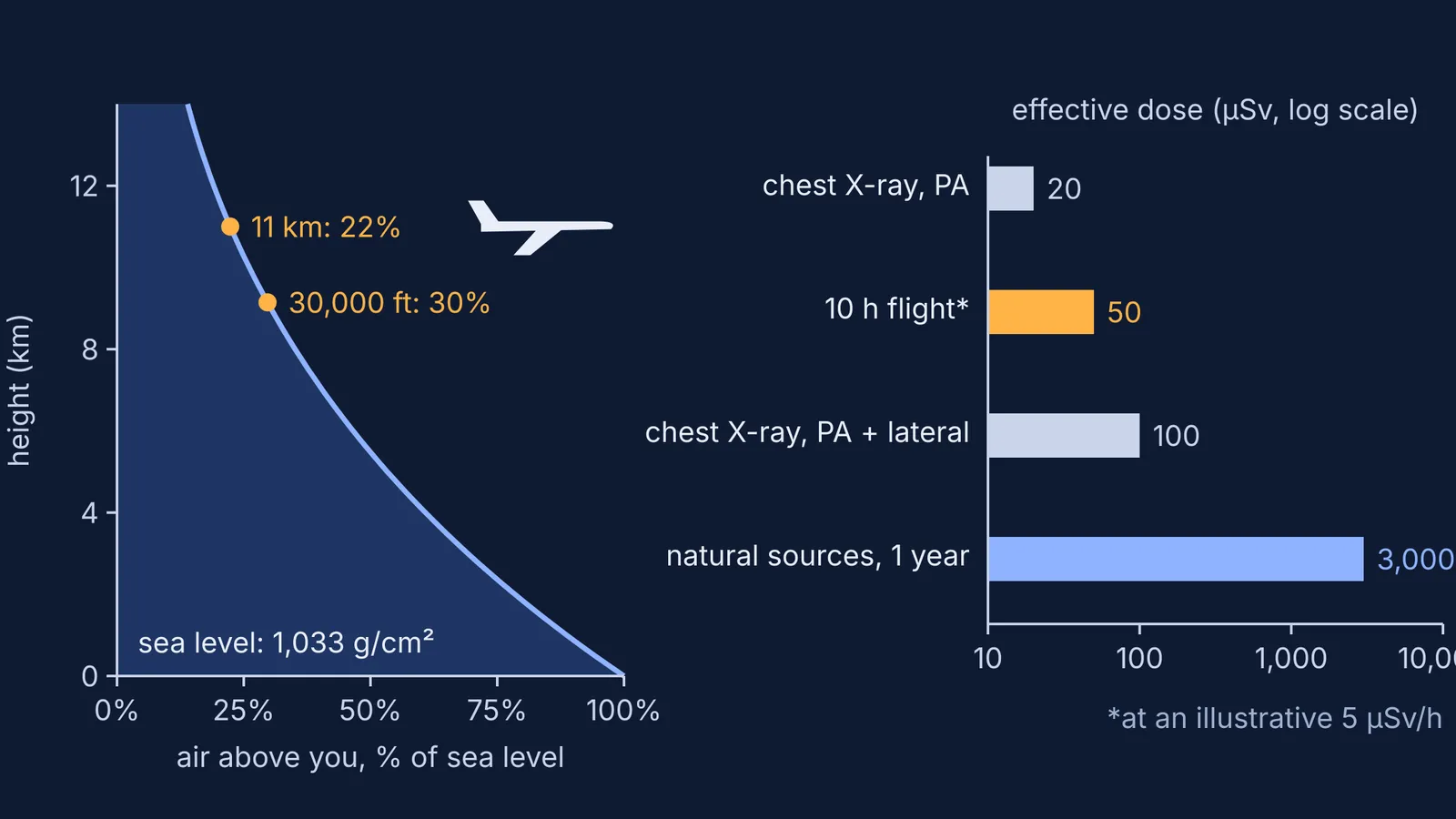
Sea level. p = 101,325 Pa and g = 9.81 m/s². p/g = 101,325/9.81 = 10,330 kg/m², which is 1,033 g/cm².
Compare with water. Water has density 1,000 kg/m³, so 10,330 kg/m² is the mass of a 10.3 m deep column of water. The air above you at sea level shields you about as well as 10 m of water.
At 11 km. The standard atmosphere gives p = 22.6 kPa. p/g = 22,600/9.81 = 2,304 kg/m² = 230 g/cm².
Fraction left. 22.6/101.3 = 0.22, so only 22% of the shield is above you. That is about 2.3 m of water.
Check units. Pa/(m/s²) = (N/m²)/(m/s²) = (kg m s⁻²/m²)/(m s⁻²) = kg/m², a mass per area, as it should be.
Check against a source. At 30,000 ft (9.14 km) the same method gives p = 30.1 kPa, 30% of the sea-level value. The US Federal Aviation Administration's guide for aircrew, What Aircrews Should Know About Their Occupational Exposure to Ionizing Radiation (2026), says the same: at 30,000 ft about 30% of the shield is above the aircraft.
p/g explains the trend, not the exact dose rate. The secondary particles build up as the shower develops, so the particle count peaks high in the atmosphere and then falls towards the ground. The dose rate at 11 km is many times the ground-level rate, not simply 1/0.22 times it.
Why does the dose depend on latitude and the Sun?
Earth's magnetic field deflects charged particles. Near the geomagnetic equator, only very energetic particles get through; near the poles, the field lines point down and let lower-energy particles in. The FAA guide gives an example: at 35,000 ft, the galactic cosmic radiation level over Anchorage, Alaska is about double that over Miami and roughly triple that over Guam. Flights at Indian latitudes are among the better shielded; routes that pass over high latitudes get more.
The Sun matters too. Over its roughly 11-year cycle, the solar wind is strongest near solar maximum and pushes away more galactic cosmic rays, so flight doses are somewhat lower then. Rarely, a large solar eruption adds a burst of solar particles.
How much radiation do you get on a 10-hour flight?
Dose here means effective dose, measured in sieverts, which weights the energy absorbed by the type of radiation and the organs exposed. The unit and its history are in how Rolf Sievert measured radiation risk. 1 mSv = 1,000 µSv.
Real dose rates depend on altitude, latitude and the solar cycle, and calculators such as the FAA's CARI program work them out route by route. For a worked example, take a round illustrative value of 5 µSv per hour at cruising height.
10-hour flight. 10 h × 5 µSv/h = 50 µSv = 0.05 mSv.
16-hour flight. 16 × 5 = 80 µSv.
Check against the FAA. The FAA guide says galactic cosmic radiation doses per flight range from under 0.2 µSv on a short commuter hop to more than 100 µSv on some long flights such as New York to Tokyo, which crosses high latitudes. 50 µSv for 10 hours sits within that range.
Compare with ground level. UNSCEAR's 2026 evaluation of public exposure, summarised in this UN Information Service release, puts the worldwide average dose from natural sources at about 3.0 mSv a year, of which cosmic radiation at ground level is 0.3 mSv. 50 µSv is 50/3,000 = 1.7% of a year's natural dose, the amount the average person receives from natural sources in about 6 days.
How does a flight compare with a chest X-ray?
A published catalogue of medical doses, Mettler and colleagues in Radiology (2008), lists an average effective dose of 0.02 mSv (20 µSv) for a single posteroanterior (PA) chest X-ray, with a range of 0.007 to 0.050 mSv, and 0.1 mSv (100 µSv) for a PA and lateral pair. On those numbers, the illustrative 50 µSv flight lies between one single-view chest X-ray and a two-view study. The comparison is rough, because both the flight dose and the X-ray dose vary several-fold.
For passengers, the International Commission on Radiological Protection is clear. In ICRP Publication 132, it says that for occasional passengers, exposure to cosmic radiation is considered negligible in the context of their total radiation exposure.
Why are aircrew treated as radiation workers?
Crew fly hundreds of hours every year. The FAA guide cites UNSCEAR's estimate that aircrew receive about 2.7 mSv a year on average from their work, making them one of the most occupationally exposed groups. ICRP Publication 132 recommends that the exposure of aircraft crew be treated as occupational exposure, with doses assessed, usually by validated calculation programs, and recorded.
A quick check: if a crew member logs an illustrative 800 hours a year, 2.7 mSv ÷ 800 h = 3.4 µSv per hour on average, a little below cruising rates because climbs and descents happen in thicker air.
To practise problems like this one, where pressure, mass and units come together, the Fermi Problem Library has a step-by-step solver that explains the reasoning.
Quick checklist
Shielding by air = mass per area = p/g.
Sea level: 1,033 g/cm² (like 10.3 m of water). At 11 km: 230 g/cm², 22% of it.
p/g gives the trend; the shower of secondary particles sets the exact dose rate.
Higher altitude and higher latitude mean a higher dose rate; solar maximum lowers it slightly.
Illustrative 5 µSv/h × 10 h = 50 µSv, about 1.7% of the 3.0 mSv yearly natural dose.
PA chest X-ray: about 0.02 mSv; PA and lateral: about 0.1 mSv (Mettler 2008).
ICRP: occasional passengers' cosmic dose is negligible; aircrew exposure is occupational.


