

On this page
In the early days of X-rays and radiotherapy, doctors had no precise way to measure the radiation their patients—and they themselves—were absorbing. Rolf Maximilian Sievert changed that.
Who was Rolf Sievert?
Rolf Maximilian Sievert was a Swedish medical physicist who dedicated his career to the biological effects of ionising radiation. Born in Stockholm in 1896, Sievert played a pioneering role in making radiation safe for hospital use, as detailed in his Wikipedia biography.
From 1924 to 1937, he headed the physics laboratory at Sweden's Radiumhemmet, an early cancer treatment centre in Stockholm. Radiotherapy was a new and powerful weapon against cancer, but without careful measurement, radiation could cause horrific burns and secondary tumours. Sievert worked out how to measure radiation accurately so doctors could target tumours without dangerously overexposing healthy tissue.
Recognising that radiation safety was a global problem, he helped found the International X-ray and Radium Protection Committee (IXRPC) in 1928, serving as its first chairman. To honour his legacy, the scientific community named the SI unit of equivalent radiation dose after him. Today, the sievert (Sv) is the worldwide standard for representing the stochastic health risk of radiation.
What is the difference between a gray and a sievert?
When learning about radiation, you will encounter two main units that are often confused.
The gray (Gy) measures the physical amount of radiation energy deposited in matter. By definition, 1 gray equals 1 joule of energy absorbed per kilogram of tissue, as explained by the SI definition of the unit. If a patient's leg absorbs a specific amount of X-ray energy, the gray tells you the sheer physical impact of that beam.
However, the physical energy does not tell the whole biological story. The sievert (Sv) measures the equivalent biological effect. Like the gray, 1 sievert corresponds to 1 joule per kilogram, but it accounts for the fact that different types of radiation cause wildly different amounts of damage to human cells.
To convert from a physical dose to a biological one, you multiply the absorbed dose in grays by a radiation weighting factor (WR).
Why is alpha radiation weighting higher?
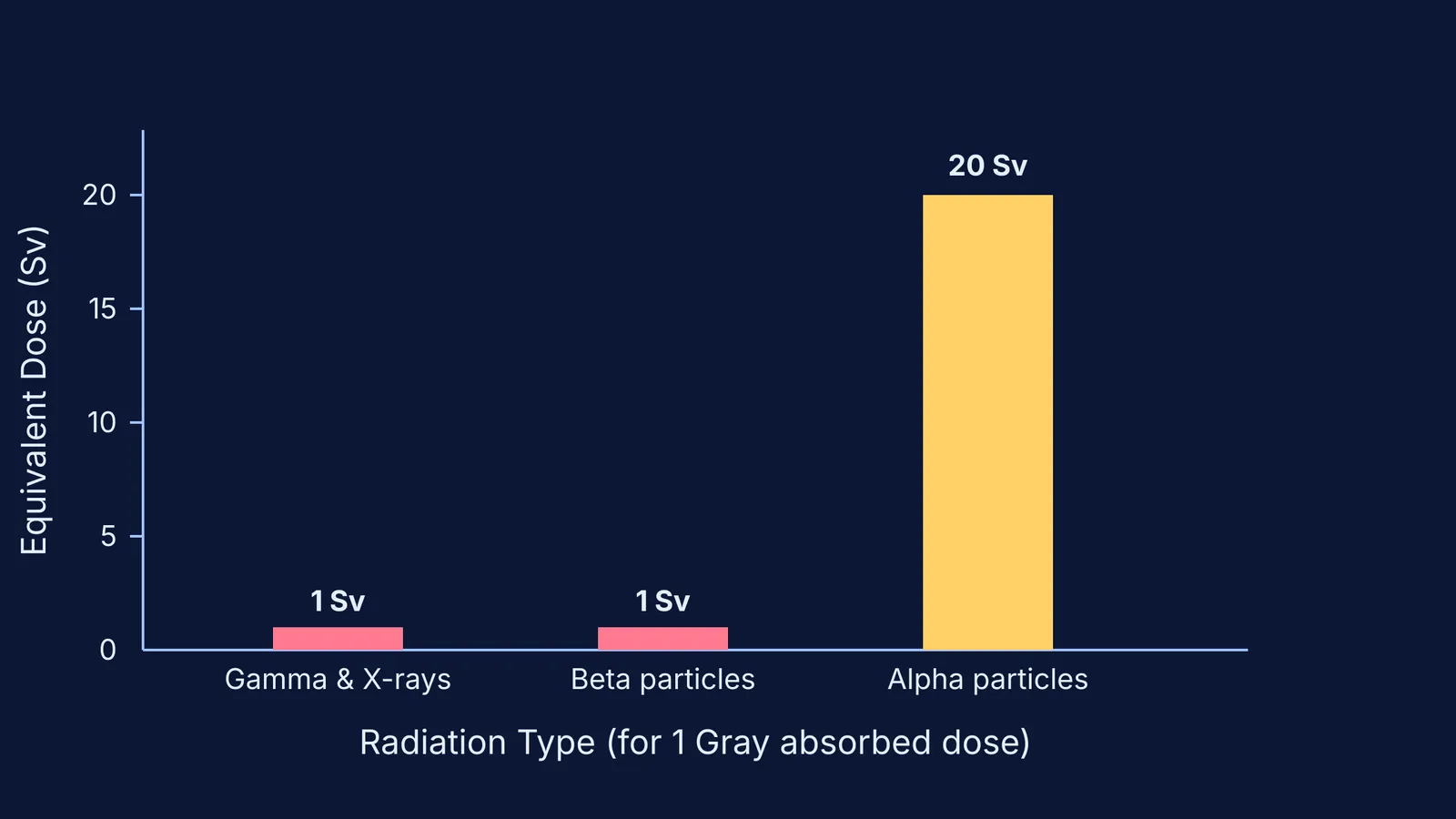
Not all radiation interacts with tissue in the same way. Photons, such as X-rays and gamma rays, travel right through the body and spread their energy out over a large volume. They have a weighting factor of 1, and beta particles (high-speed electrons) behave similarly, also taking a weighting factor of 1, as listed in the standard radiation weighting factors.
Alpha particles, however, have a weighting factor of 20. This means that for the exact same amount of physical energy deposited, alpha radiation is 20 times more damaging to living tissue than an X-ray.
Why is this the case? Alpha particles are heavy—made of two protons and two neutrons—and carry a +2 electrical charge. When they hit living tissue, they smash into many molecules over a very short microscopic distance, losing all their energy rapidly. If an alpha emitter is inhaled or swallowed, it causes intensely concentrated damage to local DNA, severely disrupting the cell's ability to repair itself. This difference in mass and charge is why understanding the recoil of the daughter nucleus in alpha decay and counting alpha and beta decays in a radioactive decay series is so heavily tested in modern physics.
If you are preparing for exams and these radiation concepts feel overwhelming or disconnected, Fermi's AI tutor can work out what you already know and build a plan for the session.
How do you calculate equivalent dose?
The International Commission on Radiological Protection (ICRP), the modern successor to Sievert's 1928 committee, relies on the sievert to set safe exposure limits globally. In their Publication 103, the ICRP states that the recommended annual public dose limit for artificial radiation is 1 mSv, according to the 2007 ICRP Recommendations.
For occupational workers—such as nuclear engineers or hospital radiographers—the limit is set much higher at 20 mSv per year, averaged over a five-year period. Similar tracking methods were pioneered early on by George de Hevesy and radioactive tracers to monitor biological pathways without triggering radiation sickness.
Here is a practical worked example to show how these units appear in physics and chemistry problems.
Question: A tissue mass of 2 kg accidentally absorbs 0.04 J of energy from an internal alpha radiation source. What is the equivalent dose in sieverts?
1. Find the absorbed dose in grays The absorbed dose is the total physical energy divided by the mass. Absorbed dose = 0.04 J / 2 kg = 0.02 Gy.
2. Identify the correct weighting factor For alpha radiation, the radiation weighting factor (WR) is 20.
3. Calculate the equivalent dose Multiply the physical dose by the weighting factor. Equivalent dose = 0.02 Gy × 20 = 0.4 Sv.
The final equivalent dose is 0.4 Sv, or 400 mSv. Even though the physical energy was just a fraction of a joule, the biological risk is substantial because of the alpha particles' high weighting factor. If you want to dive deeper into the formulas behind atomic physics and practice more calculations like this, the Fermi Concept Library has every concept in physics, chemistry, biology, mathematics and computing, each with its own lesson and its place in the map.


