

On this page
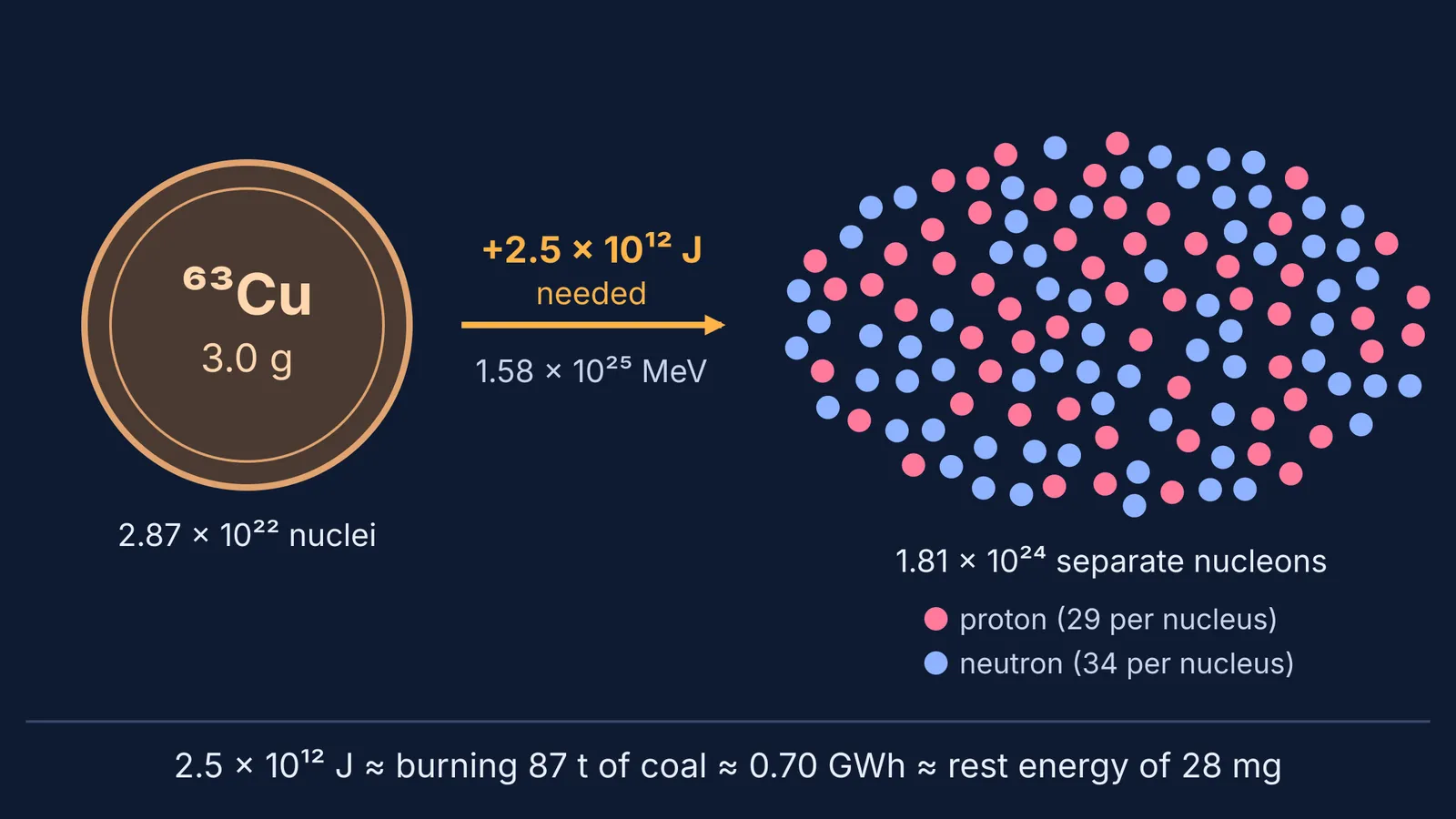
A copper coin weighs a few grams and sits in your pocket doing nothing. The NCERT Class 12 chapter on nuclei asks a sharp question about it: how much energy would you need to pull every proton and neutron in a 3.0 g coin completely apart? Assume the coin is made only of copper-63, with an atomic mass of 62.92960 u. The answer is about 1.58 × 10²⁵ MeV, or 2.5 × 10¹² J. That is roughly the heat from burning 87 tonnes of coal, all locked into the nuclei of one small coin.
What does the question ask you to find?
The total nuclear binding energy of every nucleus in the coin. Binding energy is the energy needed to split a nucleus into its separate protons and neutrons. So you do it in two parts:
Find the binding energy of one ⁶³Cu nucleus from its mass defect.
Multiply by the number of nuclei in 3.0 g.
The first part is the same mass-defect calculation you do for any single nucleus. How binding energy per nucleon varies across the periodic table is covered in the binding energy per nucleon curve, with a worked example, so it is not repeated here. What is new is scaling one nucleus up to a coin you can hold.
Why use the hydrogen-atom mass and not the proton mass?
Copper-63 has Z = 29 protons and N = 63 − 29 = 34 neutrons. The mass you are given, 62.92960 u, is the mass of the neutral atom. It includes 29 electrons.
If you subtract that from 29 bare proton masses plus 34 neutron masses, the 29 electron masses are left over on one side. To make them cancel, use the mass of a hydrogen atom, 1.007825 u, for each proton. Each hydrogen atom carries one electron, so 29 hydrogen atoms bring exactly the 29 electrons that the copper atom has. (Electron binding energies are tiny next to nuclear ones and are ignored.)
The data you need:
Mass of ¹H atom: m_H = 1.007825 u
Mass of neutron: m_n = 1.008665 u
Mass of ⁶³Cu atom: 62.92960 u
1 u = 931.494 MeV/c² (often rounded to 931.5)
Avogadro constant: 6.022 × 10²³ mol⁻¹
1 MeV = 1.602 × 10⁻¹³ J
Worked example: binding energy of the 3.0 g coin
Mass of the separate particles. 29 × 1.007825 = 29.226925 u, and 34 × 1.008665 = 34.294610 u. Together: 63.521535 u.
Mass defect. Δm = 63.521535 − 62.92960 = 0.591935 u, or about 0.59194 u.
Binding energy of one nucleus. B = 0.59194 × 931.494 ≈ 551.4 MeV.
Per nucleon, as a check. 551.4 / 63 ≈ 8.75 MeV. This sits near the top of the binding curve, as expected for a nucleus close to iron. If you got 1 MeV or 50 MeV per nucleon, something went wrong.
Number of nuclei. Moles = 3.0 / 62.92960 = 0.04767 mol. Nuclei = 0.04767 × 6.022 × 10²³ ≈ 2.871 × 10²² nuclei.
Total binding energy. 2.871 × 10²² × 551.4 MeV ≈ 1.583 × 10²⁵ MeV, which matches NCERT's 1.58 × 10²⁵ MeV.
Convert to joules. 1.583 × 10²⁵ × 1.602 × 10⁻¹³ J ≈ 2.54 × 10¹² J.
Units check: u → MeV through 931.494 MeV per u; nuclei are a pure number; MeV → J through 1.602 × 10⁻¹³. The answer is an energy, about 2.5 × 10¹² J.
How much energy is 2.5 × 10¹² J?
A few comparisons, all from the same number:
Coal. Coal is usually taken to release about 29 MJ per kg when burnt (the standard "coal equivalent"). 2.54 × 10¹² / 2.9 × 10⁷ ≈ 87,000 kg, about 87 tonnes of coal.
Electricity. 2.54 × 10¹² J / 3.6 × 10⁶ J per kWh ≈ 7.0 × 10⁵ kWh, or 0.70 GWh.
Mass. By E = mc², the energy corresponds to 2.54 × 10¹² / (3.0 × 10⁸)² ≈ 2.8 × 10⁻⁵ kg, about 28 mg. That is roughly 0.94% of the coin's 3 g.
The last comparison has a neat meaning. A separated pile of 29 hydrogen atoms and 34 neutrons per nucleus would weigh about 28 mg more than the coin. The coin is lighter than its parts by 0.94%, and that missing mass is the binding energy. For the energy in one whole gram of mass converted, see energy released when one gram of mass is converted.
Is this energy released or needed?
Needed. This is the most common slip in words, even when the arithmetic is right. Binding energy is the energy you must supply to take a nucleus apart. Nothing in this question is released. The coin is not a fuel.
Nuclear reactions release energy only when the products are more tightly bound per nucleon than the starting nuclei. Fission of heavy nuclei and fusion of light ones both do this. A nucleus near copper and iron is already close to the most tightly bound region, so neither splitting nor joining it gives much back. Compare this with a reaction that does release energy: the energy released by the fission of 1 kg of uranium-235. That is a Q value, the difference between binding energies before and after. Here you have the full binding energy of every nucleus, which is a much larger quantity per nucleus.
Keep the two ideas separate:
Total binding energy of a nucleus (551.4 MeV for ⁶³Cu): energy to separate all its nucleons.
Binding energy per nucleon (8.75 MeV): total divided by A, used to compare stability.
Is a real copper coin made of pure copper-63?
No. This is an idealisation, and it is worth saying so in an answer if the question allows.
Natural copper is about 69% ⁶³Cu and 31% ⁶⁵Cu, which is why its average atomic mass is about 63.55 u, not 62.93 u.
Coins in circulation are alloys. Indian coins today are made of alloys such as stainless steel, not pure copper.
Neither point changes the idea. A real coin's total binding energy would be of the same order, about 10¹² J, because binding energy per nucleon is close to 8.7–8.8 MeV for all these medium-mass nuclei.
If you want more mass-defect and binding-energy problems with each step explained, the Fermi Problem Library has a step-by-step solver that explains the reasoning.
What mistakes cost marks here?
Mixing atomic and nuclear masses, so the electrons do not cancel.
Writing N = 29 neutrons instead of 63 − 29 = 34.
Forgetting to multiply by the number of nuclei and giving 551 MeV as the answer for the coin.
Using 3.0 g / 63 with the mass in kg, or dropping Avogadro's number.
Calling the 2.5 × 10¹² J "energy released".
Rounding 931.494 to 931 and 0.59194 to 0.59 too early, which shifts the third significant figure.
Quick checklist
Z = 29, N = 34 for ⁶³Cu.
Δm = 29(1.007825) + 34(1.008665) − 62.92960 = 0.59194 u.
B = 551.4 MeV per nucleus, 8.75 MeV per nucleon.
Nuclei in 3.0 g: 2.871 × 10²².
Total: 1.58 × 10²⁵ MeV ≈ 2.5 × 10¹² J, about 87 t of coal.
It is energy needed to separate the nucleons, not energy released.


