

On this page
The d-block rule says Zn²⁺, Cd²⁺, Hg²⁺, Cu⁺ and Ag⁺ are colourless, because a full d¹⁰ shell leaves no room for a d–d jump. Then the lab hands you yellow CdS in group II, the red Fehling's precipitate of Cu₂O, red vermilion (HgS), and yellow AgI. All of these are d¹⁰ compounds. The rule is about ions in water; these are solids. In a solid, the colour comes from a band gap, and one line of arithmetic predicts it.
Why are Zn²⁺ and Cu⁺ ions colourless in the first place?
A d–d transition moves an electron from a lower set of d orbitals to a higher set with space in it. In Zn²⁺ (3d¹⁰) and Cu⁺ (3d¹⁰) every d orbital already holds two electrons, so there is nowhere to go. Why d⁰ and d¹⁰ aqua ions are colourless covers this in detail.
Any other jump in hydrated Zn²⁺ needs ultraviolet light. Water holds its lone pairs tightly, so moving one onto zinc's empty 4s orbital costs more than a visible photon carries.
How can a d¹⁰ solid absorb visible light?
Swap the water for sulphide, oxide or iodide in a crystal and two things change.
The donor gives up electrons more easily. S²⁻ and I⁻ are large, soft anions that hold their p electrons loosely.
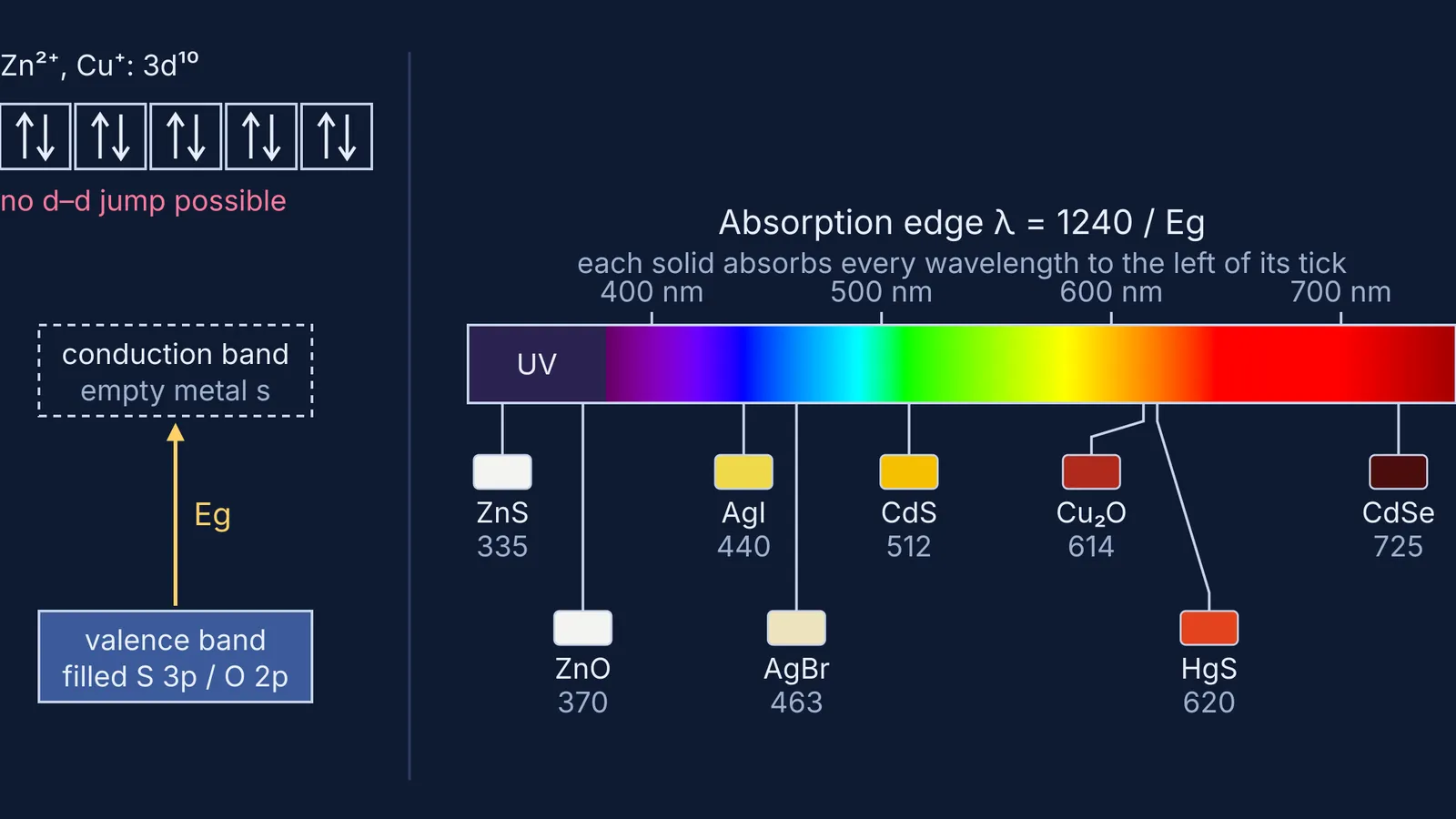
Orbitals merge into bands. In a crystal, the filled p orbitals of all the anions overlap into one broad valence band. The empty s orbitals of all the metal ions overlap into a conduction band. Broad bands reach towards each other, so the gap between the top of one and the bottom of the other, the band gap Eg, can be small enough for visible light.
A photon with energy at or above Eg lifts an electron from the anion-based valence band to the metal-based conduction band. In molecular language this is charge transfer from anion to metal, the same idea that makes d⁰ permanganate purple in why KMnO₄ is purple with no d electrons. No d–d transition is involved.
How do you turn a band gap into a colour?
A semiconductor absorbs every photon with energy above Eg, so every wavelength shorter than an edge:
λ(edge) = hc/Eg = 1240/Eg, with λ in nm and Eg in eV.
The 1240 is hc/e = 1239.8 eV nm, derived in why zinc oxide turns yellow on heating. Then read the colour like this:
Edge below about 380 nm: only UV is absorbed, so the solid is white.
Edge in the blue-green (about 450 to 520 nm): violet and blue are removed, so you see yellow.
Edge in the orange (about 590 to 630 nm): everything up to orange is removed, so you see red.
Edge beyond about 700 nm: almost all visible light is absorbed, so the solid looks very dark red to black.
Worked example: predict the colours from the band gaps
All gaps are room-temperature values from one compilation, Strehlow and Cook's Compilation of Energy Band Gaps in Elemental and Binary Compound Semiconductors and Insulators (J. Phys. Chem. Ref. Data, 1973). Gaps vary a little with crystal form, temperature and sample, so treat them as approximate.
Part (a): find each absorption edge.
ZnS (hexagonal), Eg ≈ 3.7 eV (reported 3.68 to 3.88): λ = 1240/3.7 ≈ 335 nm. UV only: white, as in group IV.
ZnO, Eg ≈ 3.35 eV: λ ≈ 370 nm. UV only: white, which is why ZnO works as a sunscreen.
CdS, Eg = 2.42 eV: λ = 1240/2.42 ≈ 512 nm. Violet, blue and some blue-green are absorbed: yellow.
Cu₂O, Eg ≈ 2.02 eV: λ ≈ 614 nm. Everything up to orange is absorbed: red to red-brown. (The same table lists 2.17 eV for a sharp low-temperature line; particle size also shifts the shade.)
α-HgS (cinnabar), Eg ≈ 2.00 eV: λ = 620 nm: red.
CdSe, Eg ≈ 1.71 eV: λ ≈ 725 nm. Nearly the whole visible range is absorbed: very dark red to black.
Part (b): which group-12 sulphide is a yellow pigment and which is a red one? CdS absorbs up to 512 nm, so it is the yellow (cadmium yellow). HgS absorbs up to 620 nm, so it is the red (vermilion). ZnS absorbs nothing visible, so it is a white pigment. Cadmium and mercury compounds are toxic.
Part (c): a twist with HgS. The HgS that comes down with H₂S in salt analysis is black. That is β-HgS (metacinnabar), whose gap is only about 0.5 eV, so it absorbs all visible light. Heating converts it to red α-HgS, the cinnabar form. Same formula, different gap.
Why does the gap shrink from ZnS to CdS to HgS?
Down group 12: ZnS 3.7 eV, CdS 2.42 eV, α-HgS 2.00 eV. The bottom of the conduction band is built mainly from the empty metal s orbital. Going down the group, the metal–sulphur bonds become more covalent and the empty s level sits closer to the filled S 3p band. For mercury, the 6s orbital is pulled down further by relativistic effects, the same effect behind mercury being a liquid. For exams, "more covalent, smaller gap" is the trend to remember.
Changing the anion works the same way. Selenium is less electronegative than sulphur, so its 4p electrons sit higher in energy and the gap closes: CdS 2.42 eV to CdSe 1.71 eV, and ZnS 3.7 eV to ZnSe about 2.67 eV, which is yellow. If you were taught that AgI is coloured because of polarisation and covalent character, that is the same story in Fajans' language.
Why is AgI more yellow than AgBr when its gap is larger?
From the same table: AgCl 3.25 eV (edge 382 nm), AgBr 2.68 eV (463 nm) and AgI 2.82 eV (440 nm). By the edge rule alone, AgBr should be the more yellow one. It is not: AgBr is pale cream and AgI is clearly yellow.
The reason is the kind of gap. AgBr's lowest gap is indirect: an electron crossing it must also change momentum, with help from a lattice vibration. That absorption is weak, so AgBr is only faintly tinted. Its strong, direct absorption starts at about 4.29 eV, in the UV. AgI's gap is direct, so it absorbs strongly right at its edge and looks a definite yellow. AgCl's edge sits at the violet border, so it looks white.
One more for practice: red HgI₂ has a gap of about 2.13 eV, so λ ≈ 582 nm, leaving scarlet. Above about 127 °C it turns into a yellow form with a larger gap. To rework these calculations step by step, the Fermi Problem Library has a step-by-step solver that explains the reasoning.
Quick checklist
d¹⁰ aqua ions are colourless: no d–d jump, and charge transfer from water needs UV.
Coloured d¹⁰ solids absorb across a band gap (anion p to metal s).
Edge wavelength: λ(nm) = 1240/Eg(eV). The solid absorbs everything shorter.
Edge below 380 nm: white. Around 450 to 520 nm: yellow. Around 590 to 630 nm: red. Above 700 nm: dark.
Gaps shrink down group 12 (ZnS > CdS > HgS) and from S to Se.
AgBr's gap is indirect, so it is only cream; AgI's is direct, so it is yellow.


