

On this page
"Determination of the contents of cold drinks" is one of the most popular CBSE Class 12 investigatory projects. It works because a bottle of soft drink holds four things you can test for with school reagents: dissolved carbon dioxide, acid, sugar and, in many colas, phosphate. This post gives you a test panel for all four, the equation behind each colour, and a worked titration that turns a qualitative project into a quantitative one.
Before you start, read the ingredient label of each drink and write it down. The label is your hypothesis. Phosphoric acid is listed as acidity regulator INS 338, and citric acid as INS 330. Your tests then check what the label says.
How do you test a cold drink for carbon dioxide?
Pour about 20 mL of a freshly opened drink into a boiling tube fitted with a cork and a delivery tube. Dip the other end of the delivery tube into lime water and warm the drink gently in a water bath. Bubbles of gas pass through and the lime water turns milky:
Ca(OH)₂ + CO₂ → CaCO₃↓ + H₂O
If you keep bubbling, the milkiness can clear again, because excess CO₂ turns the insoluble carbonate into soluble calcium hydrogencarbonate: CaCO₃ + H₂O + CO₂ → Ca(HCO₃)₂. Record both observations. Warming works because gases are less soluble in warm water, which why a warm cold drink goes flat faster explains with Henry's law.
How acidic is a cold drink?
Dip a strip of universal indicator paper in each drink, or better, use a pH meter. Colas are strongly acidic. A survey of 380 drinks in the Journal of the American Dental Association measured colas at about pH 2.4 to 2.5, and 93% of all the drinks tested were below pH 4.0.
Record the pH of a flat (boiled and cooled) sample too. Fresh drinks carry carbonic acid from dissolved CO₂, so the flat sample tells you how much of the acidity comes from the added acids.
How do you test for sugar, and why can the result mislead?
Dilute 2 mL of drink with 10 mL of water. Add 2 mL of Benedict's solution and heat the tube in a boiling water bath for a few minutes. A green, yellow, orange or brick-red precipitate of copper(I) oxide, Cu₂O, shows a reducing sugar such as glucose or fructose. The reducing sugar takes electrons from Cu²⁺ and reduces it to Cu⁺.
Sucrose is not a reducing sugar, so it should fail this test. To detect it, boil a fresh sample with a few drops of dilute HCl for a few minutes, neutralise it with sodium carbonate, and then repeat the Benedict's test. Acid hydrolysis splits sucrose into glucose and fructose, which do reduce Benedict's solution.
Two cautions belong in your report:
A cold drink is acidic, so some of its sucrose slowly hydrolyses on the shelf, as explained in why sucrose hydrolysis is called inversion. A positive Benedict's test before hydrolysis does not prove that glucose was added at the factory.
Diet drinks should fail both sugar tests. Sweeteners such as aspartame and sucralose are not reducing sugars, so they give no Cu₂O.
How do you test for phosphate?
Take 2 mL of drink, add a few drops of concentrated nitric acid and then ammonium molybdate solution, and warm the tube in a water bath. A canary-yellow precipitate of ammonium phosphomolybdate shows phosphate:
PO₄³⁻ + 3NH₄⁺ + 12MoO₄²⁻ + 24H⁺ → (NH₄)₃[PMo₁₂O₄₀]↓ + 12H₂O
The atoms balance (P 1, Mo 12, O 52, N 3, H 36 on each side) and so does the charge (0 on each side). Colas that list INS 338 should give the yellow precipitate. Drinks that list only citric acid should give little or none, unless another phosphate additive is present. Run a blank with distilled water alongside so you can compare colours.
Worked example: how much phosphoric acid is in a cola?
These readings are illustrative, not measured values for any real drink.
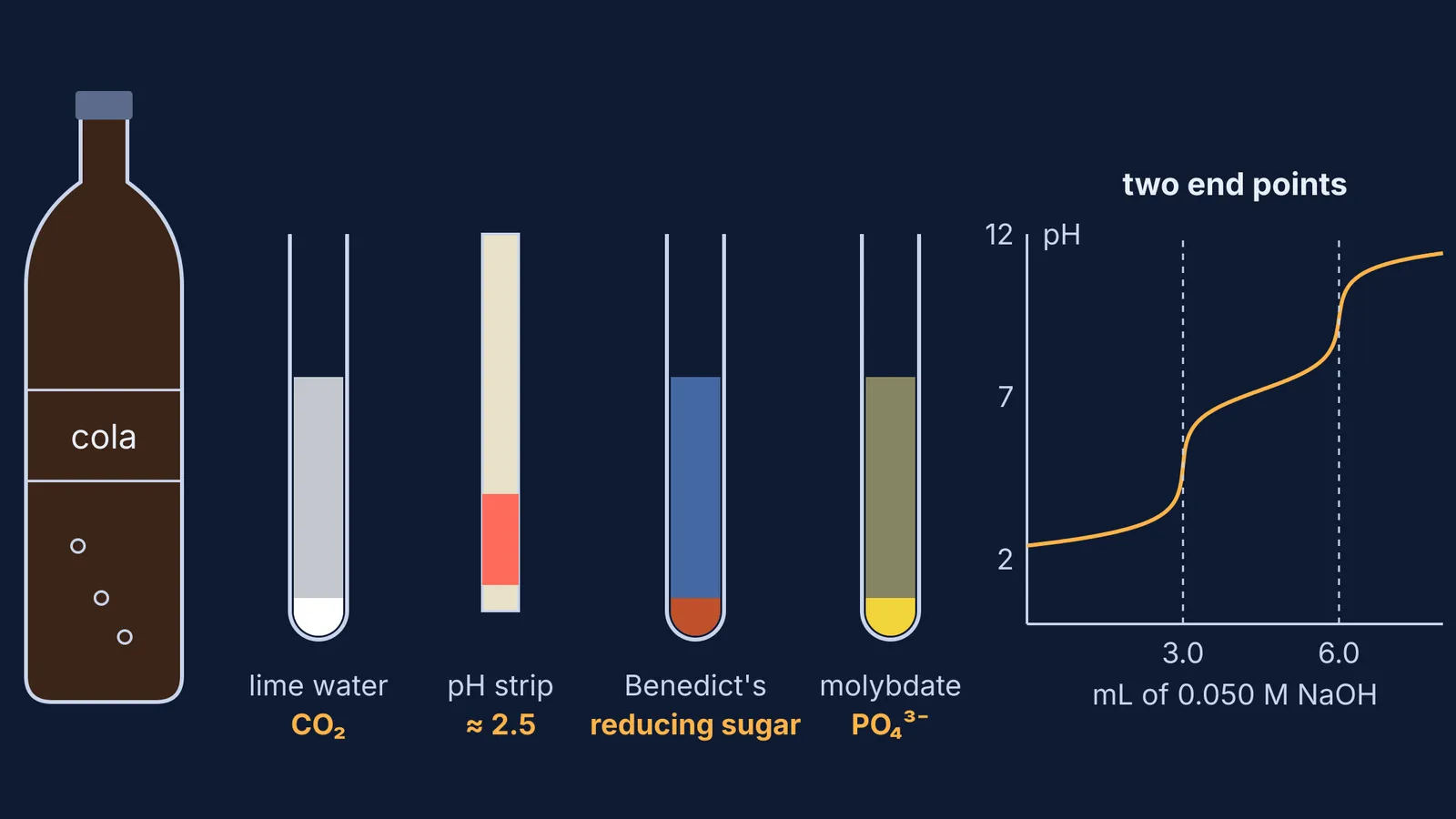
You boil 25.0 mL of cola gently for a few minutes to drive off CO₂, cool it, and titrate it with 0.050 M NaOH, recording the pH after each addition with a pH meter. The curve shows a first jump at 3.0 mL and a second jump at 6.0 mL. Find the concentration of H₃PO₄ in g L⁻¹.
Decide what each jump means. H₃PO₄ shows two end points with NaOH. The first is H₃PO₄ → H₂PO₄⁻ and the second is H₂PO₄⁻ → HPO₄²⁻. The third proton (pKa ≈ 12.3) is too weak to give a jump. Titrating phosphoric acid with NaOH explains why.
Moles of OH⁻ to the second end point. 0.050 mol L⁻¹ × 0.0060 L = 3.0 × 10⁻⁴ mol.
Moles of H₃PO₄. Each H₃PO₄ uses 2 OH⁻ by the second end point, so H₃PO₄ = 3.0 × 10⁻⁴/2 = 1.5 × 10⁻⁴ mol.
Concentration. 1.5 × 10⁻⁴ mol ÷ 0.0250 L = 6.0 × 10⁻³ mol L⁻¹.
Mass concentration. 6.0 × 10⁻³ mol L⁻¹ × 98.0 g mol⁻¹ = 0.59 g L⁻¹.
Check with the first jump. For pure H₃PO₄ the second end point should come at twice the first. Here 6.0 = 2 × 3.0, so the data are consistent with phosphoric acid being the main acid. If the second volume is clearly more than twice the first, another acid (often citric) is adding to the titre, and your answer is an upper limit.
Three practical points decide whether this works:
Boil off the CO₂ first. Carbonic acid also reacts with NaOH and would make the titre too high.
Use a pH meter. The caramel colour in colas hides the pink of phenolphthalein. If you have no meter, dilute the sample a lot and expect a fuzzy end point.
Repeat for concordant readings. Two titres within 0.1 mL of each other are worth more than one.
If the n-factor reasoning in steps 2 and 3 is the part you get wrong, the Fermi Problem Library has a step-by-step solver that explains the reasoning for polyprotic acid titrations.
What safety points matter for this project?
Concentrated nitric acid burns skin and eyes. Wear goggles and gloves, add it drop by drop, and warm the molybdate test in a water bath, not a direct flame.
A boiling cola foams up fast. Use a beaker at least four times the sample's volume and heat it gently.
Point boiling tubes away from everyone while heating.
Never taste or drink anything that has been in lab glassware, even if it started as a cold drink.
Quick checklist
Read the label first: INS 338 is phosphoric acid, INS 330 is citric acid.
CO₂: lime water turns milky (CaCO₃), and may clear with excess gas.
Acidity: colas measure about pH 2.4 to 2.5.
Benedict's: positive for reducing sugars; sucrose only after acid hydrolysis; diet drinks negative.
Phosphate: canary-yellow ammonium phosphomolybdate with HNO₃ and molybdate.
Titration: boil off CO₂, use a pH meter, count 2 OH⁻ per H₃PO₄ at the second end point.
Label made-up or sample readings as illustrative in your report.


