

On this page
In short
A cold drink goes flat faster when warm because the solubility of gases in liquids drops as temperature rises. According to Henry's law and data from the NIST Chemistry WebBook, water at 0 °C can hold over twice as much dissolved carbon dioxide as water at 25 °C. As the drink warms, the extra gas escapes as bubbles.
When you open a bottle of soda straight from the fridge, it responds with a sharp hiss and a steady stream of bubbles that dance to the surface, bringing with them a refreshing, sharp taste. However, if you leave that exact same bottle on a warm dining table or out in the sun for a few hours, the lively fizz disappears entirely. The distinctive, acidic bite is gone, leaving behind a drink that tastes heavy, flat, and excessively sweet.
The secret to this carbonation lies in how gases dissolve in liquids, a process heavily governed by both pressure and temperature. For students preparing for Class 12 chemistry, the physics inside a simple soda bottle provides a clear, real-world example of chemical equilibrium and gas laws in action.
Why are drinks fizzy in the first place?
Carbonated drinks are manufactured by forcing carbon dioxide (CO₂) to dissolve in water under very high pressure. This fundamental relationship is described by Henry's law, which states that the concentration of a dissolved gas in a liquid is directly proportional to its partial pressure in the gas phase above that liquid.
Inside a sealed soda bottle, the space above the liquid is packed with pure CO₂ at a pressure much higher than atmospheric pressure. This high pressure effectively forces the gas molecules to remain trapped between the water molecules. However, the moment you unscrew the cap, you release that built-up gas, and the pressure drops instantly to match the surrounding room. The partial pressure of carbon dioxide in the normal atmosphere is very low, so the liquid can no longer hold all that dissolved gas. It begins to rapidly escape, forming the bubbles you see. If you are solving equilibrium problems involving partial pressures, you might also want to review the Average molar mass of a gas mixture: worked air and vapour examples.
Why does a cold drink go flat faster when it gets warm?
While a drop in pressure starts the process of a drink going flat, temperature dictates how quickly and thoroughly it happens. Temperature plays a critical, inverse role in how much gas a liquid can hold. Unlike dissolving a solid like salt or sugar in water—which usually gets easier as the water gets hotter—dissolving a gas is an exothermic process. This means that as the gas dissolves into the liquid, it releases a small amount of heat.
Because heat is a product of the dissolution reaction, raising the temperature of the liquid acts like adding more of a product. According to Le Chatelier's principle, if you add heat to a system that is already at equilibrium, the system will naturally shift to absorb that extra energy and counteract the change. For a carbonated drink, raising the temperature shifts the chemical equilibrium firmly backward toward the gaseous state. As the liquid warms up, the dissolved gas molecules gain kinetic energy. They move around more violently, which allows them to easily overcome the weak intermolecular forces binding them to the water. They break free, gather into larger bubbles, and escape into the air. You can explore similar equilibrium shifts in Adding an inert gas to an equilibrium: constant V vs constant P.
How does Henry's law change with temperature?
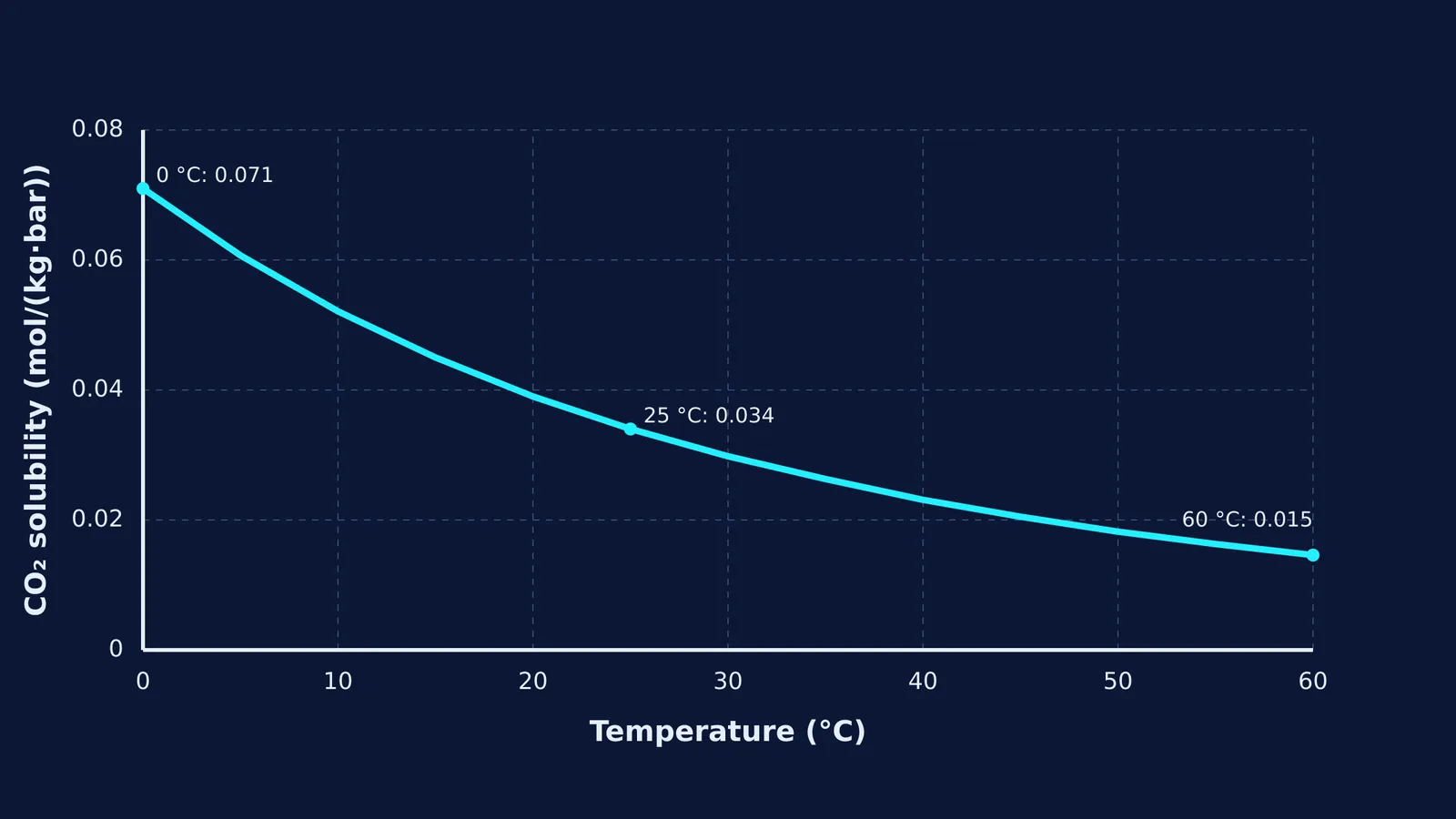
The Henry's law constant tells us exactly how this solubility changes as the temperature climbs. We can track this inverse relationship across different temperatures using data from the NIST Chemistry WebBook.
At the freezing point of water, 0 °C (273 K), the Henry's law constant for CO₂ in water is approximately 0.071 mol/(kg·bar). At standard room temperature, around 25 °C (298 K), the constant drops sharply to about 0.034 mol/(kg·bar). This means that simply bringing a cold drink out of the fridge and allowing it to reach room temperature strips away more than half of its ability to hold onto dissolved carbon dioxide. By the time the water reaches 60 °C—the typical temperature inside a hot car left out in the summer sun—the constant falls even further to just 0.015 mol/(kg·bar). This sharp decrease in gas solubility is precisely why an ice-cold drink holds onto its fizz for a long time, while a warm drink gives it up almost immediately.
Visualising how temperature drives gas out of a solution can make equilibrium problems much easier to tackle. If you are struggling to picture these abstract shifts, the Fermi Simulation Lab offers interactive simulations for the ideas that are easier to see than to read.


