

On this page
India has a lot of coal and imports most of its methanol. A July 2024 Ministry of Coal release says the country imports over 90% of the methanol it uses, and that the coal gasification mission aims to gasify 100 million tonnes of coal by 2030. But the chemistry has a catch you can work out with Class 11 stoichiometry: even in a perfect plant, one carbon atom in every three must leave as CO₂. Here is the ratio algebra, the heat balance and the CO₂ per tonne.
How is methanol made from coal?
The NCERT methanol step is CO + 2H₂ → CH₃OH, over a catalyst at high pressure. It takes the gas mixture, called syngas, as given. In a coal plant, that syngas has to be made first.
A 2021 PIB release from the Ministry of Science and Technology describes India's first coal-to-methanol pilot plant, built by BHEL in Hyderabad. It makes 0.25 tonnes of methanol a day from high-ash Indian coal in four stages: gasify the coal to syngas, clean and condition the syngas, convert it to methanol, and purify the methanol. "Conditioning" is where the CO₂ comes from.
Why does the H₂ to CO ratio have to be 2?
Read the methanol equation as a recipe: one CO needs two H₂. Too little hydrogen leaves CO over; too much leaves H₂ over. Either way, you pay to compress gas that never becomes product.
Now compare two ways of making syngas.
Steam reforming of methane: CH₄ + H₂O → CO + 3H₂. Here H₂/CO = 3, more hydrogen than methanol needs.
Steam gasification of carbon: C + H₂O → CO + H₂. Here H₂/CO = 1, only half the hydrogen methanol needs.
Coal is mostly carbon, so coal syngas is hydrogen-poor. The US NETL methanol page says syngas from slagging coal gasifiers typically has H₂/CO between 0.3 and 1, so extensive water gas shift is needed.
How does the water gas shift fix the ratio?
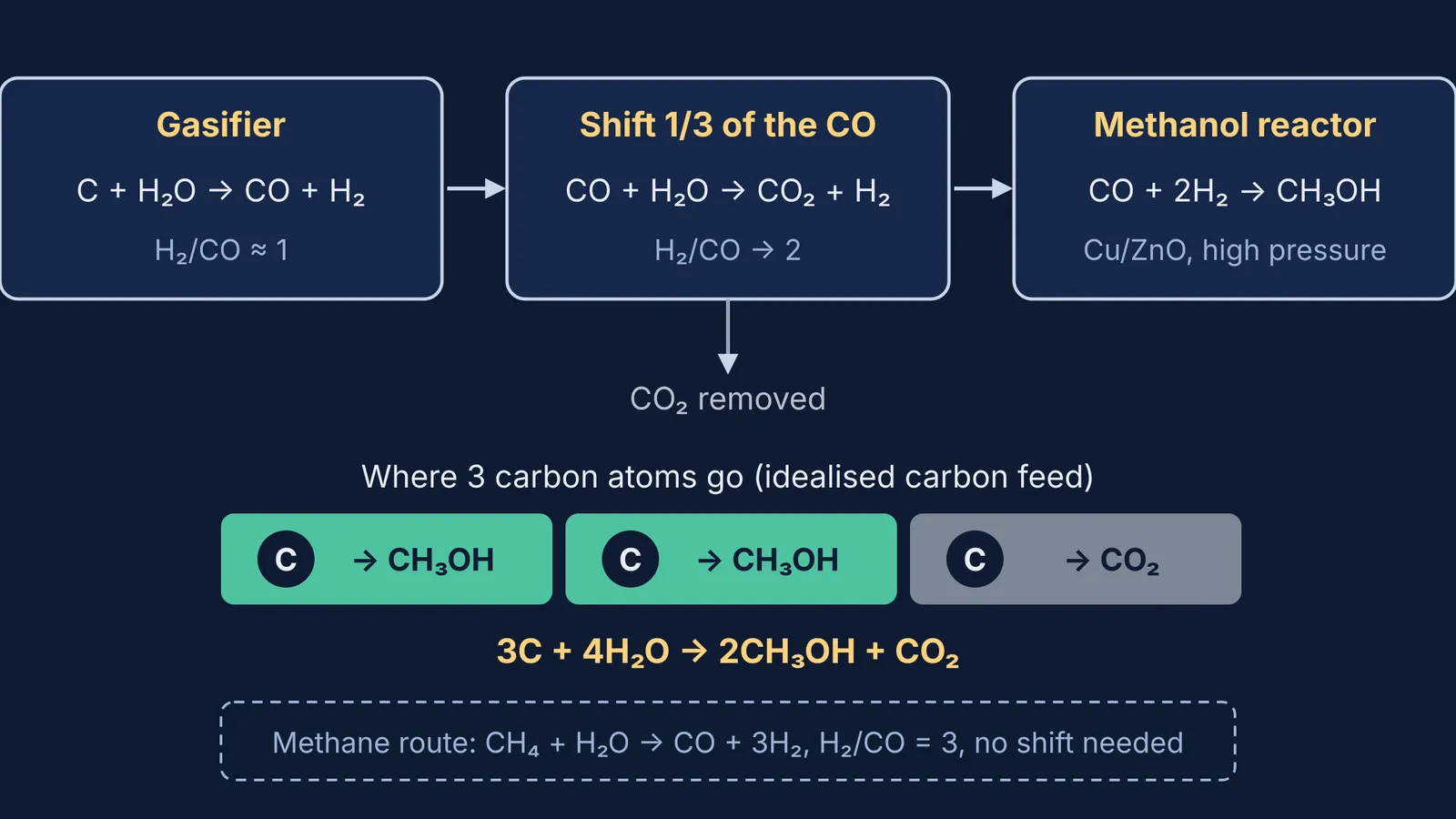
The water gas shift turns CO and steam into CO₂ and H₂:
CO + H₂O ⇌ CO₂ + H₂
Each CO shifted removes one CO and adds one H₂. A hydrogen plant shifts almost all the CO; a methanol plant shifts just enough to reach the target ratio.
Worked example: why exactly one-third?
Take an idealised feed of pure carbon. Real coal also has hydrogen, oxygen, sulphur and ash.
Step 1: syngas from the gasifier. C + H₂O → CO + H₂. Start with 1 mol CO and 1 mol H₂.
Step 2: shift a fraction f of the CO. After the shift you have (1 − f) mol CO and (1 + f) mol H₂, plus f mol CO₂.
Step 3: set the ratio to 2.
(1 + f) / (1 − f) = 2
1 + f = 2 − 2f
3f = 1, so f = 1/3
Step 4: write it for 3 carbon atoms. 3C + 3H₂O → 3CO + 3H₂. Shift one CO: CO + H₂O → CO₂ + H₂. You now have 2CO + 4H₂ + CO₂. The 2CO and 4H₂ make 2CH₃OH.
Step 5: add up and check.
3C + 4H₂O → 2CH₃OH + CO₂
Carbon: 3 = 2 + 1. Hydrogen: 8 = 8 + 0. Oxygen: 4 = 2 + 2. It balances.
So one carbon in three leaves as CO₂, fixed by atom counting alone.
Step 6: the methane contrast. CH₄ + H₂O → CO + 3H₂ gives one spare H₂ for every CO, so there is no reason to shift anything. The ideal overall reaction is CH₄ + ½O₂ → CH₃OH, with no CO₂ in the equation at all.
Step 7: a real gasifier. If the syngas has H₂/CO = r, the same algebra gives (r + f) / (1 − f) = 2, so f = (2 − r)/3. At r = 0.5, f = 0.5: half the CO must be shifted, and half the carbon leaves as CO₂.
One more detail. After the shift, the gas still holds that CO₂. Plants judge their gas by the stoichiometric number, (H₂ − CO₂)/(CO + CO₂), which should be about 2. For 2CO + 4H₂ + CO₂ it is (4 − 1)/(2 + 1) = 1. Removing the CO₂ brings it to 4/2 = 2, which is why these plants remove CO₂ before the methanol reactor.
Where does the heat come from?
Use Hess's law with standard enthalpies of formation, taking methanol and water as gases: ΔfH of CH₃OH(g) = −201.0, CO₂ = −393.5, H₂O(g) = −241.8 kJ mol⁻¹. Carbon is an element, so its ΔfH is zero. Tables differ slightly, so treat the answers as approximate.
ΔH = [2(−201.0) + (−393.5)] − [4(−241.8)]
ΔH = −795.5 + 967.2 = +171.7 kJ for 2 mol CH₃OH
The reaction is endothermic. Check it step by step: three gasifications at +131.3 kJ each, one shift at −41.2 kJ, two methanol steps at −90.5 kJ each, total +171.7 kJ.
In a real gasifier, some coal is burnt with oxygen inside the vessel. In the ideal case, burning carbon gives 393.5 kJ per mol, so you need 171.7 / 393.5 = 0.44 mol of extra carbon per 2 mol CH₃OH. That carbon also leaves as CO₂.
How much CO₂ per tonne of methanol, at minimum?
Now combine the two sources of CO₂ for 2 mol CH₃OH.
From the shift: 1 mol CO₂.
From burning carbon for heat: 0.44 mol CO₂.
Total: 1.44 mol CO₂ per 2 mol CH₃OH, or 0.72 mol per mol CH₃OH.
Masses: CH₃OH = 32.04 g/mol, CO₂ = 44.01 g/mol. So 0.72 × 44.01 / 32.04 = 0.99 t of CO₂ per tonne of methanol.
Carbon fed: (3 + 0.44)/2 = 1.72 mol C per mol CH₃OH, which is 0.64 t of carbon per tonne of methanol.
The shift alone gives 0.69 t. Treat 0.99 t as a floor, not a plant figure: real plants also need oxygen from an air separation unit, steam and compression power, and they lose heat. Indian coal is high in ash, so the tonnes of coal needed are well above 0.64 t too. The PIB release notes that melting and handling this ash is a particular challenge for Indian gasifiers.
If one of these steps trips you up, the Fermi Problem Library has worked problems with a step-by-step solver that explains the reasoning.
What do the numbers mean for exams and for India?
For an exam, this topic tests excess-reagent thinking (see limiting reagent and percentage yield problems), ratio algebra and Hess's law. Le Chatelier appears too: CO + 2H₂ → CH₃OH turns 3 mol of gas into 1, so Δn = −2 and high pressure favours methanol.
For India, coal-to-methanol cuts imports but makes CO₂ by its stoichiometry. Whether that trade is worth it is a policy choice; the one-in-three is chemistry.
Quick checklist
Methanol needs H₂/CO = 2. Methane reforming gives 3; carbon gasification gives about 1.
Shift a fraction f of the CO: (1 + f)/(1 − f) = 2 gives f = 1/3.
Overall, for idealised carbon: 3C + 4H₂O → 2CH₃OH + CO₂. Check C, H and O.
For syngas with H₂/CO = r, the shifted fraction is (2 − r)/3.
ΔH = +171.7 kJ per 2 mol CH₃OH(g); burning 0.44 mol C supplies it.
Minimum CO₂: about 0.99 t per tonne of methanol, a stoichiometric floor.


