

On this page
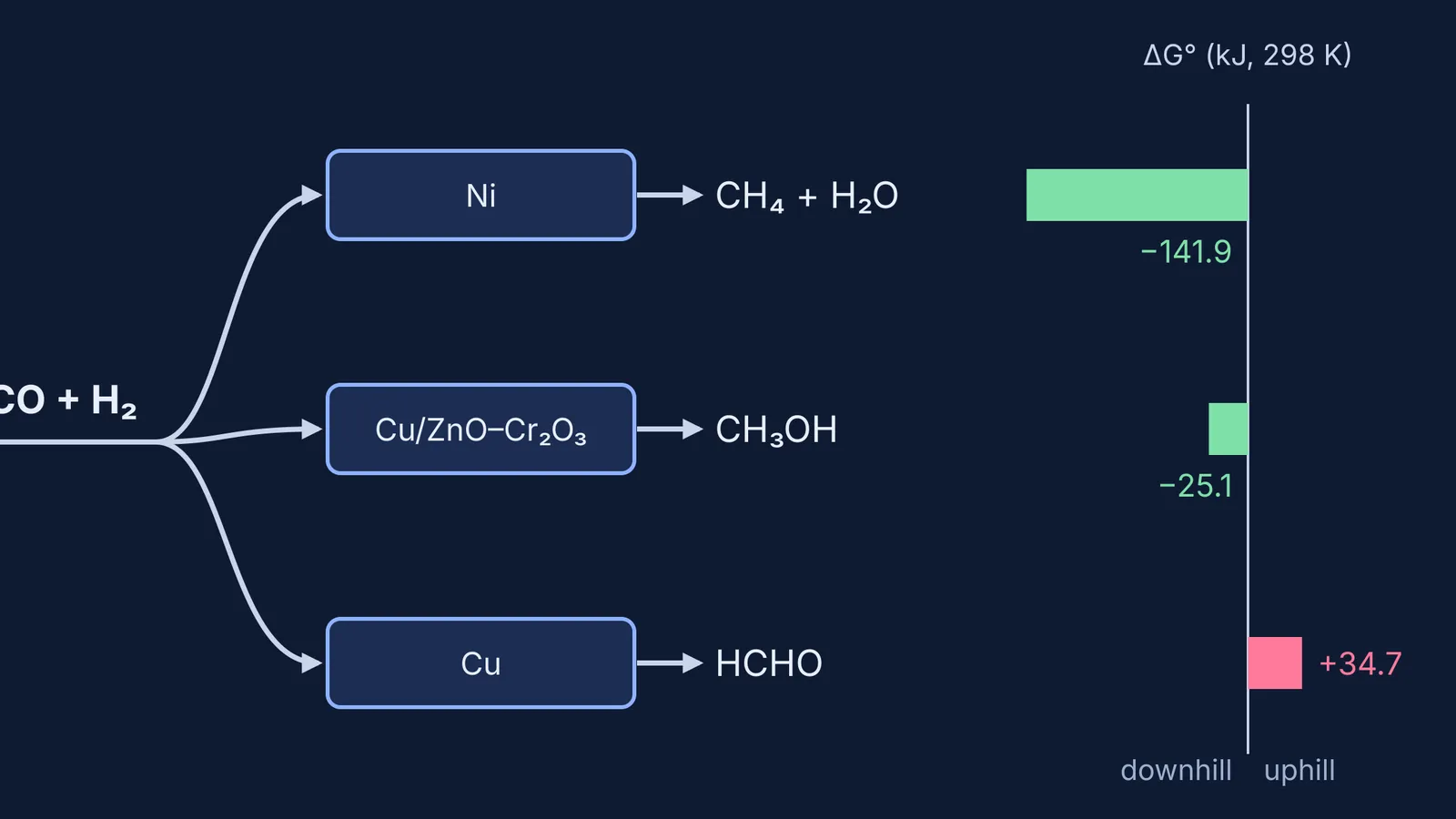
Pass the same mixture of carbon monoxide and hydrogen over nickel and you get methane. Pass it over copper with zinc oxide and chromium oxide and you get methanol. Pass it over copper alone and, according to NCERT, you get formaldehyde. NCERT's Class 12 Surface Chemistry chapter uses this trio to show the selectivity of catalysts. That chapter was dropped when NCERT rationalised the syllabus, but the example still turns up in question banks. It is a good example, but one of its three equations hides a surprise. Check each route with standard Gibbs energies and the formaldehyde line turns out to be uphill. This post explains what selectivity is, works through the ΔG° check, and says what the check tells you.
What is the selectivity of a catalyst?
Selectivity is a catalyst's ability to steer a reaction towards one particular product when several products are possible from the same starting materials. NCERT's example:
CO(g) + 3H₂(g) → CH₄(g) + H₂O(g), over Ni
CO(g) + 2H₂(g) → CH₃OH(g), over Cu/ZnO–Cr₂O₃
CO(g) + H₂(g) → HCHO(g), over Cu
Each equation balances. In (1), C 1, O 1 and H 6 on both sides. In (2), C 1, O 1, H 4. In (3), C 1, O 1, H 2.
In simple terms, the difference comes from how each surface holds CO. Nickel breaks the C–O bond and adds hydrogen until the carbon becomes CH₄ and the oxygen leaves as water. Copper keeps the C–O bond intact and adds hydrogen to the carbon, so the oxygen stays in the product.
Do not confuse selectivity with activity. Activity is how much a catalyst speeds up a reaction. Selectivity is which reaction it speeds up. A catalyst can be very active and poorly selective, and the reverse. This is also a different idea from shape selectivity in zeolites, where the pore size decides which molecules can get in or out.
Can a catalyst make any reaction happen?
No. A catalyst lowers the activation energy of the forward and the reverse reaction by the same amount. It changes how fast equilibrium is reached, but not where equilibrium lies, so it changes neither ΔG° nor K. The reasoning is set out in does a catalyst change the equilibrium constant?
So selectivity has a limit. A catalyst can choose among reactions that are already thermodynamically favourable. It cannot make a reaction with a large positive ΔG° give much product. That gives you a test you can apply to NCERT's three equations.
How do you check each route with ΔG°?
Use standard Gibbs energies of formation at 298 K. These are approximate values from standard data tables; different tables differ by a few kJ. Because all three equations are written for gases, use the gas-phase values for CH₃OH and H₂O, not the liquid ones.
CO(g): −137.2 kJ mol⁻¹
CH₄(g): −50.5 kJ mol⁻¹
H₂O(g): −228.6 kJ mol⁻¹
CH₃OH(g): −162.3 kJ mol⁻¹
HCHO(g): −102.5 kJ mol⁻¹
H₂(g): 0, as for any element in its standard state
The rule is ΔG° = ΣΔfG°(products) − ΣΔfG°(reactants). If you need a refresher, see standard Gibbs energy of reaction from formation values.
Worked example
Methane over Ni. ΔG° = (−50.5 + (−228.6)) − (−137.2) = −279.1 + 137.2 = −141.9 kJ.
Methanol over Cu/ZnO–Cr₂O₃. ΔG° = −162.3 − (−137.2) = −25.1 kJ.
Formaldehyde over Cu. ΔG° = −102.5 − (−137.2) = +34.7 kJ.
Convert to K at 298 K using K = e^(−ΔG°/RT), with R = 8.314 J K⁻¹ mol⁻¹ and T = 298 K. Methane: K ≈ 7 × 10²⁴. Methanol: K ≈ 2.5 × 10⁴. Formaldehyde: K ≈ 8.3 × 10⁻⁷.
What the last K means. For CO + H₂ ⇌ HCHO, K = p(HCHO) / (p(CO) × p(H₂)), with pressures in bar. With CO and H₂ each at 1 bar, the equilibrium pressure of HCHO is about 8 × 10⁻⁷ bar, under one part per million.
Is the sign safe? Some tables give ΔfG° of HCHO(g) nearer −110 kJ mol⁻¹. Then ΔG° = −110 + 137.2 = +27.2 kJ. Still positive.
Two routes are downhill and one is uphill. Raising the temperature does not rescue the third. Two gas molecules become one, so ΔS° is negative, and the −TΔS° term makes ΔG° more positive as T rises.
Why does the methanol route need such high pressure?
NCERT's alcohols chapter gives the methanol conditions as ZnO–Cr₂O₃, 200–300 atm and 573–673 K; see how methanol and ethanol are made industrially. The ΔG° check explains why.
At 298 K, ΔG° is only −25.1 kJ. The reaction is exothermic: with ΔfH° values of about −110.5 kJ mol⁻¹ for CO and −201.0 kJ mol⁻¹ for CH₃OH(g), ΔH° ≈ −90.5 kJ. Then ΔS° = (ΔH° − ΔG°)/T ≈ (−90.5 + 25.1)/298 ≈ −0.219 kJ K⁻¹. Treating ΔH° and ΔS° as constant, at 573 K ΔG° ≈ −90.5 + 573 × 0.219 ≈ +35 kJ, so K falls well below 1.
The plant runs hot anyway because the reaction is too slow when cold. The price is a small K, and high pressure pays it. Three moles of gas become one (Δn = −2), so by Le Chatelier's principle high pressure pushes the equilibrium towards methanol. The methane route has a ΔG° so large and negative that it needs no such help.
Then how is formaldehyde actually made?
Not from CO and H₂. Industry makes formaldehyde by oxidising methanol, over a silver catalyst or an iron–molybdenum oxide catalyst:
CH₃OH(g) + ½O₂(g) → HCHO(g) + H₂O(g)
Check the balance: C 1, H 4, O 2 on both sides. Then ΔG° = (−102.5 + (−228.6)) − (−162.3) = −168.8 kJ. Strongly downhill.
The oxygen is what makes the difference: the hydrogen leaves as water, whose very negative ΔfG° drives the reaction. So CO and H₂ do end up as formaldehyde in industry, but by a detour. First they become methanol (downhill), then the methanol is oxidised (downhill again). Every step on the real route has a negative ΔG°.
What do exams ask about catalyst selectivity?
Match the catalyst to the product: Ni gives CH₄, Cu/ZnO–Cr₂O₃ gives CH₃OH, Cu gives HCHO, as NCERT states them.
Define selectivity and tell it apart from activity.
Say whether a catalyst changes ΔG°, K or the equilibrium composition. It changes none of them.
Compute ΔG° from ΔfG° values and predict whether a reaction is feasible.
If you want to practise ΔG° and K problems with each step explained, the Fermi Problem Library has a step-by-step solver that explains the reasoning.
Selectivity checklist
Selectivity: same reactants, different catalyst, different product.
Activity is how fast; selectivity is which product.
A catalyst changes neither ΔG° nor K.
With gas-phase data at 298 K: CH₄ route −141.9 kJ, CH₃OH route −25.1 kJ, HCHO route +34.7 kJ.
K for CO + H₂ → HCHO is about 8 × 10⁻⁷, so the equilibrium yield is tiny.
Methanol needs high pressure because Δn = −2 and K is small at operating temperatures.
Formaldehyde is made industrially by oxidising methanol (ΔG° ≈ −168.8 kJ), not from CO and H₂.


