

On this page
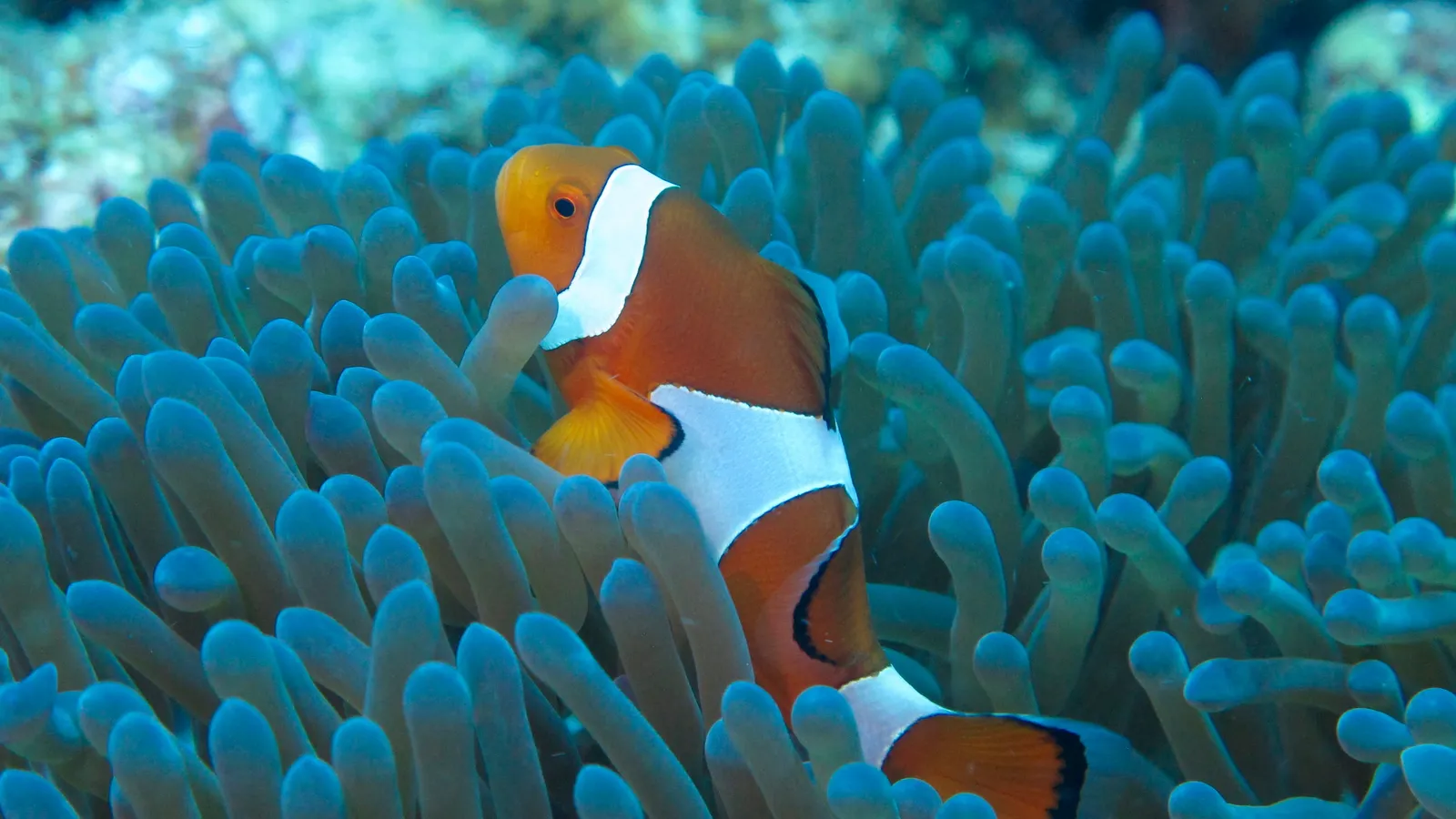
You have probably seen the orange-and-white fish tucked inside a sea anemone and wondered how it survives. Scientists now have a good, if not final, answer, and it sits in the thin layer of slime on the fish's skin. There is also a twist for Class 12 students: your NCERT textbook and the research papers label this partnership differently.
Why does a sea anemone not sting clownfish?
Sea anemones are cnidarians, non-chordate animals whose tentacles carry nematocysts: capsules that fire a thread carrying a cocktail of toxins. A nematocyst fires after a mechanical or chemical trigger, and sialic acid, a sugar found in fish skin mucus, is one chemical cue that helps prime that discharge (Roux and colleagues, bioRxiv preprint).
In 2025, a team including Natacha Roux and Vincent Laudet published a direct test in BMC Biology. They checked four predictions, and all four held:
Anemonefish mucus has lower sialic acid levels than the mucus of non-symbiotic damselfish.
The drop is specific to the mucus, not the whole body.
As young fish develop, sialic acid levels fall as protection rises.
The anemone's own mucus contains minimal sialic acid.
A phys.org report on the study adds the vivid part: young larvae have normal sialic acid levels and get stung if they approach an anemone, but once they metamorphose and develop their white stripes, the levels drop and they can enter safely. The anemone's own low-sugar mucus is likely what stops it stinging itself. The clownfish is not armoured; it is chemically quiet.
The story is not fully closed. A separate 2025 study by Sara Heim and colleagues in Scientific Reports measured total sialic acid of 13 to 16 µM in the mucus of anemone-dwelling fish, against 21 to 30 µM in non-symbiotic damselfish. Because the sugar is still present, those authors suggest the protection may depend on concentration, or that the chemistry is more complex than simple presence or absence.
What does each partner gain?
The clownfish gets a home that predators avoid. The Roux study describes the fish as living inside the anemone and benefiting from the protection of its toxic nematocysts (BMC Biology, 2025).
The anemone gets more than NCERT suggests:
Defence. The fish protect the anemone from its own predators, according to the same 2025 paper.
Oxygen at night. Szczebak and colleagues (2013) in the Journal of Experimental Biology found that anemonefish and anemones in physical contact took up more oxygen at night than pairs kept apart, and concluded that the fish's night-time behaviour appears to oxygenate their host.
Nutrients. Anemonefish provide nitrogen and carbon to the anemone and to the algae living in its tissues (Roux and colleagues, preprint).
That is two-way benefit, which is why the research literature calls this mutualism.
Is clownfish and sea anemone mutualism or commensalism in NCERT?
In NCERT's Class 12 Biology chapter Organisms and Populations (2026-27 reprint), the pair appears under commensalism. The textbook says the fish gets protection from predators that stay away from the stinging tentacles, and that “the anemone does not appear to derive any benefit by hosting the clown fish.” The same chapter defines mutualism as an interaction that confers benefits on both species, with lichens, mycorrhizae and the fig and wasp as examples.
The textbook judges what the anemone visibly gains; the research measured oxygen, nutrients and defence and found real gains. For a classic textbook mutualism, see how fig and wasp mutualism pollination works; commensalism examples from NCERT covers the rest of the (+, 0) list.
How do you answer this in an exam?
Use a three-step check on any interaction question:
Name both partners and their groups: clownfish (a bony fish, a chordate) and sea anemone (a cnidarian, a non-chordate).
Give each partner a sign: + for benefit, 0 for no effect, − for harm.
Match the pair of signs: (+, 0) is commensalism, (+, +) is mutualism, (+, −) is parasitism or predation.
The population interactions signs table lays out every combination.
Model answer when asked to name NCERT's interaction:
Commensalism. The clownfish lives among the stinging tentacles of the sea anemone and is protected from predators, which stay away from the tentacles. The anemone does not appear to benefit.
Model answer when asked why the fish is not stung:
The clownfish's skin mucus contains less sialic acid, a sugar that helps trigger nematocyst discharge, so the anemone's stinging cells do not fire. Research also shows the anemone gains defence, oxygen and nutrients, so biologists describe the pair as mutualism.
If the question gives you the benefits to both partners, trust the signs and write mutualism. If it simply asks for NCERT's example, write commensalism.
If the (+, −, 0) labels still blur together, the Fermi Concept Library gives every concept in biology its own lesson and its place in the map. For practice, the Fermi Problem Library has worked problems with a step-by-step solver that explains the reasoning rather than printing an answer.
Next time you revise Chapter 11, run the three-step check on the cattle egret and the orchid on a mango branch too.


