

On this page
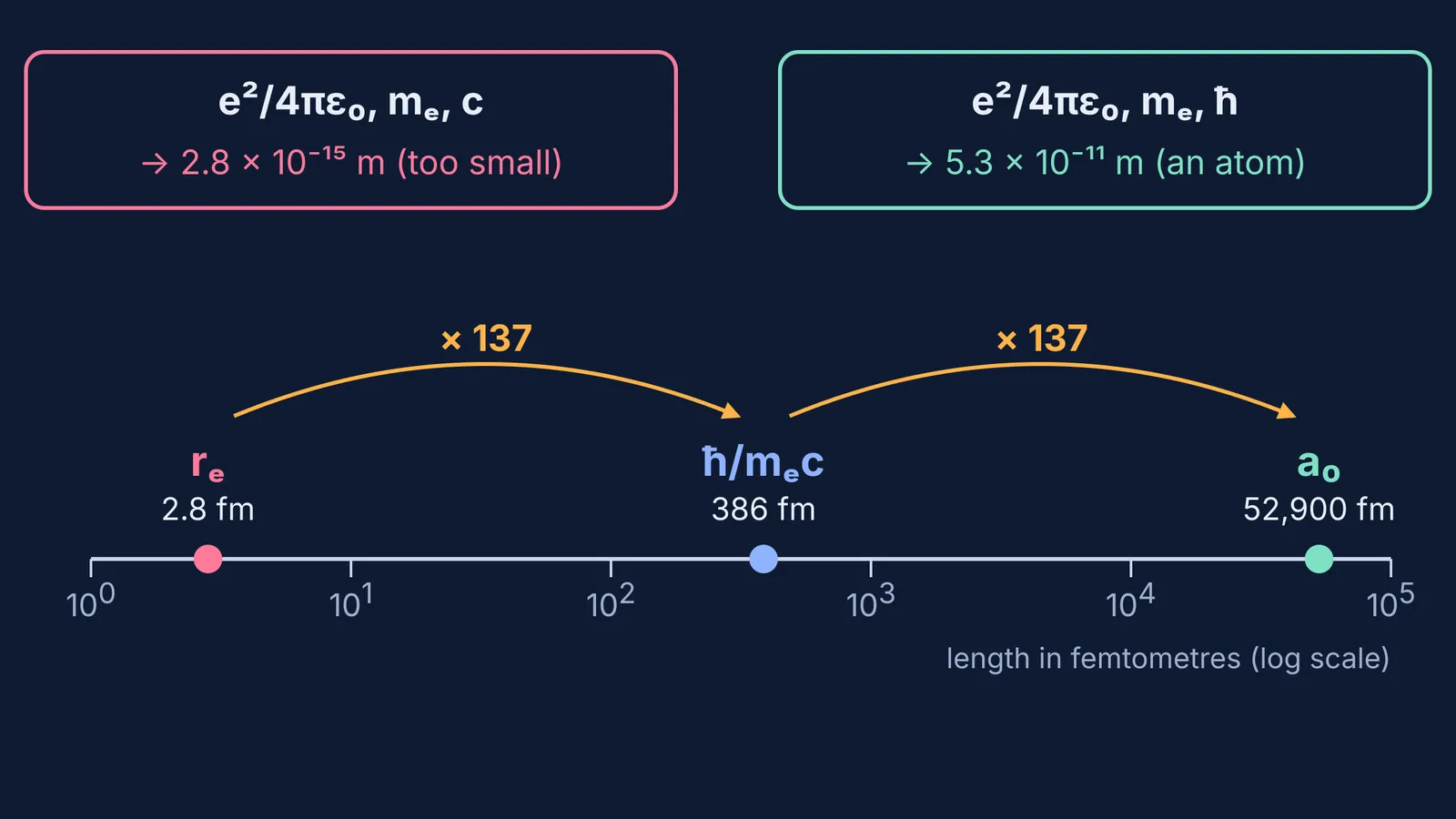
Try to work out the size of an atom using only the electron's charge, its mass and the speed of light. You get a length, but it is about 2.8 × 10⁻¹⁵ m, the size of a nucleus and about 19,000 times too small. Swap the speed of light for Planck's constant and the right answer, 5.3 × 10⁻¹¹ m, falls out. This comparison of the classical electron radius with the Bohr radius is a short proof that atoms cannot be explained without quantum mechanics, and it shows where the fine-structure constant 1/137 comes from.
What lengths can you build from e, mₑ and c?
Charge always enters electrostatics as the combination e²/(4πε₀), so treat that as one quantity. Its unit is J m, which is kg m³ s⁻². The other two ingredients are mₑ (kg) and c (m s⁻¹).
Look for a length of the form (e²/4πε₀)ᵃ mₑᵇ cᵈ:
Seconds: −2a − d = 0, so d = −2a.
Metres: 3a + d = 1, so 3a − 2a = 1 and a = 1.
Kilograms: a + b = 0, so b = −1, and d = −2.
There is only one answer, the classical electron radius:
rₑ = e²/(4πε₀ mₑc²)
The quick way to put numbers in is to use e²/(4πε₀) = 1.440 eV nm and mₑc² = 511.0 keV:
rₑ = 1.440 eV nm ÷ 511,000 eV = 2.818 × 10⁻⁶ nm = 2.82 × 10⁻¹⁵ m, or 2.82 fm.
Now drop c and keep only e²/(4πε₀) and mₑ. The seconds equation becomes −2a = 0, so a = 0, and then the metres equation says 0 = 1. No length exists at all. Classical electrostatics plus Newton's mechanics has no natural size for an atom. Add c and the only size it offers is a nuclear one.
Why does replacing c with ħ give the Bohr radius?
Repeat the method with ħ (unit J s, which is kg m² s⁻¹) in place of c. Write the length as (e²/4πε₀)ᵃ mₑᵇ ħᵈ:
Seconds: −2a − d = 0, so d = −2a.
Metres: 3a + 2d = 1, so 3a − 4a = 1 and a = −1, d = 2.
Kilograms: a + b + d = 0, so b = −1.
This gives the Bohr radius:
a₀ = 4πε₀ħ²/(mₑe²)
With ħc = 197.33 eV nm, write a₀ = (ħc)² ÷ [mₑc² × e²/(4πε₀)]:
a₀ = (197.33)² ÷ (511,000 × 1.440) nm = 38,938 ÷ 735,800 nm = 0.05292 nm = 5.29 × 10⁻¹¹ m.
That is the measured size scale of a hydrogen atom. The derivation of the Bohr radius from Bohr's postulates reaches the same formula from quantised angular momentum. Here you see that no other combination of these constants could have worked.
There is a short physical reason ħ matters. Squeeze an electron into a region of size r and the uncertainty principle gives it kinetic energy of about ħ²/(2mₑr²), which grows as r shrinks. The Coulomb energy −e²/(4πε₀r) pulls the other way. The total is lowest at r = 4πε₀ħ²/(mₑe²) = a₀, with energy −13.6 eV. Without ħ there is no kinetic cost for squeezing, and nothing stops the collapse.
How are rₑ, ħ/mₑc and a₀ related through α?
Use all four constants together and you can build a pure number, the fine-structure constant:
α = e²/(4πε₀ħc) = 1.440 ÷ 197.33 = 0.0072974 = 1/137.04
Because α has no units, it has the same value in SI, CGS or any other system. Once a dimensionless number exists, dimensional analysis can no longer pick one length: any length times any power of α is also a length. That is exactly what happens. Between rₑ and a₀ sits a third length, the reduced Compton wavelength of the electron:
ħ/(mₑc) = 197.33 eV nm ÷ 511,000 eV = 3.862 × 10⁻⁴ nm = 3.86 × 10⁻¹³ m, or 386 fm.
The three lengths form a ladder with the same step:
rₑ = α × (ħ/mₑc)
ħ/mₑc = α × a₀
so rₑ = α² × a₀
Worked example: check that rₑ/a₀ equals α²
rₑ = 2.818 × 10⁻¹⁵ m and a₀ = 5.292 × 10⁻¹¹ m.
Divide: rₑ/a₀ = 2.818 × 10⁻¹⁵ ÷ 5.292 × 10⁻¹¹ = 5.325 × 10⁻⁵.
Square α: (0.0072974)² = 5.325 × 10⁻⁵.
They match to every digit you carry. The atom is 1/α² ≈ 18,800 times larger than the classical electron radius.
Check the middle rung: 386 fm × 137.04 ≈ 52,900 fm = 5.29 × 10⁻¹¹ m, and 2.82 fm × 137.04 ≈ 386 fm.
The algebra makes it exact. rₑ/a₀ = [e²/(4πε₀mₑc²)] × [mₑe²/(4πε₀ħ²)] = [e²/(4πε₀ħc)]², which is α².
What does the classical electron radius actually mean?
It is the distance at which the electrostatic energy of two electron charges equals the electron's rest energy: e²/(4πε₀rₑ) = mₑc² = 511 keV. If you imagined the electron as a small ball of charge whose field energy made up all its mass, the ball would have to be about this size. The exact number depends on the model. A thin shell of charge has energy e²/(8πε₀R), which gives R = rₑ/2, about 1.4 fm. A uniform solid sphere gives R = 0.6 rₑ, about 1.7 fm. Dimensional analysis only fixes a size up to such factors, which is why the conventional definition keeps none of them.
The picture is not literal. The electron is not a ball of radius 2.8 fm. High-energy scattering experiments find no size for it at all, down to lengths far below rₑ. For contrast, the proton really is extended, about a femtometre across, as Robert Hofstadter's electron-scattering experiments showed.
rₑ is still useful. It sets the strength with which a free electron scatters low-energy light (Thomson scattering). The cross-section is σ = (8π/3)rₑ² = 6.65 × 10⁻²⁹ m², and it appears in X-ray scattering and in how slowly light leaks out of the hot interior of a star.
The same constant-matching method also gives the Planck length from G, h and c, worked in finding the Planck length by dimensional analysis. For more on α and atomic structure, the Concept Library covers each idea with worked examples.
Quick checklist
From e²/(4πε₀), mₑ and c the only length is rₑ = e²/(4πε₀mₑc²) = 2.82 × 10⁻¹⁵ m.
From e²/(4πε₀) and mₑ alone, no length exists.
With ħ: a₀ = 4πε₀ħ²/(mₑe²) = 5.29 × 10⁻¹¹ m, the size of an atom.
α = e²/(4πε₀ħc) ≈ 1/137, dimensionless in every unit system.
rₑ : ħ/mₑc : a₀ = α² : α : 1, steps of 137.
The electron is not a ball of radius rₑ; rₑ sets the Thomson cross-section 6.65 × 10⁻²⁹ m².


