

On this page
For decades, physicists thought the proton was a fundamental, indivisible point of charge. By the 1950s, questions were brewing about the structure of the atomic nucleus. Theoretical physics suggested that if a proton had a magnetic moment, it might have an internal structure, but no one had proved it. To find out what lay inside, a researcher needed a probe small enough to measure the ultimate building blocks of matter.
Robert Hofstadter provided that probe. By firing electrons at nearly the speed of light into targets of liquid hydrogen, he mapped the proton's structure and won the 1961 Nobel Prize in Physics (NobelPrize.org).
How did Robert Hofstadter use electron scattering?
You cannot measure a proton with visible light because its wavelength is far too large. To see such a tiny object, you need a wave with an incredibly short wavelength that can penetrate the nucleus without destroying it.
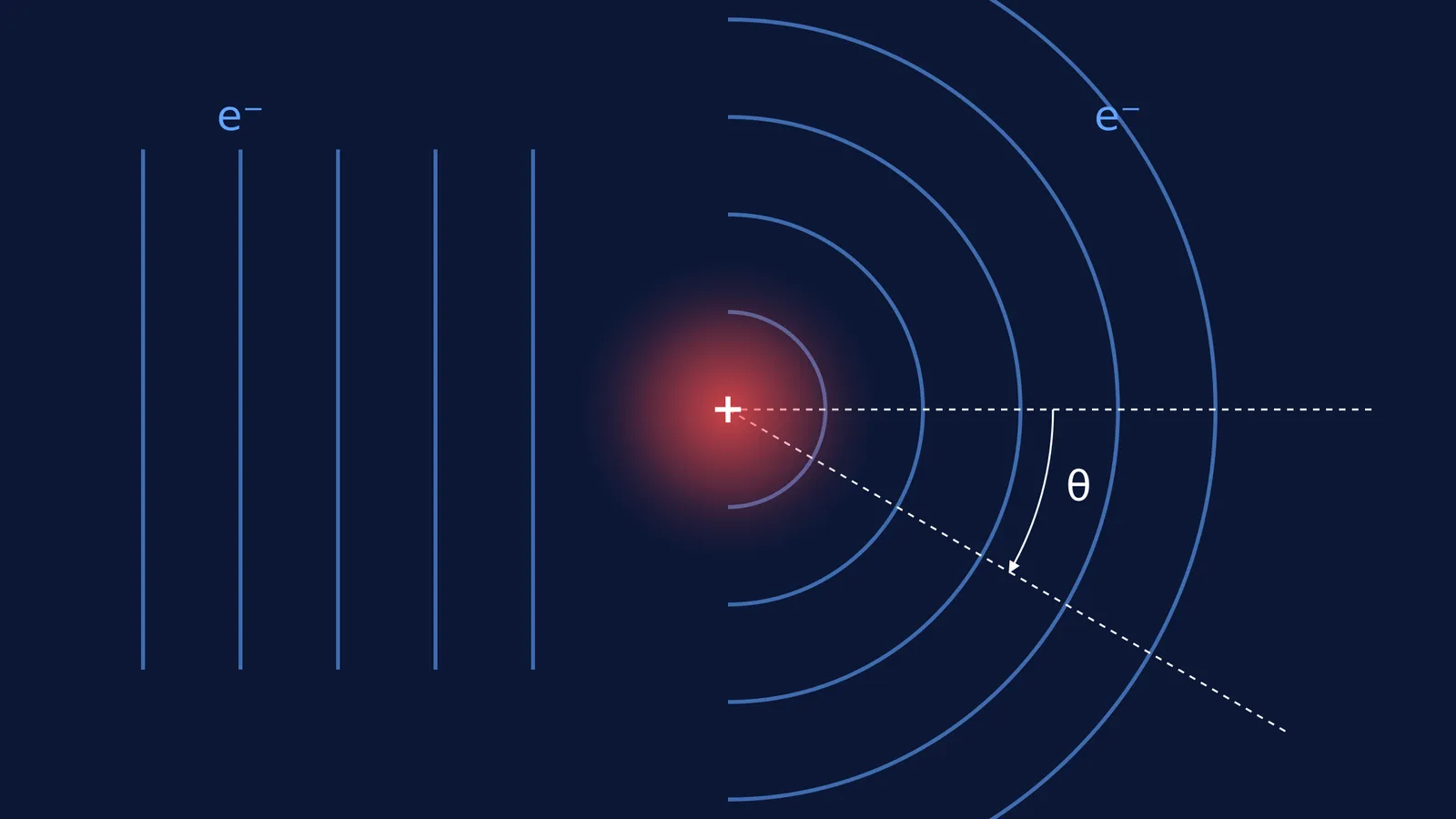
Because of wave-particle duality, fast-moving electrons act as waves. The higher their energy, the shorter their wavelength. In the mid-1950s, Hofstadter used the Mark III linear accelerator at Stanford University, which generated electron beams with energies between 100 MeV and 600 MeV (NobelPrize.org). At these extremely high energies, the electron's wavelength is short enough to resolve details inside the atomic nucleus, acting like an unimaginably powerful microscope.
Hofstadter aimed his electron beam at targets made of liquid hydrogen. Because a hydrogen nucleus is simply a single proton, it provided a perfectly clean target. As the incoming electrons approached the protons, the electric and magnetic forces caused them to deflect, or scatter. By meticulously measuring the number of electrons scattering at different angles, Hofstadter could work backwards to deduce the size and shape of the object they were bouncing off.
To capture these scattered electrons, he used a large magnetic spectrometer (NobelPrize.org). If the proton were a simple point charge, the electrons would scatter according to a predictable mathematical formula. Instead, Hofstadter observed a distinctly different pattern, with fewer electrons bouncing back at large angles than the standard point-particle theory predicted.
What is the proton size and shape?
The scattering pattern proved definitively that the proton is an extended object, not a simple geometric point.
Hofstadter's measurements showed that the proton has a root-mean-square radius of about 0.8 × 10⁻¹³ cm (NobelPrize.org). Today, this length is called 0.8 fermis (fm), a unit Hofstadter himself popularised in honour of Enrico Fermi.
Furthermore, he mapped its complex internal structure. The proton has a dense, positively charged core whose charge density drops off smoothly toward the edges. Rather than a hard sphere like a billiard ball, it behaves more like a fuzzy cloud of charge and magnetism.
He successfully applied the exact same technique to the neutron by using targets of deuterium, or heavy hydrogen. He found that while the neutron has no overall electric charge, its internal structure contains a positive core surrounded by a negative outer shell, adding up to zero. This was a major revelation for the physics community.
What is the wavelength of a 500 MeV electron?
To effectively probe a proton, the electron's wavelength must be similarly small. We can calculate this using high-energy physics principles and the de Broglie wavelength formula (Wikipedia). For the relationship between energy and wavelength, see E = 1240/λ: the quick photon-energy formula in eV and nm.
At very high energies, an electron's speed is so close to the speed of light that its momentum p is roughly E/c. Using the de Broglie wavelength formula λ = h/p:
Substitute momentum to get λ = hc/E.
In useful units, hc ≈ 1240 MeV·fm.
For an electron with energy E = 500 MeV, the wavelength is λ = 1240 / 500 = 2.48 fm.
Since 2.48 fm is exceptionally close to the proton's own size, the electron wave is perfectly scaled to probe its internal charge distribution. You can also read about earlier atomic models in Hantaro Nagaoka and the Saturnian model of the atom or the discovery of the probing particle itself in George Johnstone Stoney, who named the electron.
Understanding atomic structure with Fermi
Understanding complex scattering experiments requires visualising invisible forces, trajectories, and charge distributions. When a textbook explanation of an electric field or an atomic model is hard to picture, the Fermi Simulation Lab provides interactive simulations for the ideas that are easier to see than to read.
If you get stuck calculating the kinetic energy or wavelength of an electron, Fermi's AI tutor works out what you already know and builds a plan for the session. Most learning tools answer questions, but Fermi teaches, guiding you through the reasoning step by step so you sit down to a clear next step.


