

On this page
"Analysis of fruit and vegetable juices for their acidity" is on the CBSE Class 11 chemistry project list, and lemon juice is the obvious juice to start with. It looks like the vinegar titration, but with one important difference: the main acid in lemon, citric acid, gives up three protons, not one. Get that ratio wrong and your answer is three times too large. This guide covers the method, why you see only one end point, which indicator to use, and a fully worked calculation.
Why is lemon juice harder to titrate than vinegar?
Vinegar contains acetic acid, which is monoprotic, so one mole of NaOH neutralises one mole of acid. Our post on how much acetic acid is in vinegar works through that 1 : 1 case.
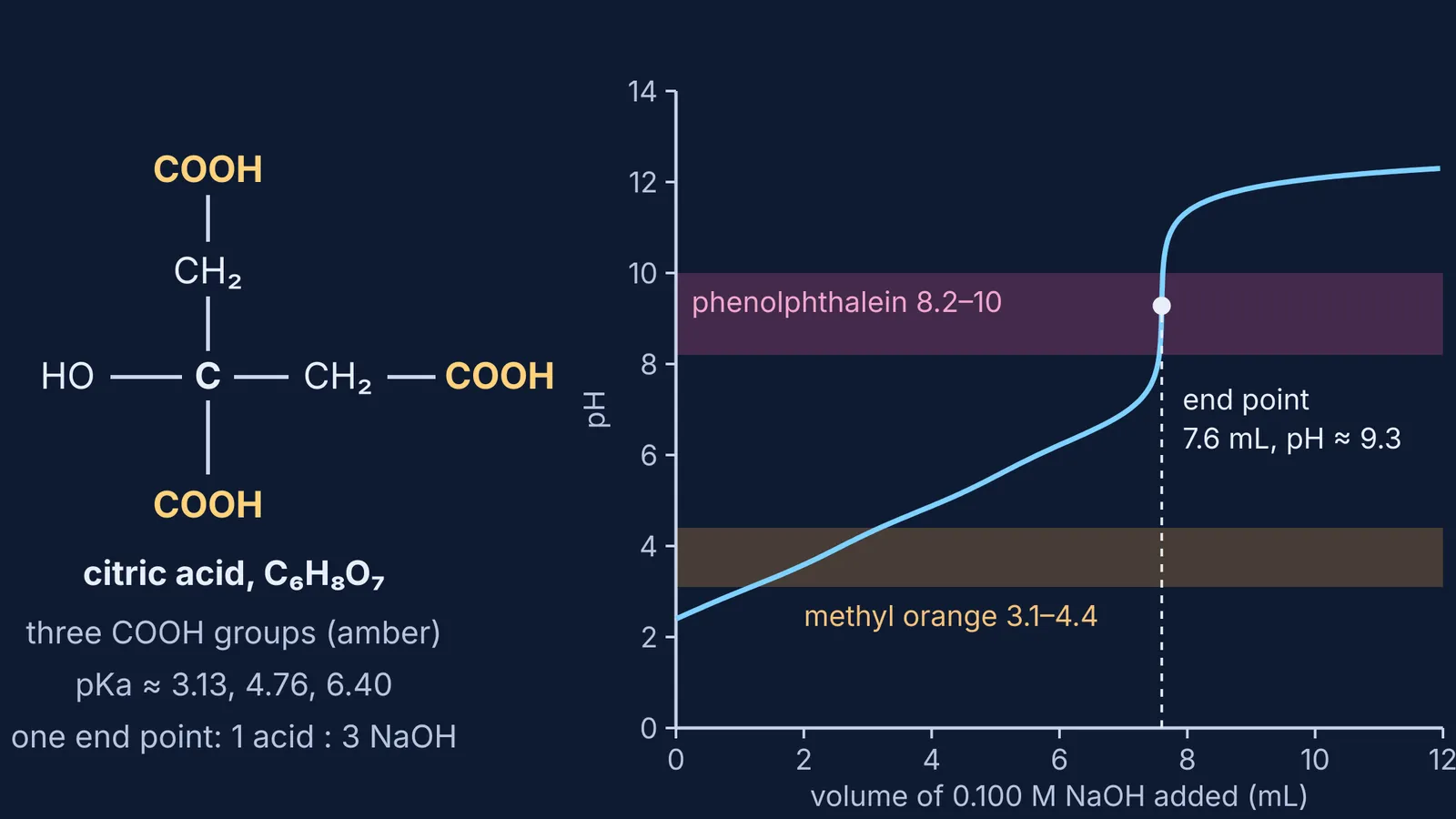
Citric acid (C₆H₈O₇) has three carboxylic acid (–COOH) groups. Its fourth hydrogen-bearing group, the –OH on the central carbon, is far too weakly acidic to react with NaOH under titration conditions, so citric acid is triprotic and tribasic towards NaOH:
C₆H₈O₇ + 3NaOH → Na₃C₆H₅O₇ + 3H₂O
Check it: 6 C, 11 H, 10 O and 3 Na on each side. The key ratio is 1 mol citric acid to 3 mol NaOH.
Why does citric acid give only one end point?
The three protons come off in steps. Typical textbook values at 25 °C are pKa₁ ≈ 3.13, pKa₂ ≈ 4.76 and pKa₃ ≈ 6.40; different tables differ slightly in the second decimal place.
A polyprotic acid shows a separate jump in pH for each proton only when its pKa values are far apart, roughly 4 units or more. Phosphoric acid's values are about 5 units apart, which is why it gives two clear end points; see titrating phosphoric acid with NaOH. Citric acid's values are only about 1.6 units apart. Before the first proton is fully removed, the second is already reacting, and the same happens with the third. The buffer regions merge into one long, gently rising slope.
The result is a single sharp jump at the point where all three protons have been neutralised. In the worked example below, the solution at that point is about 0.014 M sodium citrate. Citrate is a weak base, and its pH works out to about 9.3.
Which indicator should you use, phenolphthalein or methyl orange?
Use phenolphthalein. It changes colour between about pH 8.2 and 10, which sits right on the steep jump near pH 9.3.
Methyl orange changes between about pH 3.1 and 4.4. Calculating the titration curve for the example below, the solution reaches pH 4.4 after only about 3.2 mL of NaOH, while the true end point is at 7.6 mL. With methyl orange you would stop at less than half the real titre, partway through the merged buffer region, and the colour change would be gradual rather than sharp. Our guide to choosing between phenolphthalein and methyl orange explains the general rule: a weak acid against a strong base needs an indicator that changes on the basic side.
How do you do the titration?
Squeeze a fresh lemon and filter the juice through cotton or filter paper to remove pulp and seeds.
Pipette 10.0 mL of juice into a 100 mL volumetric flask and make it up to the mark with distilled water. Diluting ten times keeps your titre to a sensible size and stops the juice's pale colour from hiding the pink.
Pipette 10.0 mL of the diluted juice into a conical flask and add 2–3 drops of phenolphthalein.
Titrate with standardised 0.100 M NaOH until a faint pink colour lasts about 30 seconds.
Repeat until you have concordant titres.
Work under a teacher's supervision and wear goggles; NaOH is corrosive even when dilute.
How do you calculate citric acid from the titre?
The readings below are illustrative, chosen to match a typical lemon.
Data: 10.0 mL of juice diluted to 100 mL. A 10.0 mL aliquot needs 7.6 mL of 0.100 M NaOH.
Moles of NaOH: 0.100 mol L⁻¹ × 7.6 × 10⁻³ L = 7.6 × 10⁻⁴ mol.
Moles of citric acid in the aliquot: divide by 3. 7.6 × 10⁻⁴ ÷ 3 = 2.53 × 10⁻⁴ mol.
Scale up to the original juice: the aliquot was one-tenth of the diluted solution, and all of that came from 10.0 mL of juice. So 10.0 mL of juice held 2.53 × 10⁻³ mol.
Convert to mass: anhydrous citric acid, C₆H₈O₇, has a molar mass of 192.1 g mol⁻¹. 2.53 × 10⁻³ × 192.1 = 0.487 g in 10.0 mL.
Express per litre: 0.487 g × 1000/10.0 = 48.7 g L⁻¹, or about 4.9% (m/v).
So the juice contains about 49 g of citric acid per litre. That matches the figure of about 1.44 g per fluid ounce (roughly 49 g L⁻¹) for fresh lemon juice quoted in our post on natural sources of acids like lemon and tamarind.
What does your answer really measure?
Strictly, the titration measures the total acid that NaOH can neutralise up to the phenolphthalein end point. Lemon juice is mostly citric acid, but it also contains smaller amounts of malic acid and ascorbic acid (vitamin C), and these react with NaOH too. The honest way to state your result is "titratable acidity, expressed as citric acid". That wording is standard in food analysis, and examiners will notice it.
Also state which form of citric acid your molar mass refers to. Anhydrous citric acid is 192.1 g mol⁻¹. Citric acid monohydrate, C₆H₈O₇·H₂O, the form often sold as crystals, is 210.1 g mol⁻¹. With the same titre, the monohydrate figure is 2.53 × 10⁻³ × 210.1 = 0.532 g per 10 mL, or about 53 g L⁻¹. Neither is wrong, but you must say which one you used.
If you want to practise the ratio and dilution steps on more problems, the Fermi Problem Library has titration problems with a step-by-step solver that explains the reasoning.
Checklist for your juice acidity project
Balanced equation written, with the 1 : 3 ratio stated.
Juice filtered and diluted ten times before titrating.
Phenolphthalein used, not methyl orange.
NaOH standardised, and concordant titres recorded.
Dilution factor applied before converting to g L⁻¹.
Result stated as titratable acidity expressed as citric acid, with anhydrous or monohydrate named.


