

On this page
A sour taste is your first clue that a food contains an acid. NCERT's Class 10 science chapter Acids, Bases and Salts reminds you that acids are sour in taste and turn blue litmus red, and its Table 2.3, "Some naturally occurring acids", is the list most Indian students are asked to learn. Here it is, with the numbers behind it and two places where research tells a fuller story. If you want the basics first, start with our guide to acids and bases from Class 7.
Which acid is in lemon, curd, tamarind and tomato?
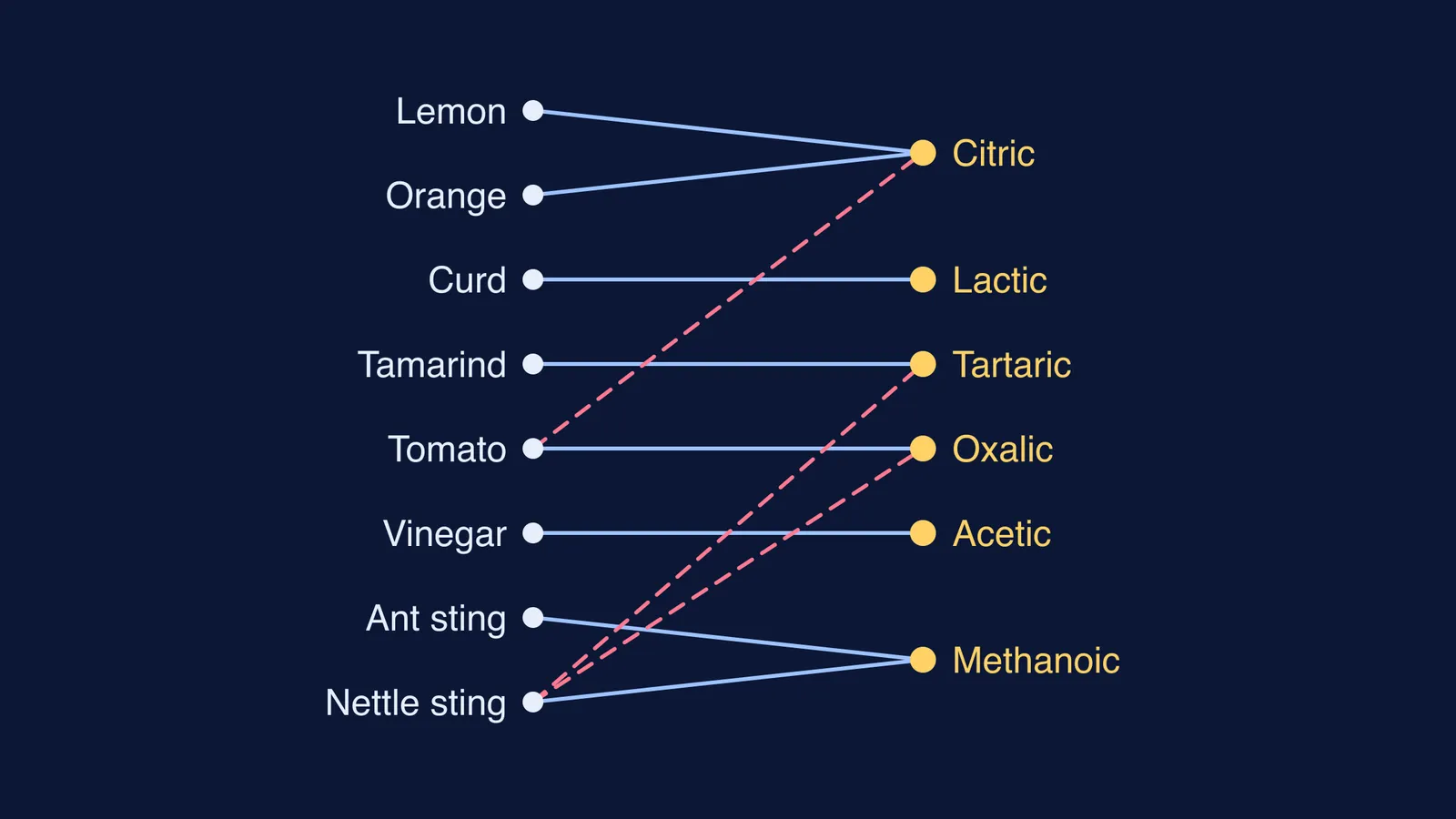
NCERT's Table 2.3 matches eight natural sources to their acids (NCERT Class 10 Science, Chapter 2):
Lemon: citric acid
Orange: citric acid
Sour milk (curd): lactic acid
Tamarind: tartaric acid
Tomato: oxalic acid
Vinegar: acetic acid
Ant sting: methanoic acid
Nettle sting: methanoic acid
Methanoic acid and formic acid are two names for the same compound (PubChem, formic acid). So you have six acids to learn, not eight.
How much acid is in lemon juice and tamarind?
Fresh lemon juice contains 1.44 g of citric acid per fluid ounce, and fresh lime juice 1.38 g, according to a 2008 study in the Journal of Endourology (Penniston and colleagues, 2008). One fluid ounce is about 29.6 mL, so that works out to roughly 49 g per litre, or about 0.7 g in a 15 mL tablespoon of juice. In the same study, commercial lemonades held only 0.03 to 0.22 g per ounce. The NCERT chapter puts the pH of lemon juice at about 2.2.
In a study of 16 tamarind genotypes from the Bastar region of Chhattisgarh, the titratable acidity of the pulp, expressed as tartaric acid, ranged from 7.97% to 19.59% across genotypes, averaged over two seasons (Shukla and Singh, Journal of Pharmacognosy and Phytochemistry, 2019). The pH of the pulp ran from 2.59 to 3.47.
Curd's lactic acid is made by the bacteria that set the milk. Our explainer on how lactic acid bacteria turn milk into curd covers the biology.
Why do ant stings and nettle leaves burn?
NCERT says the stinging hairs of nettle leaves inject methanoic acid, causing a burning pain, and notes that a bee sting leaves an acid that a mild base like baking soda can ease (NCERT Class 10 Science, Chapter 2).
Not every ant sprays acid, though. A 2025 review in Myrmecological News reports that the venoms of the non-stinging ant subfamily Formicinae largely consist of concentrated formic acid (Koch, Niedermeyer and Tragust, 2025). The same review notes that the venoms of most other ant subfamilies are commonly peptidic and are delivered by injection with well-developed stings.
Is tomato's acid really oxalic acid?
This is where the textbook simplifies. A 2018 paper on measuring acids in tomatoes states that citric acid is the dominant organic acid at all stages of ripening, while unripe green tomatoes may also contain significant amounts of malic acid (Agius and colleagues, MethodsX, 2018).
The nettle story has a twist too. Researchers who analysed the stinging hairs of the nettle Urtica thunbergiana found histamine, oxalic acid and tartaric acid as the major constituents, with formic acid present only at a low concentration (Fu and colleagues, Annals of Botany, 2006). In their tests on rats, 2% oxalic acid and 10% tartaric acid caused persistent pain, while 10% formic acid caused only moderate pain in the first 10 minutes. That was one nettle species, so treat it as a refinement, not a rewrite.
How can you learn the pairs in ten minutes?
Try this plan once today and once again a few days later:
Group by acid, not by food: citric (lemon, orange), lactic (curd), tartaric (tamarind), oxalic (tomato), acetic (vinegar), methanoic (ant sting, nettle sting).
Add sound hooks: CITrus goes with CITric, TAmarind with TArtaric, and the two stings share one acid.
Cover the list and write both columns from memory. Tick what you got right and redo only the misses.
Test the kitchen: make a china rose natural indicator and try lemon juice, vinegar and tamarind water in it.
Answer three questions aloud: which acid sours curd, why NCERT suggests baking soda for a bee sting, and why the textbook's tomato pair is a simplification.
If a pair will not stick because the idea behind it is fuzzy, such as what makes an acid weak, the Fermi Concept Library has a lesson on every concept in chemistry, each with its place in the map.
When the chapter moves on to neutralisation and pH numericals, the Fermi Problem Library has worked problems with a step-by-step solver that explains the reasoning.


