

On this page
A China rose, also known as hibiscus or *gudhal*, is more than just a garden flower. It contains natural pigments called anthocyanins, which change their molecular structure—and their colour—depending on the concentration of hydrogen ions in their environment (source).
This makes the flower an excellent natural pH indicator, a topic covered in the NCERT Class 7 Science curriculum. While professional chemists might use a glass electrode (the precursor to which was invented by Arnold Beckman), a simple flower extract provides a vivid, accessible way to see acid-base chemistry in action.
How do you prepare China rose indicator?
Creating your own indicator takes about 15 minutes and requires no special laboratory equipment. Here is the standard method recommended for school science projects (source):
Collect a handful of fresh China rose (hibiscus) petals. You will need about five to ten large petals to get a strong concentration of the pigment.
Place the petals in a clean glass, beaker, or small bowl.
Pour warm water over the petals until they are just covered. Do not use boiling water, as extreme heat can degrade the delicate anthocyanin molecules, but the water must be warm enough to extract the pigment efficiently.
Keep the mixture undisturbed for 10 to 15 minutes. You can gently stir or press the petals with a spoon to help release the colour.
Watch as the water becomes coloured. Once it turns a distinct light pink or maroon, remove the petals or pour the liquid through a simple kitchen strainer.
This coloured liquid is your natural indicator, ready to test the pH of everyday substances.
What colour is China rose in acid and base?
When you add a few drops of the indicator to different solutions, it reacts rapidly to the pH level of the mixture. The NCERT textbook specifies three key macroscopic observations for this natural indicator:
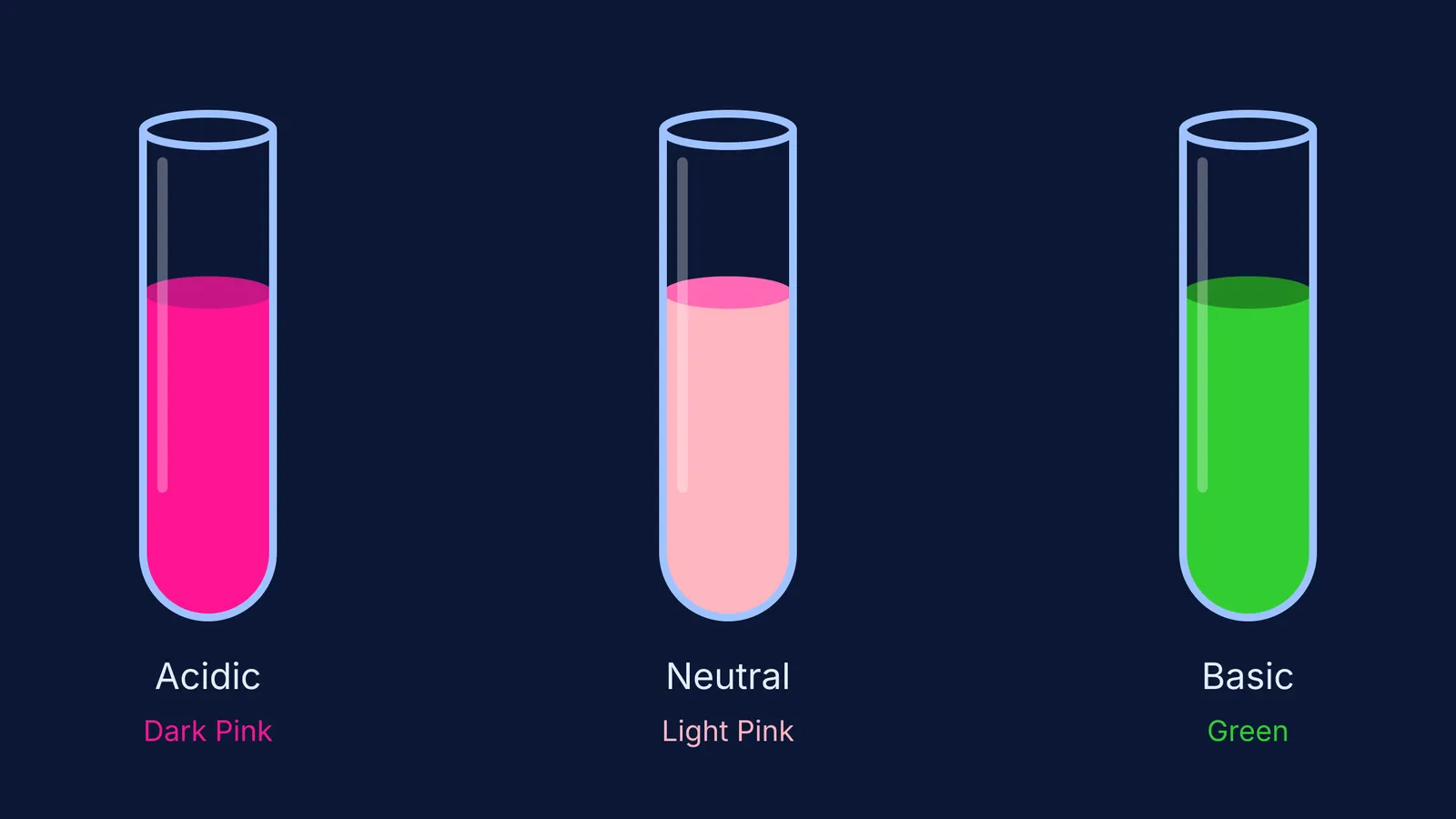
Acidic solutions: The indicator turns a deep, dark pink or magenta.
Basic solutions: The indicator turns a distinct green.
Neutral solutions: The colour does not change, remaining its original light pink or maroon.
Natural indicators like the China rose give an instant visual clue about a solution's chemical nature. If you are exploring how temperature affects neutral solutions, you might also read about the 50 °C Rule for pH 7 to see why true neutrality is not always exactly at pH 7.
How do anthocyanins change colour?
The chemistry behind the colour shift is rooted in a structural transformation of the pigment molecules. Anthocyanins contain a central molecular structure called the flavylium cation, which is highly sensitive to the concentration of hydrogen ions (H⁺) in its surroundings.
In an acidic environment (where protons are abundant, meaning pH is less than 7), the flavylium cation holds onto its positive charge. This specific molecular geometry allows it to absorb blue and green light, reflecting back an intense pink or red colour to our eyes.
As the environment becomes more basic (pH rises above 7), the concentration of protons drops significantly. The anthocyanin molecule undergoes a rapid acid-base reaction called deprotonation—it loses a proton. This loss alters the way the molecule's electrons are delocalised and arranged across its rings. The structural shift changes the specific wavelengths of light the molecule absorbs, causing the visible colour to shift from pink to purple, and eventually to green or yellow in the basic household solutions you might test.
If you want to understand the molecular structures behind these chemical reactions rather than just memorising the colour changes, you can explore the Fermi Concept Library, where every concept in chemistry has its own lesson and its place in the map.
How to test household items for pH?
You can set up a simple, hands-on experiment to classify common items found in a kitchen or bathroom. This active learning approach is far more effective than simply reading a list of acidic and basic substances.
Create a small data table in your notebook and test these five common substances by adding five drops of your China rose indicator to a small spoonful of each sample:
Lemon juice: An acid (rich in citric acid), which should immediately turn the indicator dark pink.
Vinegar: A common household acid (acetic acid), which will also turn the indicator dark pink.
Sugar solution: A neutral substance. When you add the indicator to sugar dissolved in water, the liquid will remain light pink.
Baking soda solution: A mild base (sodium bicarbonate). Dissolve a pinch in water, add the indicator, and watch it turn green.
Soap or shampoo (dilute): These cleaning agents are often formulated as mild bases, which should turn the floral extract green.
You can also use a buffer solution simulation to see how a liquid can resist these exact pH changes when small amounts of acid or base are added. Testing your own environment turns an abstract textbook rule into a memorable, visible scientific fact.


