

On this page
Measuring acidity used to be a messy, fragile business. Chemists relied on colour-changing papers that could be bleached, or delicate glass setups that broke easily in a busy lab. That changed when Arnold Beckman built his first acidity meter in 1934 for a citrus growers' exchange, turning a sensitive laboratory method into a tough, portable box.
Who invented the pH meter?
The first commercially successful electronic pH meter was invented in 1934 by Arnold O. Beckman, an assistant professor of analytical chemistry at the California Institute of Technology. He initially called his invention an "acidimeter". He manufactured the device under his company, National Technical Laboratories, which sold 444 units in its first full year of sales in 1936.
Before his invention, chemists struggled to get accurate acidity readings outside of highly controlled academic settings. His device provided a stable, electronic reading, paving the way for the modern analytical lab. Today, mastering the mathematics of acidity requires understanding how hydrogen ions behave in different conditions, from calculating the pH of 10⁻⁸ M HCl: why water's H⁺ cannot be ignored to knowing why Neutral pH is not always 7: how Kw changes with temperature.
Why did Arnold Beckman invent the pH meter?
The invention began with a practical, industrial problem in the California citrus industry. Glen Joseph, a chemist working for the California Fruit Growers Exchange, needed a reliable way to measure the acidity of lemon juice. The juice was often treated with sulfur dioxide as a preservative, which bleached traditional litmus paper and poisoned standard hydrogen electrodes.
Joseph attempted to use glass electrodes, which were less sensitive to chemical interference. However, these early glass electrodes had to be made extremely thin to pass an electrical current, making them far too fragile for everyday laboratory work.
Frustrated by broken glass, Joseph asked his friend Arnold Beckman for help. Beckman realised that the standard measuring tool of the time, the galvanometer, simply required too much current to read the faint signals coming from the glass.
How did the first pH meter work?
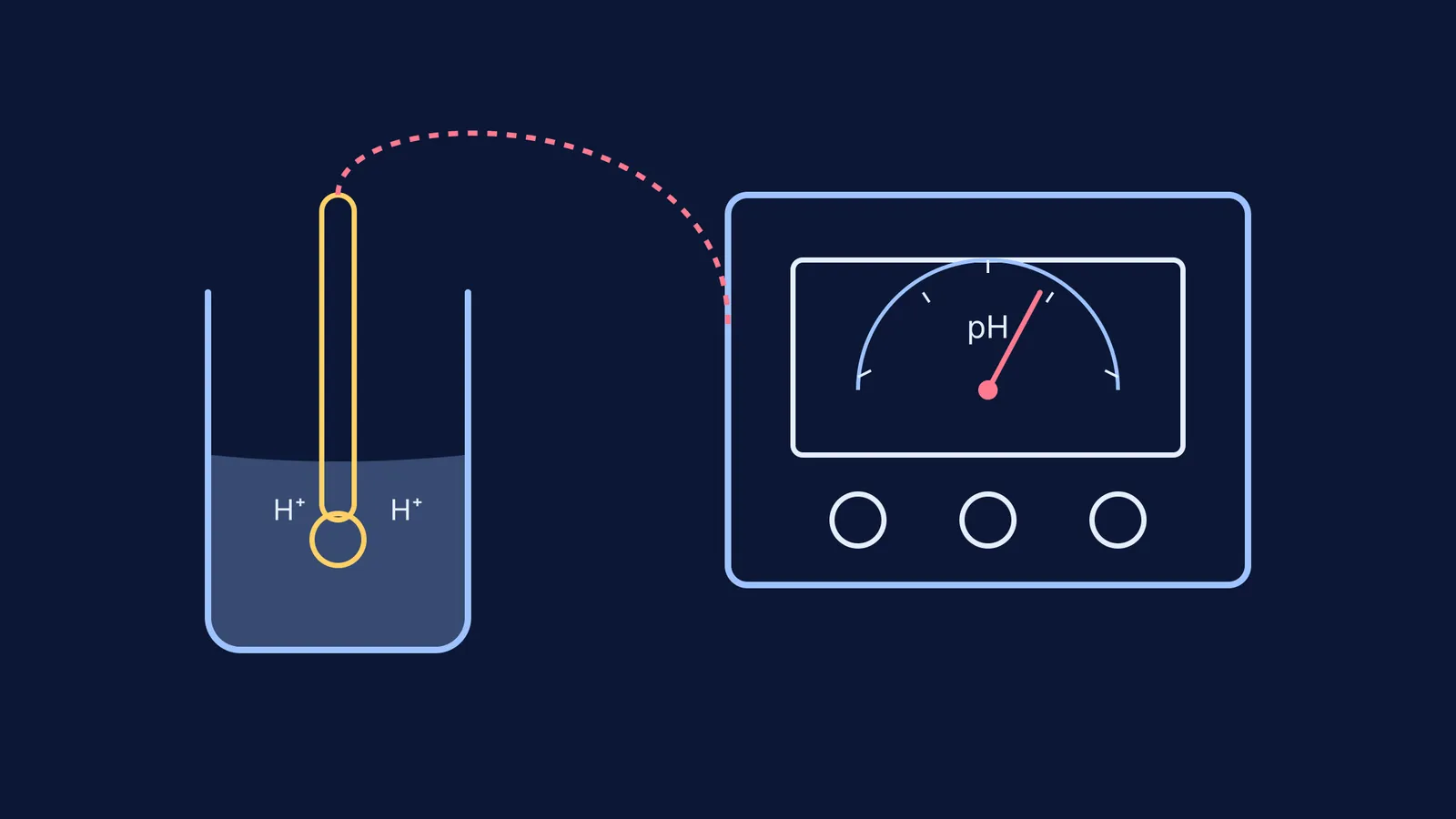
Beckman's major innovation was to use vacuum tubes to amplify the weak electrical signals. By feeding the tiny current from the glass electrode into the grid circuit of a vacuum tube, he could boost the signal enough to move the needle on a standard, robust voltmeter.
This amplification meant that the glass electrodes could be manufactured with thicker, much more rugged walls. Beckman packaged the electronic amplifier, the glass electrodes and the meter into a single, portable walnut box. It was a complete, integrated system that a technician could carry anywhere in the plant.
When you study acid-base equilibria today, you learn about principles like Conjugate acid-base pairs: Ka × Kb = Kw and what it tells you. The mathematics of these equilibria can be intricate, and getting stuck on a derivation is common. Fermi's AI tutor can work out what you already know and build a plan for the session, writing on a board and checking your understanding as it goes.
What was the impact of the invention?
When Beckman introduced his device at the American Chemical Society national meeting in San Francisco in September 1935, experts were sceptical about its broad appeal. Some predicted a maximum market saturation of only 600 units over ten years.
Instead, the demand was overwhelming. By 1939, nearly 2,000 units had been sold. This success led Beckman to resign from his professorship at Caltech to run his instrument company full-time. The ability to quickly and reliably measure pH altered biology, chemistry and medicine. It allowed for the mass production of penicillin, better agricultural testing, and the precise control of industrial chemical processes.
The American Chemical Society designated the Beckman pH meter as a National Historic Chemical Landmark on 24 March 2004. It stands as a perfect example of how solving a local, specific problem can lead to a tool that changes science globally.
If you are exploring the vast array of chemical concepts that build upon these fundamental measurements, the Fermi Concept Library contains every concept in physics, chemistry, biology, mathematics and computing, each with its own lesson and its place in the map.
A practical framework for learning analytical chemistry
When studying chemical discoveries and instrumental techniques like Beckman's, use this three-step framework to connect the history to your syllabus. It helps you see the physics behind the chemistry:
Identify the analytical problem: What was the limitation of the old method? (For example, sulfur dioxide bleached the indicators).
Note the physical principle: How did physics solve the chemistry problem? (Beckman used vacuum tube amplification to measure a weak current without drawing power).
Link it to modern concepts: How does this apply to your current studies? (Modern pH meters still rely on measuring potential differences, connecting directly to the Nernst equation).
By understanding the physical problem the inventor was trying to solve, you build a stronger intuition for the chemical principles at play.


