

On this page
If you have finished our first set of circles JEE Main practice questions with solutions, this is the next step: eight original questions, medium to hard, several joining two ideas in one question.
What does JEE Main 2027 test in circles?
Circles sit in Unit 10, Co-ordinate Geometry, of NTA's JEE (Main) 2027 syllabus, which lists the standard and general forms of a circle, its radius and centre, the circle on a given diameter, and where a line meets a circle centred at the origin. Orthogonal circles, families and common tangents are not named there; the questions below build them from those same equations.
The JEE (Main) 2027 Information Bulletin gives Mathematics 20 MCQs and 5 numerical-value questions in Paper 1, with +4 marks for a correct MCQ and −1 for a wrong one. Picking the trap instead of the answer costs you five marks.
Medium: can you link two circles, or a circle and a locus?
Q1. The circles x² + y² − 6x + 4y + k = 0 and x² + y² + 2x − 8y + 5 = 0 cut orthogonally. Then k is: (A) −27 (B) −16 (C) 17 (D) −17
Answer: (A). For orthogonal circles, 2g₁g₂ + 2f₁f₂ = c₁ + c₂, so 2(−3)(1) + 2(2)(−4) = −22 = k + 5 and k = −27. Trap: (B) drops the factor 2. Check: the centres are √52 apart and r₁² + r₂² = 40 + 12 = 52.
Q2. The length of the common chord of x² + y² − 4x − 6y − 12 = 0 and x² + y² + 4x + 2y − 4 = 0 is: (A) 2√7 (B) √7 (C) 4√2 (D) 2√2
Answer: (A). Subtracting gives the chord x + y + 1 = 0, which is 3√2 from the centre (2, 3) of the radius-5 circle, so the half-chord is √(25 − 18) = √7. Trap: (B) stops at the half-chord. Check: from (−2, −1), radius 3, the distance is √2 and 9 − 2 = 7.
Q3. The locus of the midpoints of chords of x² + y² = 16 that subtend a right angle at the centre is: (A) x² + y² = 8 (B) x² + y² = 4 (C) x² + y² = 32 (D) x² + y² = 12
Answer: (A). A chord subtending 90° at O is 4 cos 45° = 2√2 from O, so its midpoint satisfies h² + k² = 8. Trap: (C) is the director circle. Check: the chord from (4, 0) to (0, 4) has midpoint (2, 2).
Q4. The circle through the origin and the points where x + y = 1 meets x² + y² = 9 is: (A) x² + y² − 9x − 9y = 0 (B) x² + y² + 9x + 9y − 18 = 0 (C) x² + y² − x − y = 0 (D) x² + y² + 9x + 9y = 0
Answer: (A). Every such circle is x² + y² − 9 + λ(x + y − 1) = 0, and the origin gives λ = −9. Trap: (B) takes λ = +9. Check: on the line, x² + y² − 9(x + y) = 9 − 9 = 0.
Hard: can you combine tangents, families and complex numbers?
Q5. The number of common tangents to x² + y² − 2x − 4y − 4 = 0 and x² + y² + 4x + 6y + 4 = 0 is: (A) 1 (B) 2 (C) 3 (D) 4
Answer: (B). The centres (1, 2) and (−2, −3), both radius 3, are √34 apart, less than 6, so the circles cut. Trap: (D) compares 34 with r₁² + r₂² = 18, not (r₁ + r₂)² = 36. See the conditions for two circles to touch.
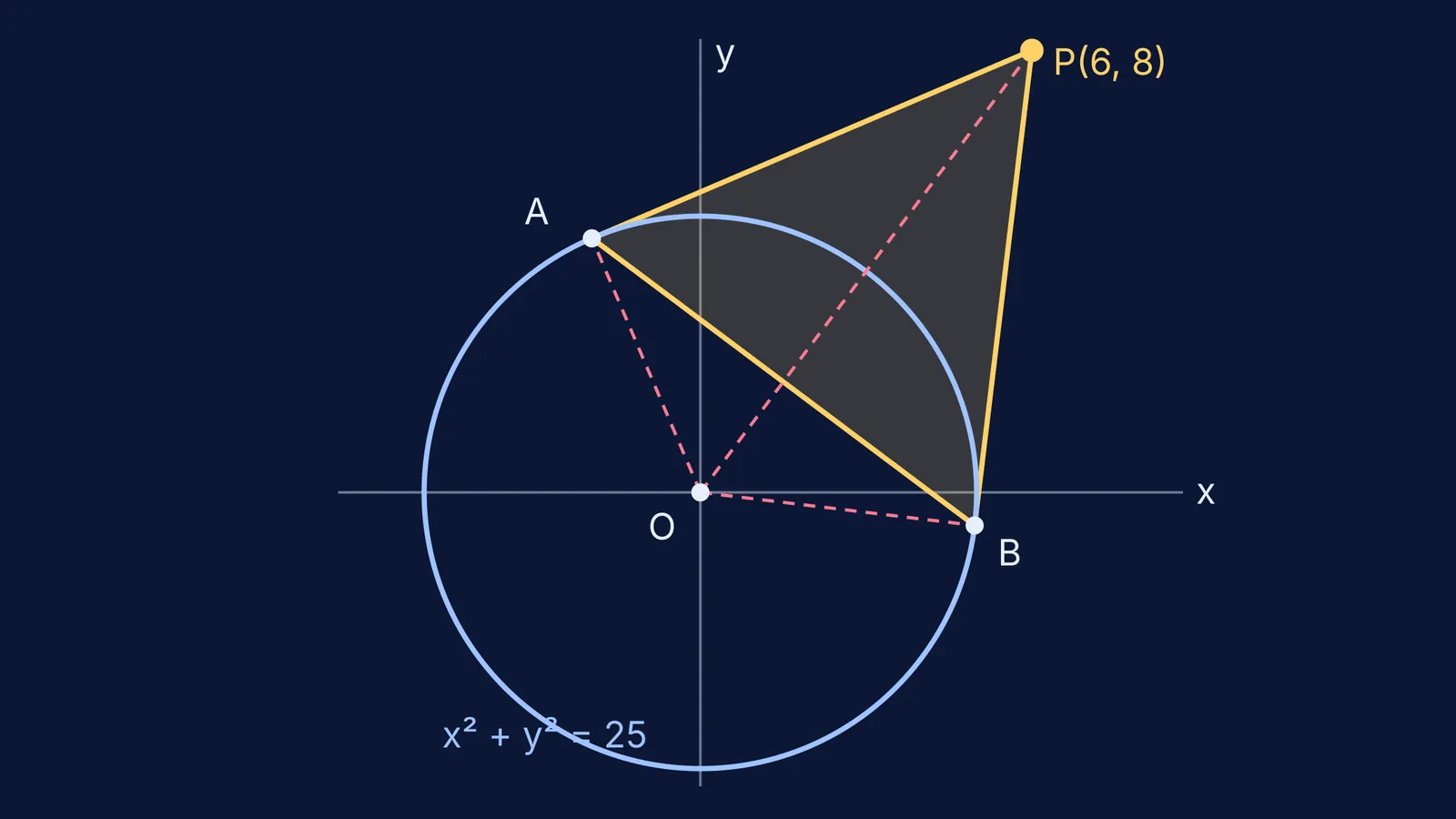
Q6. Tangents from P(6, 8) touch x² + y² = 25 at A and B. The area of triangle PAB is: (A) 75√3/4 (B) 25√3 (C) 75√3/2 (D) 25√3/2
Answer: (A). The chord of contact 6x + 8y = 25 is 2.5 from O, so AB = 2√(25 − 6.25) = 5√3, and P is 7.5 from it. Area = ½ × 5√3 × 7.5 = 75√3/4. Trap: (B) is the area of OAPB. Check: sin(∠APB/2) = 5/10, so PAB is equilateral with side 5√3.
Q7. The circle that touches x + y = 2 at (1, 1) and passes through (3, 3) is: (A) x² + y² − 4x − 4y + 6 = 0 (B) x² + y² = 2 (C) x² + y² − 6x − 6y + 10 = 0 (D) x² + y² − 4x − 4y + 4 = 0
Answer: (A). Use (x − 1)² + (y − 1)² + λ(x + y − 2) = 0; (3, 3) gives 8 + 4λ = 0, so λ = −2. Trap: (B), from λ = +2, touches the line at (1, 1) but misses (3, 3). Check: the centre (2, 2) is √2 from the line, equal to the radius.
Q8. The locus of z with |z − 1| = 2|z + 2| is: (A) a circle, centre −3, radius 2 (B) a circle, centre 3, radius 2 (C) a circle, centre −3, radius 4 (D) a straight line
Answer: (A). Squaring, (x − 1)² + y² = 4[(x + 2)² + y²], so x² + y² + 6x + 5 = 0. Trap: (D) is the ratio-1 case. Check: z = −1 and z = −5 satisfy it and are the ends of a diameter.
How should you use this second set?
Do all eight in one timed sitting, without notes.
Label each miss: a sign, a dropped factor, half a length, or the wrong locus.
Later in the week, redo the misses from both sets with one number changed, then revise with our guide on how to prepare circles for JEE Main.
If you can follow a solution but could not have started it yourself, the Fermi Problem Library has worked problems with a step-by-step solver that explains the reasoning. For the rest of the syllabus, see Fermi Test Prep for JEE Main and Advanced preparation.


