

On this page
On a hot afternoon a tree can buzz loudly, yet the noise comes from an insect you could hold in your palm. The trick is two parts working together: a clicker that snaps like a tin-can lid, and a hollow body tuned to ring at the same pitch.
What is a cicada's tymbal?
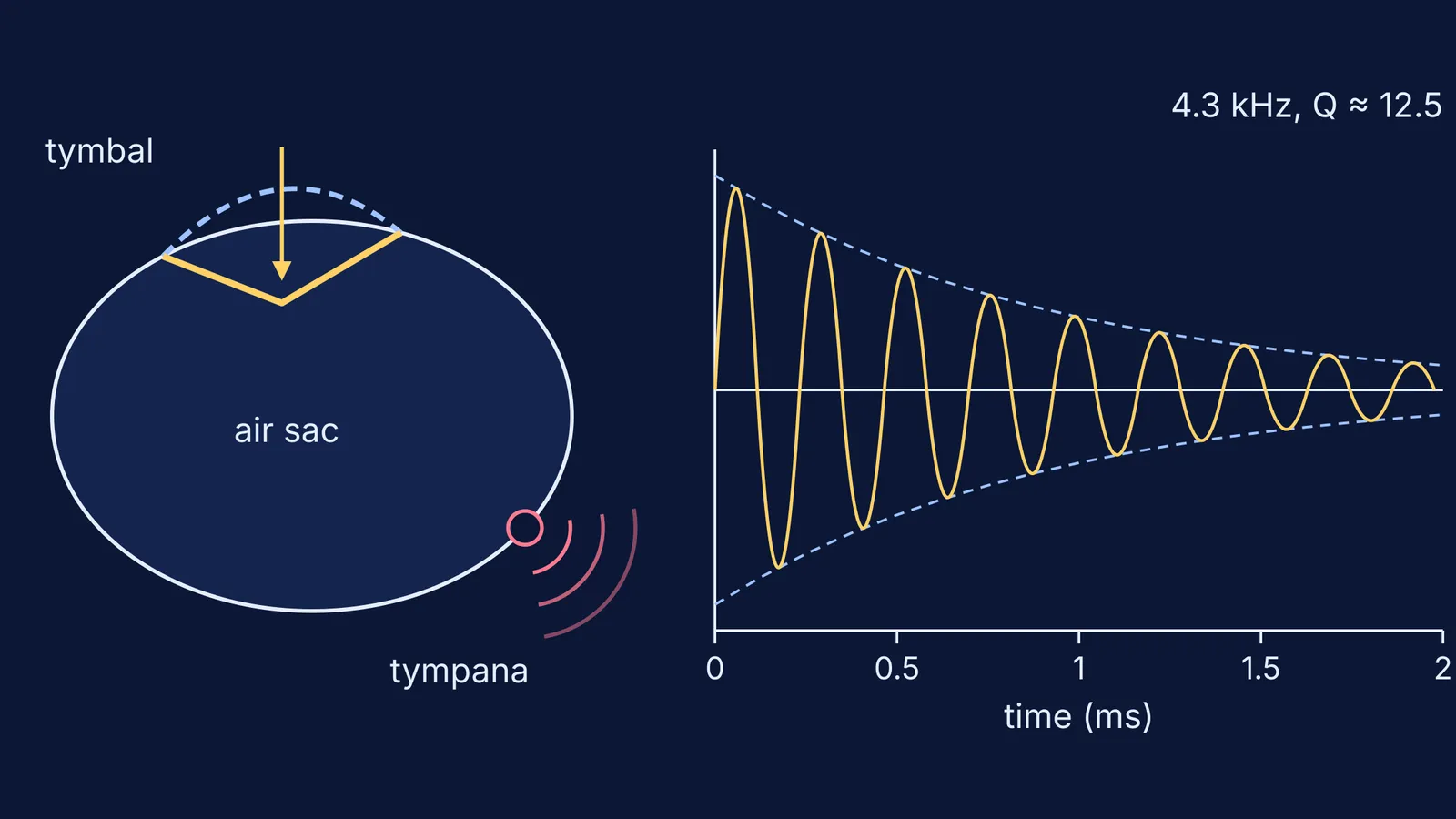
The tymbal is a ribbed, drum-like plate in a male cicada's body wall that a muscle pulls inward until it buckles with a click. The clearest measurements come from a 1995 study by D. Young and H. C. Bennet-Clark on the Australian cicada *Cyclochila australasiae*:
The tymbal is a curved membrane with alternating long and short ribs and a stiffer tymbal plate, joined by flexible cuticle containing resilin, a springy protein.
The tymbal muscle pulls the plate inward like a lever, so the tymbal surface moves more than twice as far as the muscle shortens.
The long ribs buckle one after another, each snapping from a curved shape to a V shape at its narrow middle.
The inward buckle makes a loud click with a dominant frequency around 4 kHz.
A resilin pad springs the tymbal back out; that out-click is more than 20 dB quieter.
Press the lid of a tin can and you feel the same snap-through: the curved metal holds, then suddenly flips and clicks. The cicada does this with each of its two tymbals, again and again. Like every sound, the call starts with something vibrating, as our post on how vibrating objects produce sound explains.
Why is a cicada's abdomen hollow?
A click from a tiny plate would be weak in open air. The cicada fixes this with its abdomen, which in males holds a large air sac.
In a 1992 study using dried cicadas and model cicadas built from a miniature earphone and a plastic cavity, Bennet-Clark and Young concluded that the male abdomen forms a Helmholtz resonator, with the air sac as the cavity and the thin eardrums (tympana) as its neck. It is the same physics as the hum you get by blowing across a bottle. The model resonated at the species' natural song frequency, 4.3 kHz, and in a gas in which sound travels more slowly the resonance dropped, as the physics predicts.
Each inward buckle pushes about 6 µl of volume into an air sac of about 2 ml, and the peak sound pressure inside the sac reaches 155–159 dB SPL (Young and Bennet-Clark, 1995). The same authors' conference abstract states the abdomen's job: it is resonant at the tymbal's frequency and provides acoustic matching between the tymbals and the surrounding air.
Resonance is easier to see than to read about, which is what the interactive simulations in the Fermi Simulation Lab are for.
How loud can a cicada get?
Guinness World Records lists the shrill thorntree cicada, *Brevisana brevis*, as the loudest insect, with a calling song averaging 106.7 decibels measured 50 cm away. Do not compare that with the 155–159 dB figure above: that was measured inside the body of a different species, right at the source, and sound weakens as it spreads.
How is a cricket's chirp different from a cicada's?
Crickets use friction, not buckling. A 2009 study by Fernando Montealegre-Z and colleagues describes how a male cricket's left forewing carries a scraper (the plectrum) that sweeps along a row of teeth (the file) on the right forewing. Each tooth produces one wave of a pure tone. Wing areas such as the harp resonate at the rate of tooth strikes, and both wings must vibrate in step so their sound adds up rather than cancelling.
Cicada: a muscle buckles a ribbed plate that rings at the song pitch; the hollow abdomen resonates with it.
Cricket: a scraper runs along a toothed file; thin wing patches are the resonators.
Both: a fast, repeated mechanical event drives a part tuned to the same frequency, so the sound is loud and almost single-pitched.
Crickets also chirp faster on warm nights.
How can you test the resonator idea at home?
You need an empty glass bottle, some water and five minutes.
Blow gently across the mouth of the bottle until it hums. That is the air inside resonating, like the cicada's air sac.
Pour in some water so there is less air, and blow again. The note goes up, as our post on how water level changes a bottle's pitch explains.
Press your palm flat over the mouth and pull it away quickly. The short pop, like a tymbal click, makes the air ring at about the pitch you got by blowing.
For a short exam answer, three sentences cover it: "A muscle buckles the tymbal inward, making a click. The air-filled abdomen resonates at the same frequency and amplifies the click. Crickets instead rub a scraper along a toothed file on their wings."
To link resonance, natural frequency and sound waves into one picture, the Fermi Concept Library gives every physics concept its own lesson and its place in the map.


