

On this page
Drop a blue crystal of copper sulphate into a beaker of diluted water glass, and within minutes a blue tube starts growing up from it like a stem. Add a crystal of iron(III) chloride and an orange-brown one follows. This is a chemical garden. It looks like biology, but it is two pieces of Class 12 chemistry working together: a precipitate that forms its own semipermeable membrane, and osmosis pushing water through it.
What is a chemical garden?
A chemical garden is a set of hollow, coloured tubes that grow when crystals of a soluble metal salt sit in a solution of sodium silicate. Sodium silicate solution is sold as water glass. It is a mixture of silicate anions in water, and for simple equations you can write it as Na₂SiO₃.
The tubes are not crystals and they are not alive. They are thin walls of amorphous metal silicate and metal hydroxide gel. The effect has been known since the seventeenth century, and it is still studied today as a model for how mineral structures self-assemble.
Why does a membrane form around the crystal?
As soon as the crystal starts to dissolve, its metal ions meet silicate ions at the crystal surface and precipitate. In simplified form:
Cu²⁺ + SiO₃²⁻ → CuSiO₃(s)
Ca²⁺ + SiO₃²⁻ → CaSiO₃(s)
Water glass is also alkaline, because silicate hydrolyses: SiO₃²⁻ + H₂O ⇌ HSiO₃⁻ + OH⁻. So some metal hydroxide forms too, for example Fe³⁺ + 3OH⁻ → Fe(OH)₃(s), which is why the iron tubes are rust-brown. Real walls are hydrated mixtures, so treat these equations as idealised.
The precipitate coats the crystal in a thin skin within seconds. That skin lets water through much more easily than it lets the dissolved ions through. It is a semipermeable membrane that builds itself. If you have only seen a membrane as a fixed sheet, as in the osmosis simulation with a semipermeable membrane, this is the same idea with a membrane that is made by a reaction.
The history is close to NCERT too. In the 1860s Moritz Traube made membranes by precipitating copper ferrocyanide, and Wilhelm Pfeffer later deposited such membranes in porous pots to make the first measurements of osmotic pressure. You can read that story in how Wilhelm Pfeffer measured osmotic pressure.
How does osmosis make the tubes grow?
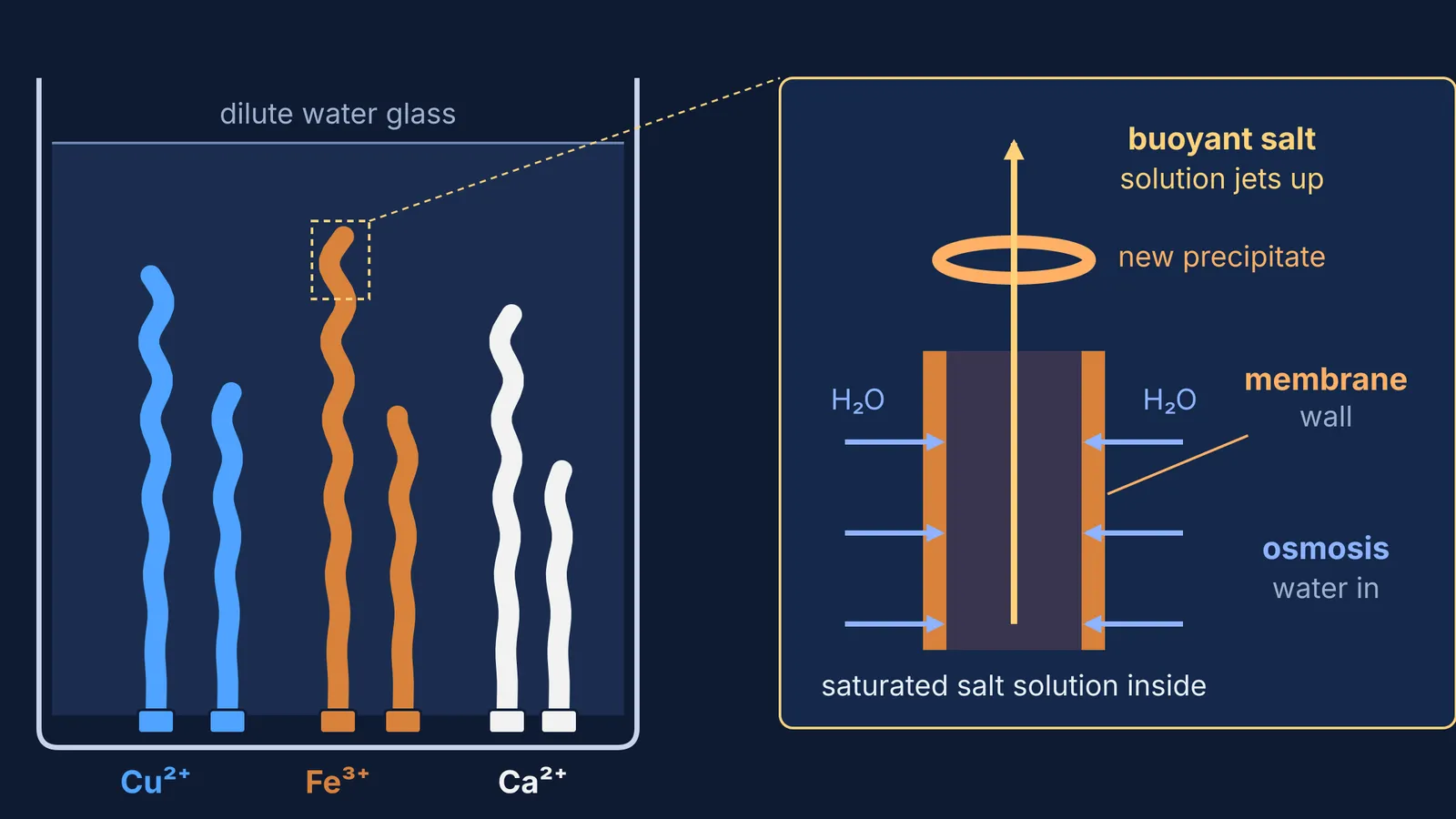
Follow one crystal step by step:
Inside the membrane the crystal keeps dissolving, so the liquid there is close to a saturated salt solution.
Outside is the more dilute silicate solution. Water flows in, from the side with fewer dissolved particles to the side with more. This is osmosis.
Pressure builds inside the skin, so it swells and finally ruptures, usually at a weak point near the top.
A jet of salt solution escapes. Where it meets silicate, it precipitates a new ring of membrane. The jet keeps moving up, so the tube grows upward.
The cycle repeats for as long as there is crystal left to dissolve.
Why upward? The leaking metal salt solution is less dense than the surrounding water glass, so it rises by buoyancy. Growth needs osmosis and buoyancy together: osmosis bursts the membrane, and buoyancy steers the escaping solution upward.
How big is the osmotic push? A worked example
Use van 't Hoff's equation, π = iCRT, for an ideal upper bound. If the equation is new, see why π = CRT works.
Inside: saturated CuSO₄. Tables give the solubility of CuSO₄ as about 20–22 g of anhydrous salt per 100 g of water near room temperature (values differ slightly between tables). Take 20.7 g per 100 g.
Molar mass of CuSO₄ = 63.55 + 32.06 + 4(16.00) ≈ 159.6 g mol⁻¹.
Molality = 20.7 ÷ 159.6 ÷ 0.100 kg ≈ 1.30 mol kg⁻¹. The solution is dense, about 1.2 g mL⁻¹, so the molarity is also close to 1.3 mol L⁻¹.
CuSO₄ → Cu²⁺ + SO₄²⁻, so the ideal i = 2.
π(inside) = 2 × 1.3 × 0.0821 × 298 ≈ 64 atm.
Outside: about 0.5 mol L⁻¹ Na₂SiO₃. Na₂SiO₃ → 2Na⁺ + SiO₃²⁻, so the ideal i = 3.
π(outside) = 3 × 0.5 × 0.0821 × 298 ≈ 37 atm.
Net push inwards ≈ 64 − 37 ≈ 27 atm.
That is the ideal value. It would hold up a column of water about 280 m tall. A wall a fraction of a millimetre thick could never hold that, and it doesn't have to, because the real pressure is far smaller:
Ion pairing. A 2:2 salt like CuSO₄ pairs strongly at this concentration, so the effective number of particles is well below 2 per formula unit. Activities are far from ideal at 1.3 mol L⁻¹.
Silicate is not simple. Water glass contains a mix of silicate ions, some of which have polymerised, so i = 3 is only a rough guess.
The membrane leaks. It is only partly semipermeable, and it bursts long before any equilibrium pressure is reached.
So label 27 atm as an ideal upper bound, not a measured pressure. For more practice comparing i × C on both sides of a membrane, see ranking colligative properties, and the Fermi Problem Library has a step-by-step solver that explains the reasoning for osmotic pressure numericals.
How do you grow a chemical garden safely?
You need a tall glass beaker or jar, water glass, water, and a few crystals of salt.
Dilute water glass with roughly 3 to 5 parts of water and pour it into the beaker. Let it settle so there are no bubbles.
Drop in small crystals or pea-sized lumps, spaced apart: copper(II) sulphate (blue), iron(III) chloride (orange-brown) and calcium nitrate or calcium chloride (white).
Do not move the beaker. Tubes appear within minutes and can grow for an hour or more.
To keep the garden, carefully siphon off the silicate and replace it with water.
Safety notes:
Sodium silicate solution is strongly alkaline. It irritates skin and can damage eyes. Wear goggles and gloves, and wash any splash off with plenty of water.
Metal salts are harmful. Copper sulphate is harmful if swallowed and toxic to aquatic life. Iron(III) chloride is corrosive and acidic. Handle them with a spatula, never your fingers.
Avoid cobalt and nickel salts, even though they appear in many videos. They are toxic and suspected carcinogens.
Ask your teacher how to dispose of the solutions, rather than pouring large amounts of copper waste down the sink.
For a CBSE project, change one variable at a time: the silicate concentration, the salt, or the crystal size. Measure the tube height every two minutes with a ruler taped to the beaker and plot height against time. If you are unsure why silicate can form so many different ions, see silicate structures from the formula.
Quick checklist
A chemical garden is metal salt crystals growing hollow tubes in sodium silicate solution.
The tube walls are amorphous metal silicate and hydroxide gels, not crystals.
The precipitate forms a semipermeable membrane around each crystal.
Osmosis bursts the membrane, and buoyancy sends the lighter salt solution upward.
The ideal estimate gives about 64 − 37 ≈ 27 atm; the real pressure is much lower.
Goggles and gloves: water glass is alkaline. Use Cu, Fe and Ca salts, not Co or Ni.


