

On this page
Silicate questions look like a memory test, but they are one counting problem: the formula tells you how many corners of each SiO₄ unit are shared. Learn the count and you can name a structure from its formula, and see why silicones share the same Si–O–Si backbone.
What is the building block of every silicate?
The unit is the SiO₄⁴⁻ tetrahedron: one silicon in the centre, four oxygens at the corners, and an overall charge of 4− (LibreTexts: Silicates/Descriptive_Chemistry/Main_Group_Reactions/Compounds/Aluminosilicates/Silicates)). Each corner oxygen can bond to a second silicon, which links one tetrahedron to the next.
A shared (bridging) oxygen belongs half to each tetrahedron. If each tetrahedron shares s corners, it owns 4 − s/2 oxygens, and its charge is s − 4, because silicon brings +4 and each oxygen it owns brings −2.
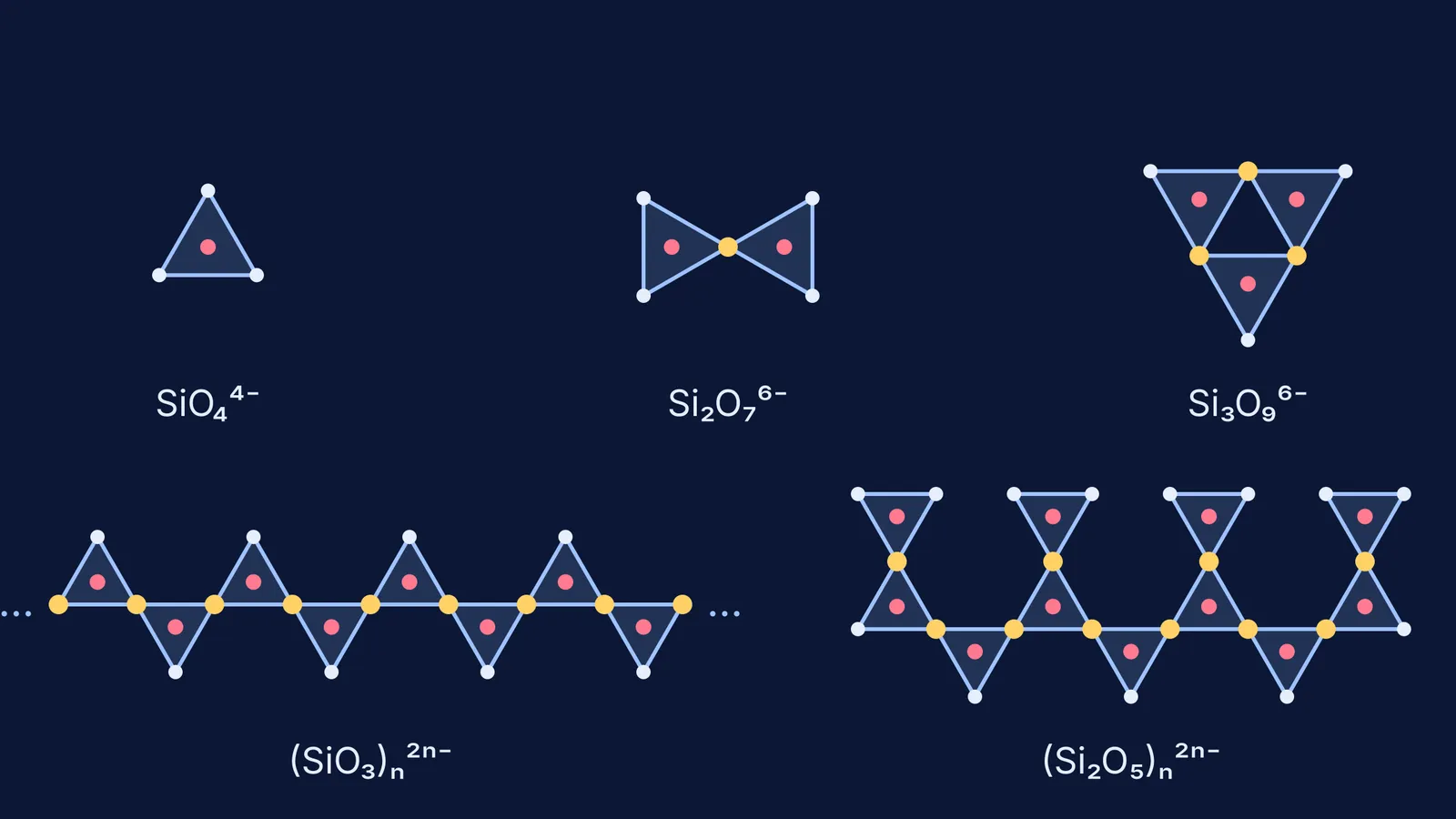
s = 0, isolated tetrahedra: SiO₄⁴⁻, as in olivine, (Mg,Fe)₂SiO₄
s = 1, two tetrahedra joined at one corner: Si₂O₇⁶⁻, the pyrosilicate ion
s = 2, rings or single chains: (SiO₃)ₙ²ⁿ⁻, including the rings Si₃O₉⁶⁻ and Si₆O₁₈¹²⁻ and the single chains of pyroxenes
s = 3, sheets: (Si₂O₅)ₙ²ⁿ⁻, as in micas and talc
s = 4, a three-dimensional framework: SiO₂, as in quartz
These classes follow Wikipedia's silicate article and Western Oregon University's silicate notes. For why heavier group 14 elements behave differently, see the inert pair effect in the p-block.
How do you work out a silicate's structure from its formula?
Remove the metal ions and any OH or water written outside the silicate unit. Keep only SiₓOᵧ.
If aluminium sits in the tetrahedra, as it does in feldspars (Wikipedia: Feldspar), count Si + Al together.
Work out O ÷ Si: 4 is isolated, 3.5 is pyro, 3 is a ring or single chain, 2.75 is a double chain, 2.5 is a sheet, 2 is a framework.
Check the charge: SiₓOᵧ carries 2y − 4x negative charges, plus one per tetrahedral Al; the metal ions, less any OH⁻, must balance it.
If the ratio is 3, a fixed count such as Si₆O₁₈ is a ring; an open-ended (SiO₃)ₙ is a chain.
Four worked examples:
Beryl, Be₃Al₂(SiO₃)₆, a ring silicate (Wikipedia: Beryl). Si₆O₁₈ gives O/Si = 3 with a fixed count of six, so it is a six-membered ring. Charge check: 3 Be²⁺ + 2 Al³⁺ = +12, and Si₆O₁₈ carries 36 − 24 = 12−.
Thortveitite, Sc₂Si₂O₇ (LibreTexts: Silicates/Descriptive_Chemistry/Main_Group_Reactions/Compounds/Aluminosilicates/Silicates)). O/Si = 3.5, so one shared corner: a pyrosilicate. Two Sc³⁺ give +6, which balances Si₂O₇⁶⁻.
Talc, Mg₃Si₄O₁₀(OH)₂, a sheet silicate (Wikipedia: Talc). Leave out the OH: Si₄O₁₀ gives 2.5, so three shared corners. Charge: Si₄O₁₀ is 4−, and 3 Mg²⁺ (+6) with 2 OH⁻ (−2) give +4.
Orthoclase, KAlSi₃O₈ (Wikipedia: Feldspar). Al + Si = 4 and O = 8, so the ratio is 2: a framework. Each Al³⁺ in place of Si⁴⁺ leaves one negative charge, which K⁺ balances.
Why is a double chain Si₄O₁₁⁶⁻?
In a double chain, tetrahedra share two or three oxygens each (Wikipedia: Silicate): half share two corners and half share three, so the average s is 2.5. Then O per Si = 4 − 1.25 = 11/4, and charge per Si = 2.5 − 4 = −1.5. Four silicons give Si₄O₁₁⁶⁻, the unit in the amphibole tremolite, Ca₂Mg₅(Si₄O₁₁)₂(OH)₂ (LibreTexts: Silicates/Descriptive_Chemistry/Main_Group_Reactions/Compounds/Aluminosilicates/Silicates)).
If the ratios still feel like a list to memorise, the Fermi Concept Library gives every chemistry concept its own lesson, so you can rebuild the list from the tetrahedron.
How do silicones form from alkylchlorosilanes?
Eugene Rochow published The Direct Synthesis of Organosilicon Compounds in 1945; Richard Müller found the same route independently. In this direct process, silicon reacts with chloromethane over a copper catalyst at about 300 °C, and dimethyldichlorosilane, (CH₃)₂SiCl₂, is the major product at about 70–90% yield (Wikipedia: Direct process).
Water swaps each Si–Cl for Si–OH, then Si–OH pairs lose water to form Si–O–Si bridges:
(CH₃)₂SiCl₂ + 2H₂O → (CH₃)₂Si(OH)₂ + 2HCl
n (CH₃)₂Si(OH)₂ → [(CH₃)₂SiO]ₙ + n H₂O
Overall, n (CH₃)₂SiCl₂ + n H₂O → [(CH₃)₂SiO]ₙ + 2n HCl, which gives polydimethylsiloxane, or PDMS (Wikipedia: Polydimethylsiloxane). The number of chlorines decides each molecule's job (same source):
R₃SiCl, one Cl: caps a chain end (trimethylsilyl chloride caps PDMS chains)
R₂SiCl₂, two: a link in a straight chain
RSiCl₃, three: a branch point that cross-links chains
Polymer length depends on how many chain-ending groups are added (Wikipedia: Dimethyldichlorosilane).
So a silicone is a condensation polymer with the silicate bridge as its backbone, but each silicon carries two methyl groups instead of extra oxygens. The most common silicones are mostly PDMS; they repel water and keep their properties from about −100 to 250 °C (Wikipedia: Silicone). Compare addition and condensation polymers, and the P–O–P bridges in oxoacids of phosphorus and sulphur.
To practise, redo each worked example from the formula alone. When a step goes wrong, the Fermi Problem Library has worked problems with a step-by-step solver that explains the reasoning rather than printing an answer.


