

On this page
A cement kiln would release carbon dioxide even if it ran entirely on solar power. The reason is in your Class 10 textbook. Clinker, the hard nodules that become cement, is made by heating limestone, and limestone gives off CO₂ when it decomposes. India is the second-largest cement producer in the world, according to IBEF's cement industry overview, so this one decomposition reaction matters at national scale. This post works out how much CO₂ comes from the rock itself, per tonne of clinker and per tonne of cement, and why India's two main answers, Portland pozzolana cement (PPC) and limestone calcined clay cement (LC3), cut it by using less clinker rather than cleaner fuel.
Why does making cement release CO₂ even without burning fuel?
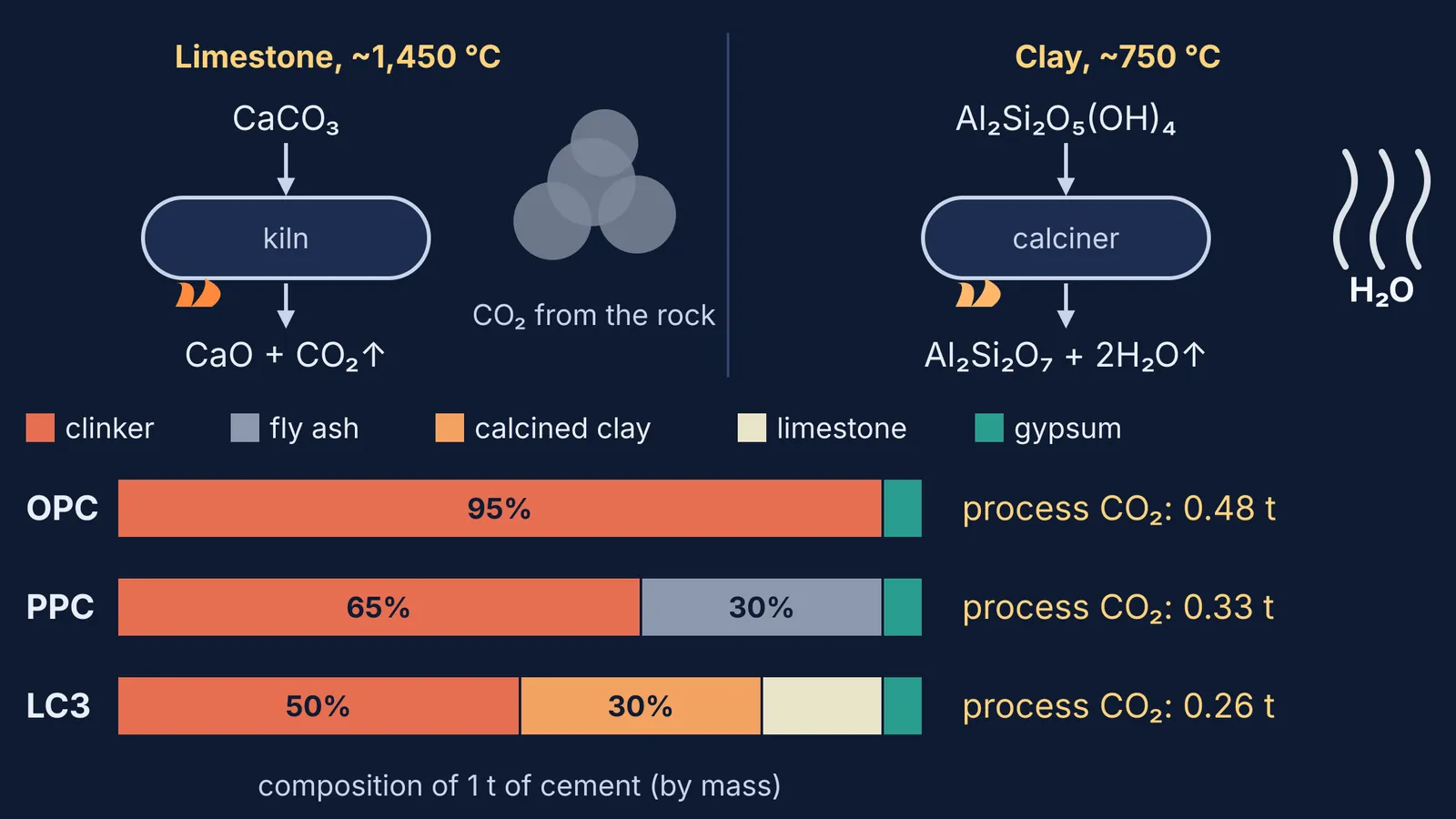
Clinker is made by burning limestone and clay together at about 1,450 °C. Most of its calcium comes from calcium carbonate, which decomposes on heating:
CaCO₃(s) → CaO(s) + CO₂(g), ΔH ≈ +178 kJ/mol
The CaO then combines with silica, alumina and iron oxide from the clay to form the four clinker minerals described in composition of Portland cement and why gypsum is added. The CO₂ simply leaves through the chimney.
So a cement plant has two separate sources of CO₂:
Process CO₂, from the limestone itself. It is fixed by chemistry. No fuel switch can remove it.
Fuel and power CO₂, from heating the kiln and grinding. This depends on the plant, the fuel and the electricity supply, so there is no single number for it.
This post is about the first one. In Joseph Aspdin and the 1824 patent that named Portland cement you can see that 44% of the mass of pure limestone leaves as CO₂.
How much CO₂ comes from one tonne of clinker?
Clinker is mostly CaO by mass. The IPCC 2006 Guidelines for national greenhouse gas inventories (Volume 3, Chapter 2) say the CaO content of clinker is generally 60 to 67%, and use 65% as the default. Take that value and assume all the CaO came from CaCO₃.
Worked example, part (a): CO₂ and heat per tonne of clinker
Mass of CaO. 65% of 1,000 kg = 650 kg = 650,000 g.
Moles of CaO. Molar mass of CaO = 56.08 g/mol, so 650,000 ÷ 56.08 = 11,590 mol.
Limestone used. The equation is 1 : 1, so 11,590 mol of CaCO₃ (100.09 g/mol) = 1,160 kg of CaCO₃ decomposed for every tonne of clinker.
CO₂ released. 11,590 mol × 44.01 g/mol = 510,000 g = 0.51 t CO₂.
Heat for the decomposition alone. 11,590 mol × 178 kJ/mol ≈ 2.06 × 10⁶ kJ, about 2.1 GJ, for the reaction alone.
The IPCC arrives at the same 0.51 and then adds 2% for kiln dust that leaves the system after calcining, giving its default of 0.52 t CO₂ per tonne of clinker. The useful shortcut is:
CO₂ per tonne of clinker = (CaO fraction) × 44.01/56.08 = (CaO fraction) × 0.785
For 60% CaO this gives 0.47 t, and for 67% it gives 0.53 t, the same range the IPCC quotes.
Why does heating clay release water, not CO₂?
LC3 uses clay that is heated, or calcined, at a much lower temperature, about 700 to 850 °C. The useful mineral in the clay is kaolinite. When it is heated it loses its hydroxide groups as water and becomes metakaolin:
Al₂Si₂O₅(OH)₄ → Al₂Si₂O₇ + 2H₂O
Check the balance: Al 2 = 2, Si 2 = 2, H 4 = 4, O 9 = 7 + 2. This is a dehydration of a hydroxide, the same kind of reaction as Ca(OH)₂ → CaO + H₂O. There is no carbon in kaolinite, so there is no CO₂ to release.
Worked example, part (b): mass lost by kaolinite
Molar mass of Al₂Si₂O₅(OH)₄ = 258.16 g/mol.
Water lost = 2 × 18.02 = 36.03 g per mole.
Mass loss = 36.03 ÷ 258.16 = 14.0%, all of it as steam.
Clay calcining still needs fuel, but it needs a lower temperature than clinker and produces no process CO₂.
How do fly ash and calcined clay replace clinker?
The answer is acid–base chemistry. When the clinker silicates react with water, they make calcium silicate hydrate (C-S-H, the binder) and calcium hydroxide, Ca(OH)₂, written CH in cement notation. Ca(OH)₂ is a base and adds little strength. You can follow the hydration step itself in how cement hardens.
Fly ash and metakaolin are rich in SiO₂ and Al₂O₃, which are acidic oxides. In the strongly alkaline water inside the paste they react with Ca(OH)₂ and form more C-S-H and calcium aluminate hydrates. In shorthand, CH + S + H → C-S-H. This is called the pozzolanic reaction. It turns a weak base into extra binder, so less clinker gives similar strength. It also explains why clinker cannot be removed completely: the pozzolan needs the Ca(OH)₂ that clinker makes.
The 15% of plain limestone in LC3 is not just filler. Its CaCO₃ reacts with aluminates from the metakaolin and clinker to form carboaluminate hydrates, which help fill the pores.
Two Indian standards set the recipes. For PPC, IS 1489 (Part 1):2015 allows 15 to 35% fly ash by mass. LC3 was developed by EPFL in Switzerland with IIT Madras, IIT Delhi, TARA (Development Alternatives) and a Cuban university, with support from the Swiss Agency for Development and Cooperation, according to IIT Madras. Its Indian standard is IS 18189:2023, as RMI's report on LC3 notes.
How much less CO₂ do PPC and LC3 release?
Because only clinker carries limestone CO₂, process CO₂ per tonne of cement = clinker fraction × 0.51 t.
Worked example, part (c): process CO₂ per tonne of cement
OPC, about 95% clinker and 5% gypsum: 0.95 × 0.51 = 0.48 t CO₂.
PPC, taking an illustrative mix of 65% clinker, 30% fly ash and 5% gypsum: 0.65 × 0.51 = 0.33 t CO₂.
LC3-50, with 50% clinker, 30% calcined clay, 15% limestone and 5% gypsum: 0.50 × 0.51 = 0.26 t CO₂. The 15% limestone is ground in raw, never heated, so it releases nothing.
Compare. 0.26 ÷ 0.48 = 0.53, so LC3-50 releases about 47% less process CO₂ than OPC.
The LC3 project's own assessment, reported by IIT Madras, gives a reduction of nearly 40% for total CO₂. That figure counts fuel too, including the fuel for calcining the clay, so it is smaller than the process-only number. Fuel CO₂ comes on top of all three answers above.
If you want to practise more decomposition and mass-ratio sums of this kind, the Fermi Problem Library has worked problems with a step-by-step solver that explains the reasoning. If acidic and basic oxides are the shaky part, the Fermi Concept Library gives each concept its own lesson.
Quick checklist
CaCO₃ → CaO + CO₂ is the source of process CO₂; fuel adds more on top.
CO₂ per tonne of clinker ≈ CaO fraction × 0.785, about 0.51 t at 65% CaO (IPCC default 0.52 with kiln dust).
Kaolinite loses 14.0% of its mass as water on calcining, with no CO₂.
Fly ash and metakaolin are acidic oxides that react with Ca(OH)₂ to make more C-S-H.
Process CO₂ per tonne of cement: OPC about 0.48 t, PPC about 0.33 t, LC3-50 about 0.26 t.


