On this page
NCERT Class 11 Biology (Reprint 2026-27) covers Cell Cycle and Cell Division in Chapter 10, and the NEET (UG) 2026 syllabus places cell division, covering the cell cycle, mitosis, meiosis and their significance, in Biology Unit 3, Cell Structure and Function. Most slips on this chapter are not missing facts. They come from merging two words, or two stages, that look alike.
Below are eight such mix-ups, grouped by the kind of confusion. Each has why it catches students, what NCERT actually says (with the section number), a quick check and a habit. If you have not yet built the chromosome-and-DNA count chain for the chapter, start with our guide to preparing cell cycle and cell division for NEET.
Which look-alike terms do students swap?
"The kinetochore is just another name for the centromere."
Both sit at the same narrow point of a chromosome, and many sketches label only one spot. NCERT 10.2.2 separates them: the centromere holds the two sister chromatids together, while kinetochores are small disc-like structures on its surface where spindle fibres attach, one for each chromatid. Check: a cell with 2n = 6 is at mitotic metaphase. How many centromeres and how many kinetochores can you count? (6 centromeres and 12 kinetochores, one per sister chromatid.) Habit: centromere joins, kinetochore docks.
"A bivalent has two chromatids, because 'bi' means two."
The prefix counts something, just not chromatids. NCERT 10.4.1 calls the paired homologous chromosomes formed in zygotene a bivalent or a tetrad: one structure, two names. In pachytene its four chromatids become distinct. Check: a plant cell with 2n = 26 reaches pachytene. How many bivalents, and how many chromatids? (13 bivalents, 52 chromatids.) Habit: "bi" counts homologues, "tetra" counts chromatids.
"A recombination nodule and a chiasma are two names for the same crossover point."
Both mark where non-sister chromatids exchanged segments, so notes often merge them. NCERT 10.4.1 keeps them in different stages. Recombination nodules appear in pachytene as the sites where crossing over takes place, and recombination is complete by the end of that stage. Chiasmata, the X-shaped links, are named in diplotene, after the synaptonemal complex dissolves and homologues start to separate everywhere except at the crossover sites. Check: a tetrad still lies inside an intact synaptonemal complex, with nodules along it. Which name fits its crossover sites? (Recombination nodules. This is pachytene; chiasmata come only in diplotene.) Habit: nodule marks the exchange; chiasma is the link it leaves behind.
What gets pulled apart, and from what?
"In metaphase I, sister chromatids face opposite poles, as in mitosis."
Three metaphases look almost the same on paper. In mitotic metaphase (NCERT 10.2.2) and metaphase II (10.4.2), fibres from opposite poles reach the kinetochores of sister chromatids. In metaphase I (10.4.1), they attach to the kinetochores of homologous chromosomes, so each homologue faces one pole. Check: in one bivalent at metaphase I, do the two sister chromatids of a single homologue face the same pole? (Yes. They travel together in anaphase I.) Habit: before naming the attachment, ask what the next anaphase will separate.
"Crossing over swaps pieces between two sister chromatids."
In a drawing, sisters are the closest pair of chromatids. NCERT 10.4 and 10.4.1 place crossing over between non-sister chromatids of homologous chromosomes, carried out by the enzyme recombinase, and describe sister chromatids as identical copies made at S phase. Check: if two identical sisters swapped matching segments, would a new combination of genes appear? (No. Swapping identical segments gives back the same sequences; a new mix needs non-sister chromatids from the two homologues.) Habit: write "non-sister, homologous" every time.
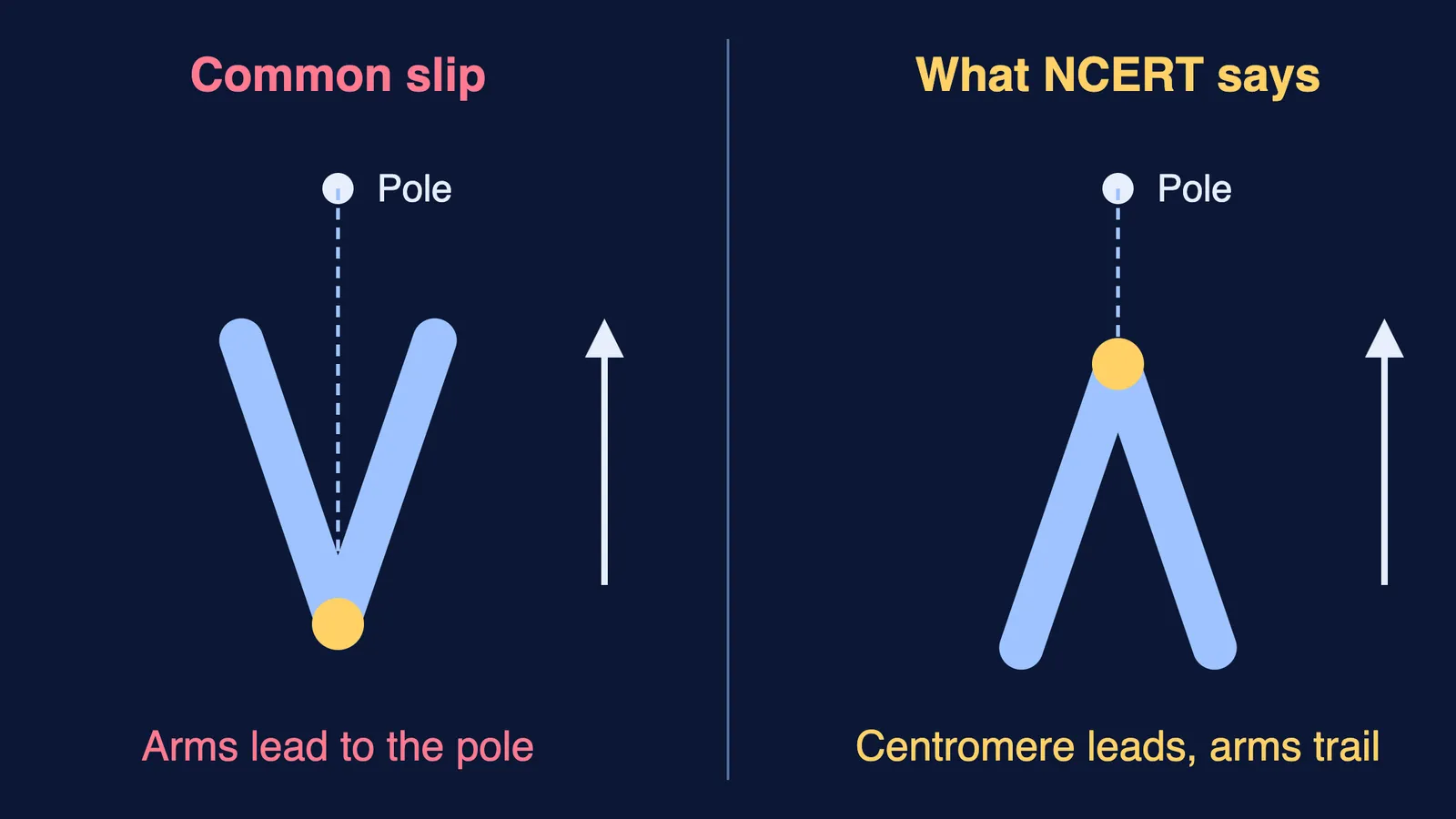
"In anaphase, the arms of a chromosome lead it to the pole."
Arrows in rough notes often start at the arm tips. NCERT 10.2.3 says each moving chromosome keeps its centromere towards the pole, at the leading edge, with the arms trailing behind. Check: in your anaphase sketch, the arm tips of a daughter chromosome sit closer to the pole than its centromere. What do you fix? (Flip it: the centromere goes nearest the pole, and the arms trail back towards the equator.) Habit: draw the centromere first, on the pole side.
What do "growth" and "equational" really mean?
"A cell grows only in G1; the rest of interphase is just copying DNA."
G1 is taught as the growth phase, so students assume growth stops after it. NCERT 10.1 says cytoplasmic growth is continuous; only DNA synthesis is limited to one stage, S. Section 10.1.1 adds that in G2, proteins for mitosis are made while growth goes on. Check: what is wrong with "A G2 cell has stopped growing and is replicating its DNA"? (Both halves: growth continues, and replication ended in S.) Habit: file growth as continuous and DNA synthesis as S only.
"Meiosis is the reduction division, so meiosis II must halve the chromosome number too."
The label "reduction" is attached to meiosis as a whole, so students spread it over both divisions. NCERT 10.2 ties "equational" to chromosome number: parent and daughter cells keep the same count. In meiosis, the halving comes when homologous chromosomes go to opposite poles in anaphase I (10.4.1 and the chapter summary), while 10.4.2 says meiosis II resembles a normal mitosis, with sister chromatids separating. Check: a cell with 2n = 10 completes meiosis I. How many chromosomes does each cell carry into meiosis II, and how many does each of its products have? (5 and 5. The number held steady, so all the reduction happened in meiosis I.) Habit: in this chapter, "equational" and "reduction" always describe chromosome number, so count it before and after each division.
What should you check in 60 seconds before you mark?
Kinetochore or centromere: which one takes the fibre?
Nodules or chiasmata: is the synaptonemal complex still there?
Equational or reduction: did the chromosome number change?
What should you practise next?
Tomorrow, redo the eight checks with the answers covered, and write the NCERT section beside any you miss. Then test the same ideas on pictures with our guide to naming mitosis and meiosis stages from a diagram.
Not sure which of these slips is yours? Fermi's AI tutor works out what you already know and builds a plan for the session.