

On this page
Ask a NEET aspirant which muscle never tires and they will say the heart. The exam asks why, and there are two separate answers: one electrical (no tetanus) and one about energy (no fatigue). Keep them apart and the topic gets easy.
What is tetanus in muscle, and why does skeletal muscle get it?
In skeletal muscle, the electrical signal is far shorter than the contraction it triggers. A skeletal muscle action potential lasts about 4 milliseconds, while the contraction lasts hundreds of milliseconds, so a new impulse can arrive before the last twitch has relaxed (Deranged Physiology).
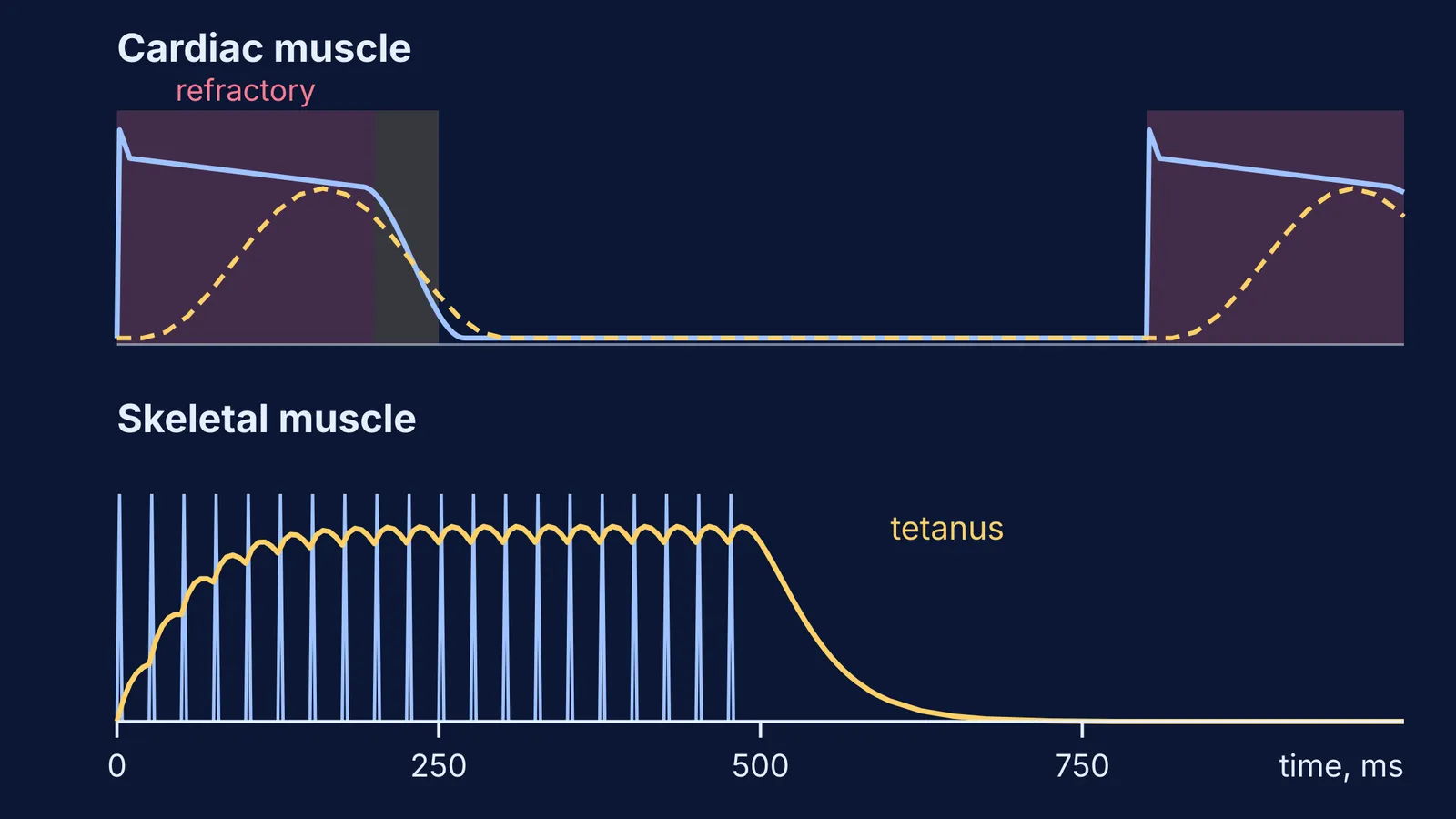
Each new twitch then builds on the one before, which is called wave summation. Tension in incomplete tetanus is about three to four times the tension of a single twitch (OpenStax Anatomy and Physiology 2e, section 10.4). When stimuli come so fast that the relaxation phase disappears, the same chapter calls the result complete tetanus.
Why can't cardiac muscle be tetanised?
The answer is timing. A cardiac contractile cell's action potential lasts 250 to 300 ms, stretched out by a plateau during which slow calcium channels let Ca2+ into the cell (OpenStax Anatomy and Physiology 2e, section 19.2).
The absolute refractory period of cardiac contractile muscle lasts about 200 ms, and the relative refractory period about 50 ms more, for a total of about 250 ms (OpenStax, section 19.2). During the absolute refractory period no stimulus, however strong, can fire the cell again.
Unlike the 4 ms skeletal spike, this locked window covers most of the cardiac contraction, so the last contraction has finished before the next can begin (Deranged Physiology). Twitches cannot stack: no summation, no tetanus.
OpenStax states the purpose plainly: the refractory period is long to prevent tetany, a condition in which muscle remains involuntarily contracted. A heart stuck in one long squeeze could not relax and refill.
For those disorders, read our explainer on myasthenia gravis, muscular dystrophy and tetany. For how cardiac muscle differs in structure, see striated, smooth and cardiac muscle differences.
Why doesn't heart muscle get tired?
Here the answer is energy supply.
Mitochondria: in adult heart cells, mitochondria occupy at least 30% of cell volume and produce about 90% of the cell's ATP (Piquereau et al., Frontiers in Physiology, 2013).
Aerobic metabolism: cardiac muscle metabolism is normally entirely aerobic, and heart cells also store oxygen in myoglobin (OpenStax, section 19.2).
Blood supply that follows demand: coronary blood flow rises almost in proportion to the heart's oxygen use (Klabunde, CV Physiology).
Built-in rest: because of the long refractory period, every contraction is followed by relaxation before the next one can start.
This is the same logic you see in red muscle fibres, rich in myoglobin and mitochondria: slow, steady, oxygen-fed work rather than short anaerobic bursts.
This describes a healthy heart. Chest pain, breathlessness or palpitations need a doctor, not a textbook.
How do you remember it? Draw this timing diagram
Practise drawing the diagram at the top of this page from memory.
Draw a time axis from 0 to 800 ms. At 75 beats a minute, one beat lasts 60,000 ms divided by 75, which is 800 ms.
On the top line, sketch a cardiac action potential: a sharp rise, a long flat plateau, then a fall that ends at 250 to 300 ms.
Shade 0 to 200 ms as absolute refractory and 200 to 250 ms as relative refractory.
Dash in the contraction curve underneath. It is mostly over when the shading ends.
On a second line, draw thin skeletal spikes close together and a tension curve that climbs and flattens. Label it tetanus.
Worked example. A second stimulus reaches a ventricular cell 150 ms after the first. What happens? Check your sketch. 150 ms sits inside the 200 ms absolute refractory period, so the cell does not respond and the force does not add up. Change the time to 600 ms and the cell is excitable again, but the first contraction is already over, so you get a fresh beat rather than summation.
If the plateau phase or refractory periods still feel shaky, the Fermi Concept Library gives every biology concept its own lesson and its place in the map. To practise timing questions like the worked example, the Fermi Problem Library has worked problems with a step-by-step solver that explains the reasoning rather than printing an answer.
In the exam, draw the shaded box first. The answer follows from it.


