

On this page
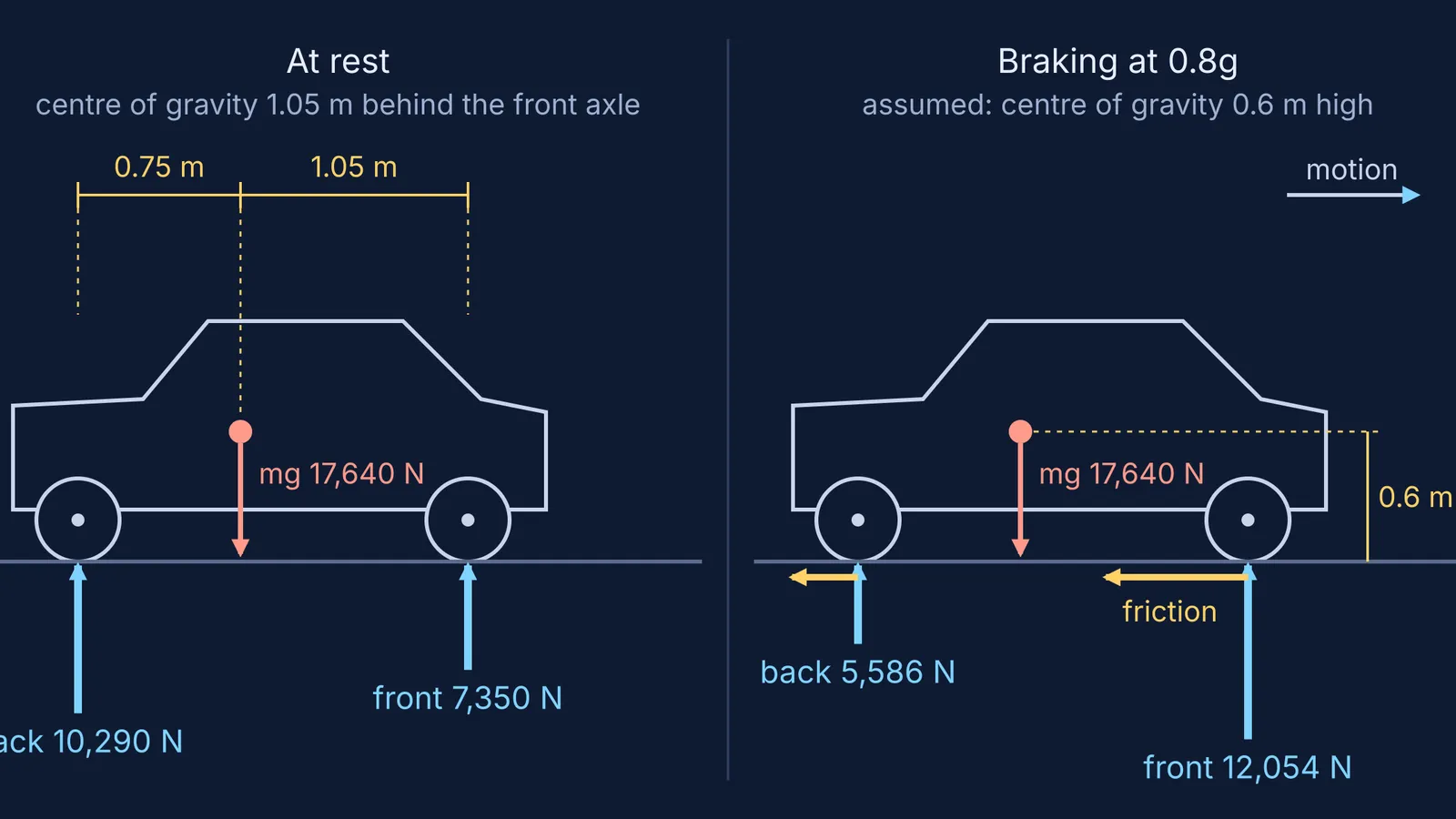
A car of mass 1800 kg stands on level ground. Its front and back axles are 1.8 m apart, and its centre of gravity is 1.05 m behind the front axle. How hard does the ground push up on each wheel? This is exercise 6.9 in the System of Particles and Rotational Motion chapter of the NCERT Class 11 physics textbook. It takes one torque equation and one force equation. The answer is 3675 N on each front wheel and 5145 N on each back wheel, and the same method then shows why braking throws weight onto the front tyres.
What does the question give you?
Mass m = 1800 kg, so the weight is mg = 1800 × 9.8 = 17,640 N.
Wheelbase (distance between the axles) L = 1.8 m.
Centre of gravity 1.05 m behind the front axle, which puts it 1.8 − 1.05 = 0.75 m in front of the back axle.
The ground is level and the car is at rest, so it is in equilibrium.
Use g = 9.8 m/s², the value NCERT uses throughout the book. We also assume the car is symmetric from left to right, so the two front wheels share the front load equally, and the two back wheels share the back load.
Which point should you take torques about?
Three vertical forces act on the car: the weight mg at the centre of gravity, the total upward force R₁ on the front axle, and the total upward force R₂ on the back axle. Two of them are unknown.
Take torques about the back axle. R₂ passes through that point, so its torque is zero and it drops out of the equation. You are left with one unknown, R₁, and you can solve for it in one line. Taking torques about the centre of gravity also works, but then both unknowns stay in the torque equation, and you need to solve two equations together.
The general rule, pick the point where the most unknown forces act, is explained in which point to take torque about in equilibrium problems.
How much force does each front and back wheel carry?
Torques about the back axle. The weight has a moment arm of 0.75 m; R₁ has a moment arm of 1.8 m. For equilibrium, R₁ × 1.8 = mg × 0.75.
Front axle. R₁ = 17,640 × 0.75 / 1.8 = 7350 N.
Vertical forces. R₁ + R₂ = mg, so R₂ = 17,640 − 7350 = 10,290 N.
Per wheel. Each front wheel carries 7350 / 2 = 3675 N. Each back wheel carries 10,290 / 2 = 5145 N.
Check with torques about the centre of gravity. Front: 7350 × 1.05 = 7717.5 N m. Back: 10,290 × 0.75 = 7717.5 N m. They balance, so the answer is consistent.
In fractions, the front axle carries 0.75/1.8 = 41.7% of the weight and the back axle carries 58.3%. Notice the pattern: each axle's share equals the distance from the centre of gravity to the other axle, divided by the wheelbase. The axle nearer the centre of gravity carries more. NCERT's car is rear-heavy because its centre of gravity sits closer to the back axle. A car with its engine in front would have its centre of gravity further forward and a larger front share.
What changes when the car brakes hard?
At rest, the split depends only on where the centre of gravity sits along the car. When the car brakes, the split changes, because the braking force acts at road level and the centre of gravity is above the road.
NCERT does not give the height of the centre of gravity, so take two assumed values for illustration: the centre of gravity is h = 0.6 m above the road, and the car decelerates at a = 0.8g = 7.84 m/s². That needs a friction coefficient of at least 0.8 between tyres and road.
In the car's frame, add a pseudo force ma acting forward at the centre of gravity. Take torques about the back wheels' contact point again:
Torque equation. R₁ × L = mg × 0.75 + ma × h.
Extra load on the front. The new term gives ma × h / L = 1800 × 7.84 × 0.6 / 1.8 = 4704 N.
New front axle force. 7350 + 4704 = 12,054 N, or 6027 N per front wheel.
New back axle force. 10,290 − 4704 = 5586 N, or 2793 N per back wheel.
Check. 12,054 + 5586 = 17,640 N. The total is still the weight, because the car does not move up or down. Only the split changes.
The front axle now carries 68.3% of the weight, against 41.7% at rest. The extra 4704 N depends only on a, h and L, not on where the centre of gravity sits along the car. A higher centre of gravity or a shorter wheelbase makes the shift larger.
Why do the front brakes do most of the work?
The maximum friction a tyre can give is about μ times the normal force on it. During hard braking the front tyres press down with 12,054 N and the back tyres with only 5586 N, so the front tyres can supply about 68% of the total stopping force. If the back brakes tried to do half the work, the back wheels would lock and skid first. This is why brakes are designed to put more braking force on the front wheels.
When you accelerate, the pseudo force points backward and the shift reverses, putting extra weight on the back wheels. Bicycles show the same effect even more strongly, because their centre of gravity is high compared with their wheelbase; see how bicycle brakes work and why the front brake matters more.
The same idea works sideways too. On a curve the outer wheels press harder than the inner ones, as worked out in why the outer wheels press harder when a car turns.
What should you remember for JEE and NEET?
This is a rigid body equilibrium problem: net force zero and net torque zero. JEE likes to add a twist, such as a car or a truck that accelerates, a ladder against a wall, or a plank on two supports with a person walking along it. The steps stay the same: draw every force, choose the point that removes the most unknowns, then use the force balance for the rest.
If you want to practise choosing the torque point on harder setups, the Fermi Problem Library has a step-by-step solver that explains the reasoning behind each equation.
Quick checklist
Weight 17,640 N; centre of gravity 1.05 m from the front axle and 0.75 m from the back.
Torques about the back axle: R₁ = 17,640 × 0.75 / 1.8 = 7350 N.
R₂ = 10,290 N; per wheel 3675 N front and 5145 N back.
The axle nearer the centre of gravity carries more.
Braking at a with the centre of gravity at height h moves mah/L onto the front axle: 4704 N with the assumed values.
Total normal force always equals the weight on level ground; only the split changes.


