

On this page
In many newer cars the speed is not only on the dashboard. It seems to float over the road a couple of metres ahead, and the driver reads it without looking down. This is a head-up display (HUD). Inside the dashboard there is no projector throwing light onto the road, only a small bright screen, a concave mirror and the windscreen itself. Every step is Class 10 and Class 12 optics: the mirror formula, the eye's power of accommodation and reflection of polarised light.
How does a head-up display make an image float ahead of the car?
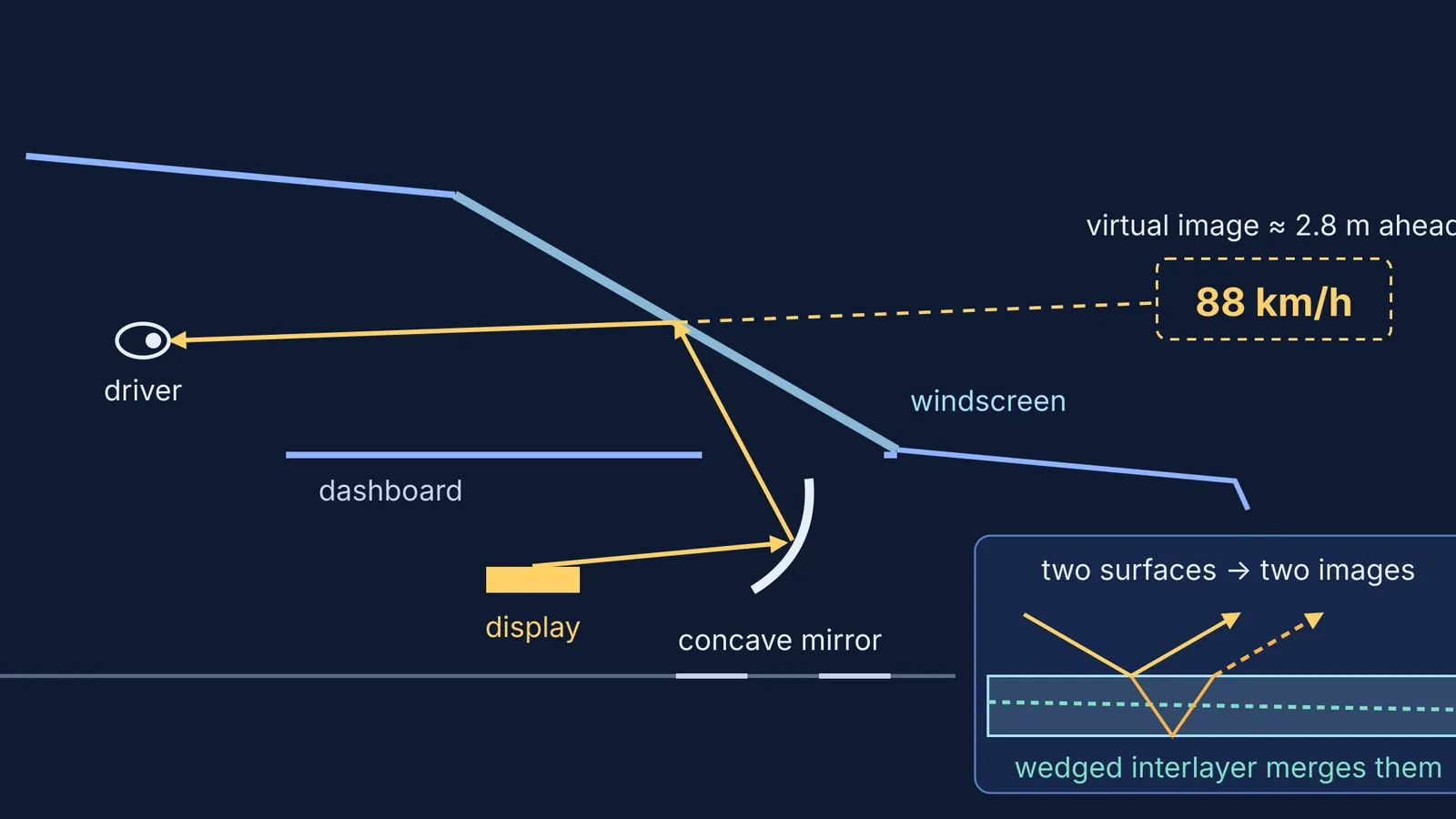
The light makes two reflections before it reaches your eye.
A small display in the dashboard shows the speed, brightly lit.
A concave mirror sits a little closer to the display than its focal length. An object inside the focal length of a concave mirror gives a virtual, upright, magnified image behind the mirror, just like a shaving mirror.
The windscreen acts as a tilted, partly reflecting plane mirror. It sends the light up and back to the driver, and the driver sees the virtual image through the glass, as if it were out over the road.
A VR headset uses the same trick with a lens: the screen sits inside the focal length so the eye sees a distant, enlarged virtual image. That version is explained in how a VR headset tricks your eyes. Real HUDs use free-form mirrors shaped to cancel the curve of the windscreen, so the spherical mirror below is a simplified model.
Where does the HUD image appear? A worked example
Use the NCERT Cartesian sign convention: distances are measured from the mirror's pole, and distances against the direction of the incident light are negative. Take a concave mirror with focal length 25 cm and the display 22 cm in front of it. These are illustrative values, not a particular car.
Data. f = −25 cm, u = −22 cm.
Mirror formula. 1/v + 1/u = 1/f, so 1/v = 1/f − 1/u = −1/25 + 1/22 = +0.00545 cm⁻¹.
Image distance. v = +183 cm. Positive v means the image is behind the mirror, so it is virtual.
Magnification. m = −v/u = −183/(−22) = +8.3. Positive means upright; the image is 8.3 times the size of the display.
Sensitivity. Move the display to u = −24 cm. Now 1/v = −1/25 + 1/24, v = +600 cm and m = +25. A 2 cm shift moves the image from 1.8 m to 6 m behind the mirror. Near the focus, tiny changes in u make huge changes in v, which is why the display must be mounted precisely.
Distance from the eye. The flat windscreen only folds the light path. If the light travels about 1 m from the mirror, via the windscreen, to the eye, the image is about 1.83 + 1.0 ≈ 2.8 m from the driver.
That is in line with real products. Valeo's windshield head-up display specification lists a virtual image distance of 2 to 4.5 m.
Why put the image a few metres away instead of on the dashboard?
When you look from the road to the dashboard, your eye lens has to change its power to refocus. The extra power needed to focus at distance d is 1/d, in dioptres with d in metres.
Dashboard at 0.8 m: 1/0.8 = 1.25 D.
HUD image at 2.8 m: 1/2.8 ≈ 0.36 D.
The road far ahead: close to 0 D.
So switching between the road and the HUD needs less than a third of the refocusing that the dashboard needs. The eyes also need to turn inward less. This is a physics comparison only; it is not a claim about crash numbers.
Why is the windscreen such a weak mirror?
At normal incidence, glass of n = 1.52 reflects only about 4% of the light, which is why you see your reflection in a window only when it is dark outside, as explained in why you see your reflection in windows at night. In a car, the HUD light meets the raked windscreen at a much steeper angle, around 60° from the normal, and there the polarisation of the light matters a great deal.
Fresnel's equations for one glass surface at 60° incidence (refraction angle 34.7° from Snell's law) give:
s-polarised light (electric field parallel to the glass surface): about 18% reflected.
p-polarised light (electric field in the plane of incidence): about 0.15% reflected.
The p reflection nearly vanishes because 60° is close to Brewster's angle, tan θ_B = 1.52, θ_B = 56.7°. So in a simple design, the image the driver sees is almost purely s-polarised. Polarised sunglasses are built to block exactly that kind of reflected light, as why polarised sunglasses cut glare shows, so they can make a HUD fade or disappear. Not every HUD behaves this way: a Panasonic patent describes converting part of the display's s-polarised light to p-polarised light because drivers wear such glasses. Whether your glasses hide the image depends on the car.
Why do some HUDs show a faint double image?
A windscreen is two sheets of glass bonded to a plastic layer, and both its front and back surfaces reflect. For glass 4.5 mm thick at 60° incidence, the two reflected rays come out parallel but offset by 2t tan(34.7°) cos(60°) ≈ 3.1 mm. The eye sees a main image and a faint ghost beside it. HUD windscreens use a slightly wedge-shaped plastic interlayer, so the two surfaces are not quite parallel and the two images line up for the driver's eye.
To see how the image jumps as the object crosses the focus, try moving it yourself in the Simulation Lab, which has interactive optics simulations for ideas easier to see than read.
Quick checklist
HUD: display inside the focal length of a concave mirror, then a windscreen reflection.
The image is virtual and upright; you cannot catch it on a screen 2.8 m ahead.
f = −25 cm, u = −22 cm gives v = +183 cm, m = +8.3; u = −24 cm gives v = +600 cm.
Refocusing: 0.36 D for the HUD image against 1.25 D for a dashboard at 0.8 m.
At 60° on glass, s reflects about 18%, p about 0.15%; Brewster's angle is 56.7°.
Two glass surfaces make a ghost about 3.1 mm away; a wedged interlayer merges them.


