

On this page
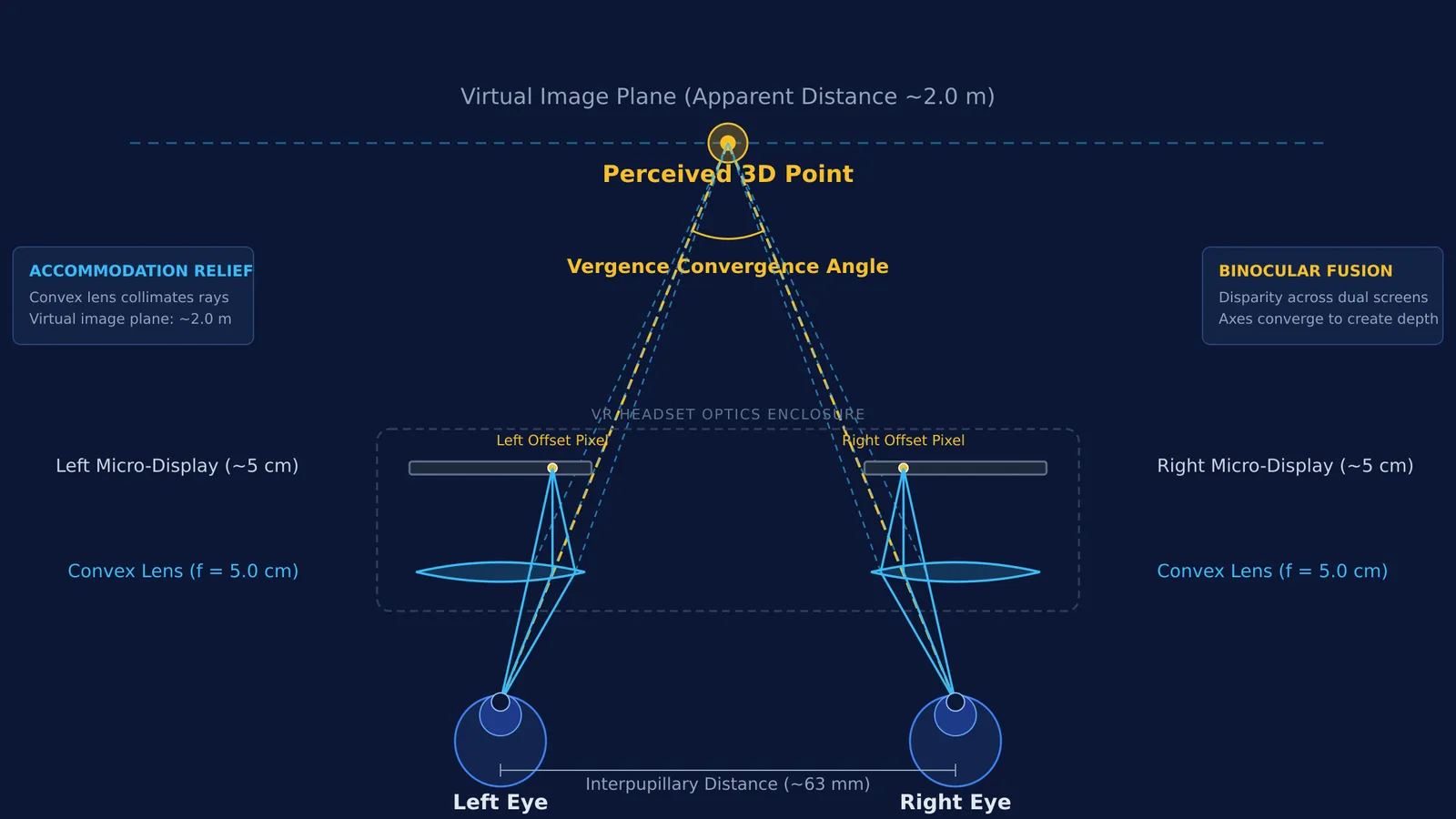
In an extensive anthropometric survey, Neil A. Dodgson (2004) showed that adult human eyes are spaced roughly 63 mm apart on average, with most adults falling between 50 mm and 75 mm. Because of this horizontal separation, your left and right eyes view any three-dimensional scene from slightly different coordinates, forming two subtly disparate retinal images.
How does binocular disparity trick the brain into seeing depth?
In 1838, British scientist Charles Wheatstone demonstrated in the *Philosophical Transactions of the Royal Society of London* that horizontal retinal disparity alone allows the brain to perceive solid depth (stereopsis). Wheatstone constructed the reflecting stereoscope using two mirrors angled at 90 degrees to present distinct perspective drawings to each eye. When the visual cortex processes these two flat inputs, it fuses them into a single three-dimensional perception of volume and relief.
Virtual reality headsets implement Wheatstone's discovery in software. A graphics engine renders virtual scenes through two virtual cameras spaced roughly 63 mm apart to match the anthropometric average reported by Dodgson. The left screen displays what the left eye sees, and the right screen shows the right eye's perspective. To explore how your eyes judge depth under ordinary conditions, read our guide on how binocular vision works.
Why do VR headsets need convex lenses in front of the screens?
As optical scientist Steven M. LaValle (2023) explains in *Virtual Reality*, dual displays alone cannot create a readable virtual environment. If you hold a display screen 5 cm in front of your face, your eyes cannot focus on it. The human eye has a near point of accommodation, conventionally taken as 25 cm in standard optics. At 5 cm, your eye's crystalline lens would need roughly 20 dioptres of accommodation—an impossible demand for human ciliary muscles. VR headsets solve this by placing a powerful convex lens between each eye and its micro-display, positioning the screen just inside the focal length.
Light rays diverging from each screen pixel refract through the convex lens, entering the pupil as nearly parallel rays. To your visual system, these rays appear to originate from an enlarged virtual image positioned roughly 1.5 to 2.0 metres in front of you, where ciliary muscles can rest comfortably. For a detailed breakdown of how eye muscles adjust lens curvature for near and distant objects, see our explainer on eye accommodation for near vision.
How do you calculate the virtual image distance using the lens formula?
As optical architect Bernard C. Kress (2020) details in *Optical Architectures for Augmented-, Virtual-, and Mixed-Reality Headsets*, VR eyepieces follow the standard thin lens formula:
1/f = 1/v - 1/u
where f is the focal length of the convex lens, u is the object distance from the lens, and v is the resulting virtual image distance.
For a representative VR eyepiece with lens power +20 dioptres (focal length f = +5.0 cm) and a micro-display placed at u = -4.88 cm:
1/v = 1/f + 1/u = 1/(+5.0) + 1/(-4.88) = -0.12 / 24.4 ≈ -0.00492 cm⁻¹
Solving for image distance gives v ≈ -203.3 cm ≈ -2.03 metres.
The negative sign confirms that the image is virtual, erect, and located on the screen side of the lens. Instead of struggling to focus at 4.88 cm, your eye accommodates to a virtual plane 2.03 metres away, lowering required accommodation from 20 dioptres to roughly 0.49 dioptres (1 / 2.03 m).
When studying ray optics for exams, tracking how virtual images move as you adjust object distances can be difficult on paper. The Fermi Simulation Lab offers interactive simulations for ideas that are easier to see than to read, letting you adjust lens positions and observe image formation dynamically. You can also explore convex lens image formation to examine how real and virtual images interchange around the focal point.
Why does the vergence-accommodation conflict cause VR fatigue?
Even though VR headsets produce a vivid three-dimensional illusion, their optics introduce a physiological trade-off. In natural vision, extraocular muscles rotate both eyeballs inward (vergence) while ciliary muscles adjust crystalline lens curvature (accommodation) to focus at that exact distance. In a landmark study in the *Journal of Vision*, David M. Hoffman and colleagues (2008) demonstrated that decoupling these two cues causes visual fatigue, delays stereoscopic fusion, and reduces depth acuity.
In the real world, looking at an object 30 cm away triggers 30 cm convergence and 30 cm accommodation simultaneously. In a VR headset, however, accommodation remains optically fixed at the virtual screen distance of roughly 2.0 metres. When a virtual object approaches you, binocular disparity prompts your eyes to converge inward to 30 cm. But if your crystalline lens accommodated to 30 cm, the display would blur instantly, because light entering your pupils is collimated from 2 metres.
This optical decoupling separates VR from other viewing formats:
Natural vision: Eyes converge on physical objects while ciliary muscles accommodate to that exact distance.
3D cinema: Polarised glasses separate views from one projector screen, keeping accommodation fixed on the distant screen.
VR headset: Lenses collimate light from displays 5 cm away to 2 metres, keeping accommodation fixed at 2 metres while eyes converge across virtual space.
How do VR headsets correct lens distortion and colour fringing?
High-power convex lenses bend peripheral light rays more sharply than paraxial rays near the optical axis, creating pincushion distortion. Lenses also cause chromatic dispersion: shorter blue wavelengths refract more than longer red wavelengths, producing colour fringing around high-contrast edges.
Modern headsets correct both optical aberrations in software before images reach the screens:
Barrel pre-distortion: Graphics shaders apply barrel distortion to the rendered frame, warping pixels outward so the lens's pincushion distortion restores straight lines.
Chromatic pre-scaling: Graphics pipelines render red, green, and blue colour channels at slightly offset scales, cancelling chromatic dispersion upon refraction.
If you want to review the underlying theory of convex lenses and ray diagrams, the Fermi Concept Library covers every concept in physics, chemistry, biology, mathematics and computing.


