

On this page
Every pain you feel is built by your brain. Yet if a surgeon touches the brain itself, you feel nothing. That fact explains why some brain operations are done on patients who are wide awake, and why a headache is not your brain "hurting".
Can the brain itself feel pain?
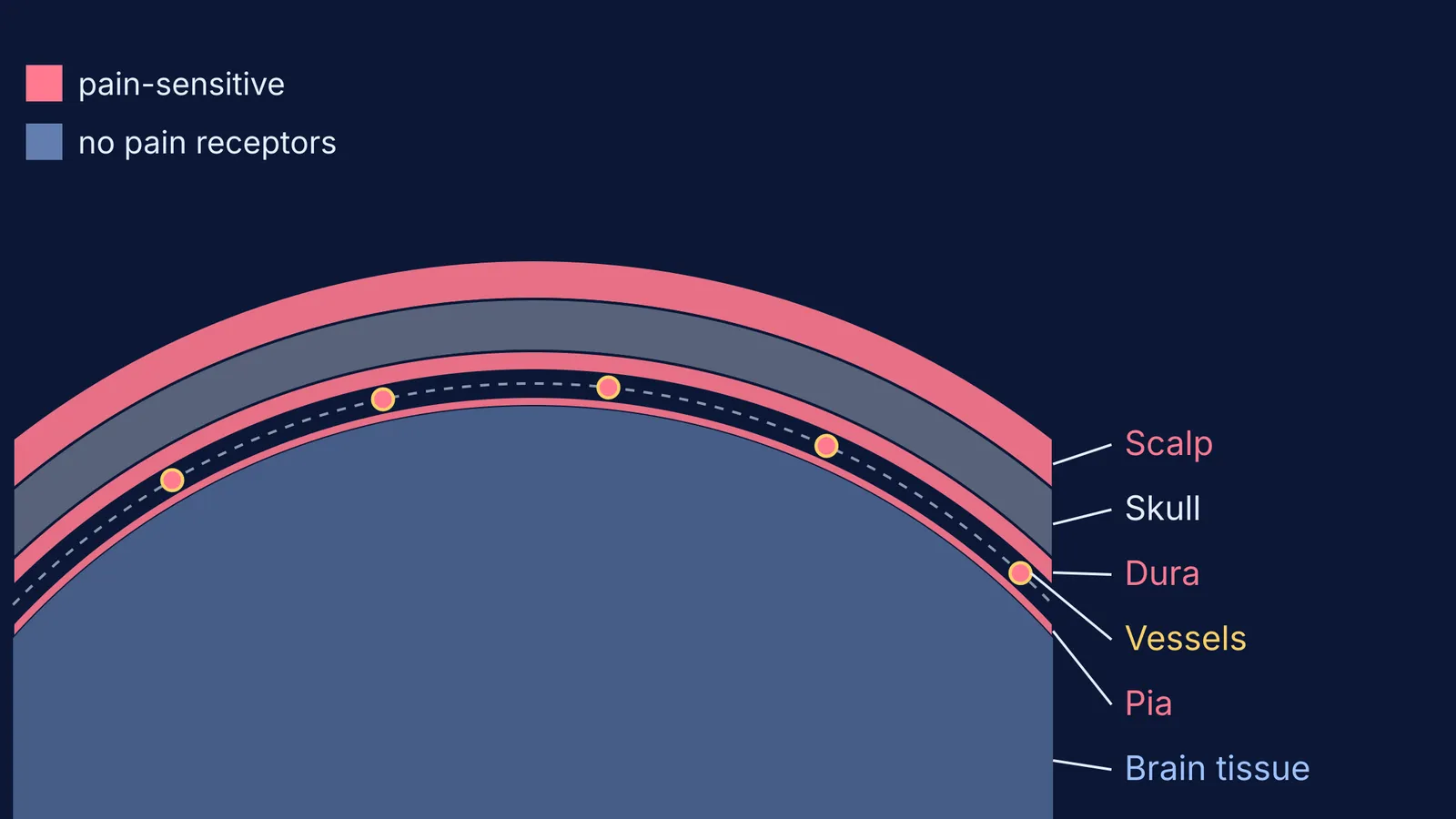
No. The tissue of the brain, the neurons and glia that do the thinking, has no nociceptors, the nerve endings that detect damage. A clinical review of awake brain surgery in the NIH's StatPearls series states that because brain tissue lacks pain receptors, patients can be fully awake while surgeons map and remove a lesion (StatPearls, Anesthesia for Awake Craniotomy).
In a 1940 study, researchers Ray and Wolff stimulated structures inside the heads of conscious patients and recorded which ones hurt (Ray and Wolff, Archives of Surgery, 1940). A later review of migraine biology cites this and Penfield's 1935 work for the early finding that stimulating blood vessels supplied by the trigeminal nerve caused pain, while stimulating brain tissue caused no discomfort (Charles and Brennan, Handbook of Clinical Neurology, 2010).
Why can brain surgery be done while you are awake?
Because only the outer layers need numbing. The StatPearls review lists the more painful steps as the pins that hold the head still, the skin cut, removing the bone flap and opening the dura, the tough outer covering of the brain. Doctors block the nerves of the scalp with local anaesthetic and add sedation for these steps (StatPearls).
Once the brain is exposed, the patient can be woken. The surgeon then stimulates small patches of cortex while the patient talks, counts or moves a hand. If speech stumbles, that patch is left alone. The same review explains the aim: the patient's real-time feedback lets the surgeon avoid removing critical areas for language and movement. It also notes that Sir Victor Horsley first operated this way in 1886, to find the source of epileptic seizures.
Neurosurgeon Wilder Penfield also stimulated the cortex of awake patients; read how Wilder Penfield mapped the brain.
Where does headache pain actually come from?
From the structures around the brain. The meninges and the blood vessels are supplied with sensory fibres from the trigeminal nerve, the large nerve that also carries feeling from your face. This pairing of trigeminal nerve endings and vessels is called the trigeminovascular system (Charles and Brennan).
A 2018 study added detail. Neurosurgeons recorded what hurt during awake operations and found 93 painful events in 53 patients (Fontaine et al., Brain, 2018). Thirty came from stimulating the dura at the base of the skull or the falx, and 61 from mechanically stimulating the pia, the thin innermost covering, or small vessels on the brain surface. The pain was sharp, intense and brief, and felt on the same side as the stimulus.
If the three coverings (dura, arachnoid, pia) blur together, our explainer on how the meninges and CSF protect the brain walks through each one.
The WHO estimates that headache disorders affect about 40% of the world's population, around 3.1 billion people in 2021 (WHO, Headache disorders fact sheet). For the difference between an everyday headache and a migraine, see what happens in the brain during a migraine.
How do you write this in a biology answer?
A worked short-answer question: "Why can a patient stay conscious during brain surgery?"
State the fact: brain tissue has no pain receptors (nociceptors).
Name what does hurt: scalp, dura, and blood vessels, supplied mainly by the trigeminal nerve.
Link to the procedure: the scalp is numbed and sedation covers the painful steps, so the patient can be awake for mapping.
Give the reason it is useful: the surgeon can test speech and movement while operating and avoid damaging those areas.
If the sensory pathway itself is shaky, the Fermi Concept Library has a lesson for each concept in biology, with its place in the wider map, so you can see how receptors, nerves and the brain connect.
What should you do about a headache in exam season?
The NHS lists common causes of headaches such as stress, bad posture, eyesight problems, not eating regular meals and not drinking enough fluids (NHS, Headaches). A quick self-check during long study days:
Have you had water and a proper meal in the last few hours?
Has your neck been bent over a book or phone for an hour or more?
Have your eyes been fixed on a screen without a break?
Did you sleep much less, or much more, than usual?
See a doctor if headaches keep coming back or get worse. The NHS advises getting urgent medical help for a headache that starts suddenly and is extremely painful, or that comes with a stiff neck, a very high temperature, vomiting or vision problems. This article is for understanding, not diagnosis.


