

On this page
Migraine is not just a bad headache. For biology students it is the nervous system in action; for anyone with headaches, knowing the difference helps you describe them to a doctor.
What is the difference between migraine and a headache?
"Headache" is the symptom; migraine is one disorder that causes it. Headache disorders affected about 40% of the world's population, or 3.1 billion people, in 2021, says the WHO fact sheet on headache disorders.
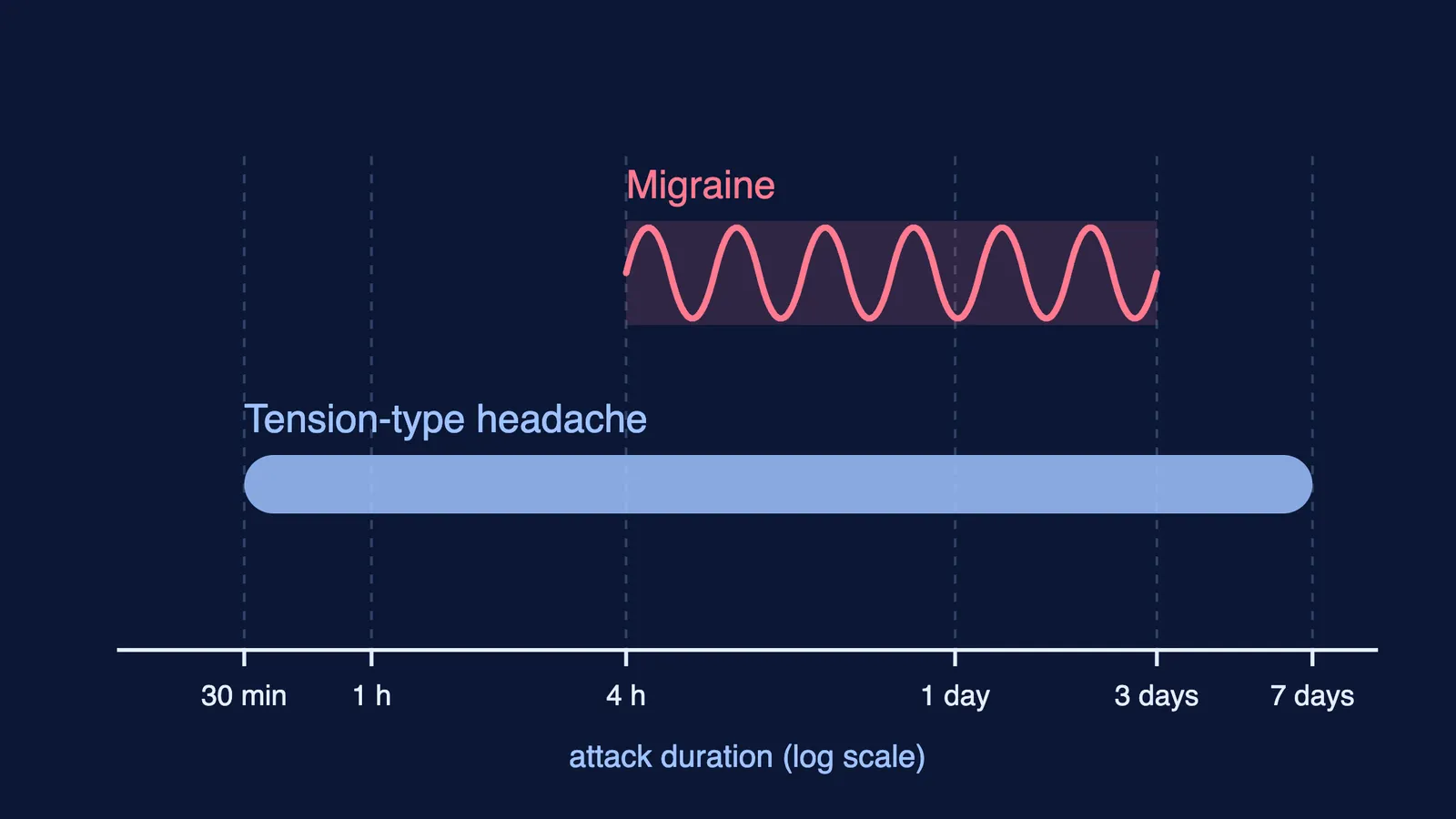
Doctors use the International Classification of Headache Disorders, ICHD-3. Under its criteria, migraine without aura has attacks lasting 4 to 72 hours in adults when untreated. The pain has at least two of four features: one-sided, throbbing, moderate or severe, or made worse by routine activity such as walking or climbing stairs. Each attack also brings nausea or vomiting, or sensitivity to both light and sound. A diagnosis needs at least five such attacks. In people under 18, attacks may last 2 to 72 hours and are more often felt on both sides.
Frequent episodic tension-type headache, as ICHD-3 defines it, lasts from 30 minutes to 7 days. It has at least two of four features: felt on both sides, pressing rather than throbbing, mild to moderate, and not made worse by activity. It brings no nausea or vomiting. The WHO describes it as pressure or tightness, "often like a band around the head".
What happens in the brain during a migraine?
In the mid-20th century, migraine was blamed mainly on blood vessels. A 2017 review in Physiological Reviews by Peter Goadsby and colleagues calls that vascular theory "now defunct". It describes migraine as a neurological disorder, widely accepted to be an inherited tendency for the brain to lose control of its inputs.
In a premonitory phase before the pain, the review says, brainstem and diencephalon systems that tune incoming light and sound signals begin to malfunction. The pain runs along the trigeminal durovascular pathway: nerves supplying the dura (the brain's tough covering) and its vessels. Newer drug classes target calcitonin gene-related peptide (CGRP), a signalling molecule, or its receptor. The WHO says the exact cause is unknown, but migraine is thought to involve pain-producing inflammatory substances released around the nerves and blood vessels of the head.
Some people first get an aura: the NHS migraine page lists zigzag lines or flashing lights, pins and needles, dizziness and difficulty speaking, and says aura should not last longer than an hour. For a related head pain, see why eating ice cream fast gives you brain freeze.
What causes a tension-type headache?
The ICHD-3 introduction to tension-type headache says the exact mechanisms are not known. Studies put its lifetime prevalence between 30% and 78%. Pain signals from the head and neck tissues probably play a role in episodic forms; central pain processing matters more in the chronic form. The most significant abnormal finding is increased tenderness of the muscles around the skull, such as the jaw and neck muscles. Once thought mainly psychological, it now appears to have a neurobiological basis, at least in its more severe forms.
Which triggers are common, and what can you track?
The NHS lists common migraine triggers: periods, anxiety, stress, tiredness, skipped meals, too much caffeine and too little exercise. The WHO adds alcohol, sleep disruption and certain foods, and suggests a headache calendar to spot other triggers. Exam season stacks several: late nights, skipped breakfast, extra chai. Our guide to how sleep helps you remember what you studied gives one more reason to protect sleep.
A headache log gives a doctor the answers they will ask for. For each headache, note:
Where: one side or both?
Feel: throbbing or pressing?
Strength: mild, moderate or severe; worse on stairs?
Extras: nausea, light or sound sensitivity, aura?
Time: start and duration.
Before it: sleep, missed meals, tea or coffee, painkillers.
Worked example: a Class 12 student logs three headaches in a month. Each lasted about six hours, throbbed on the left and came with nausea; two followed short nights. That resembles the ICHD-3 migraine description, so the log goes to a doctor. The NHS also advises against painkillers on more than 2 days a week, because this can cause more headaches.
For stress, try our four-minute breathing routine for exam stress. If it feels heavy, talk to someone you trust or call Tele MANAS on 14416.
When is a headache an emergency?
The NHS headache page says most headaches go away on their own. Get emergency help at once if a headache starts suddenly and is extremely painful, or comes with a seizure, numbness or weakness, loss of vision, drowsiness or confusion, difficulty speaking, a head injury in the last 3 months, a very high temperature or stiff neck, or a rash that does not fade when a glass is rolled over it.
The NHS migraine page says to see a GP if migraine attacks are getting worse, come more than once a week or are hard to control.
If the trigeminal nerve or the brainstem is hazy from Class 11 neural control, the Fermi Concept Library gives each biology concept its own lesson and shows its place in the map.


