

On this page
Buses run between two towns, A and B. A bus leaves each town every T minutes, and all buses travel at the same speed. A cyclist rides from A towards B at 20 km/h. Every 18 minutes a bus overtakes him, and every 6 minutes a bus coming the other way passes him. What is the bus speed, and what is T? This is a standard Class 11 relative-velocity problem, and it looks as if it has too little data. It does not. The whole solution rests on one quantity: the distance between neighbouring buses on the road.
Why is the gap between buses the bus speed times T?
Call the bus speed v. Stand at town A. A bus leaves, and T minutes later the next one leaves. By then the first bus has driven v × T further down the road. Both buses move at the same speed, so that gap never changes. Every bus going from A to B is the same distance, v × T, behind the one ahead of it.
The same holds for buses going from B to A: they leave every T minutes at the same speed, so they are also spaced v × T apart.
This gap is a ground-frame distance. It does not depend on who is watching. A common slip is to write the spacing as (v − 20) × T or (v + 20) × T. Those products mix the cyclist's motion into a gap that was fixed before he started riding.
How do you set up the two equations?
Now switch to the cyclist's frame. The spacing between buses is still v × T; only the speed at which the gaps sweep past him changes.
Buses from behind (A to B). They gain on him at v − 20 km/h. One gap closes every 18 minutes, so v × T = (v − 20) × 18.
Buses from ahead (B to A). They approach him at v + 20 km/h. One gap closes every 6 minutes, so v × T = (v + 20) × 6.
Two equations, two unknowns (v and T). Keep the times in minutes on both sides and the speeds in km/h on both sides; the units then cancel consistently, because each side is (km/h) × min.
If you want more practice with a single chase before tackling a stream of buses, see how to solve chase problems where one car catches another. For one overtaking event where the length is known, see the time for one train to overtake another. Here the length that has to be closed, the gap between buses, is the unknown.
Worked example: bus speed and T
Problem. A cyclist rides from A to B at 20 km/h. Buses leave A and B every T minutes at the same speed. A bus overtakes him every 18 minutes and an oncoming bus passes him every 6 minutes. Find the bus speed and T.
Write the spacing. Buses in either direction are v × T apart.
Overtaking equation. v × T = (v − 20) × 18.
Oncoming equation. v × T = (v + 20) × 6.
Eliminate v × T. (v − 20) × 18 = (v + 20) × 6. Divide by 6: 3(v − 20) = v + 20, so 3v − 60 = v + 20.
Bus speed. 2v = 80, so v = 40 km/h.
Find T. 40 × T = (40 − 20) × 18 = 360, so T = 9 minutes.
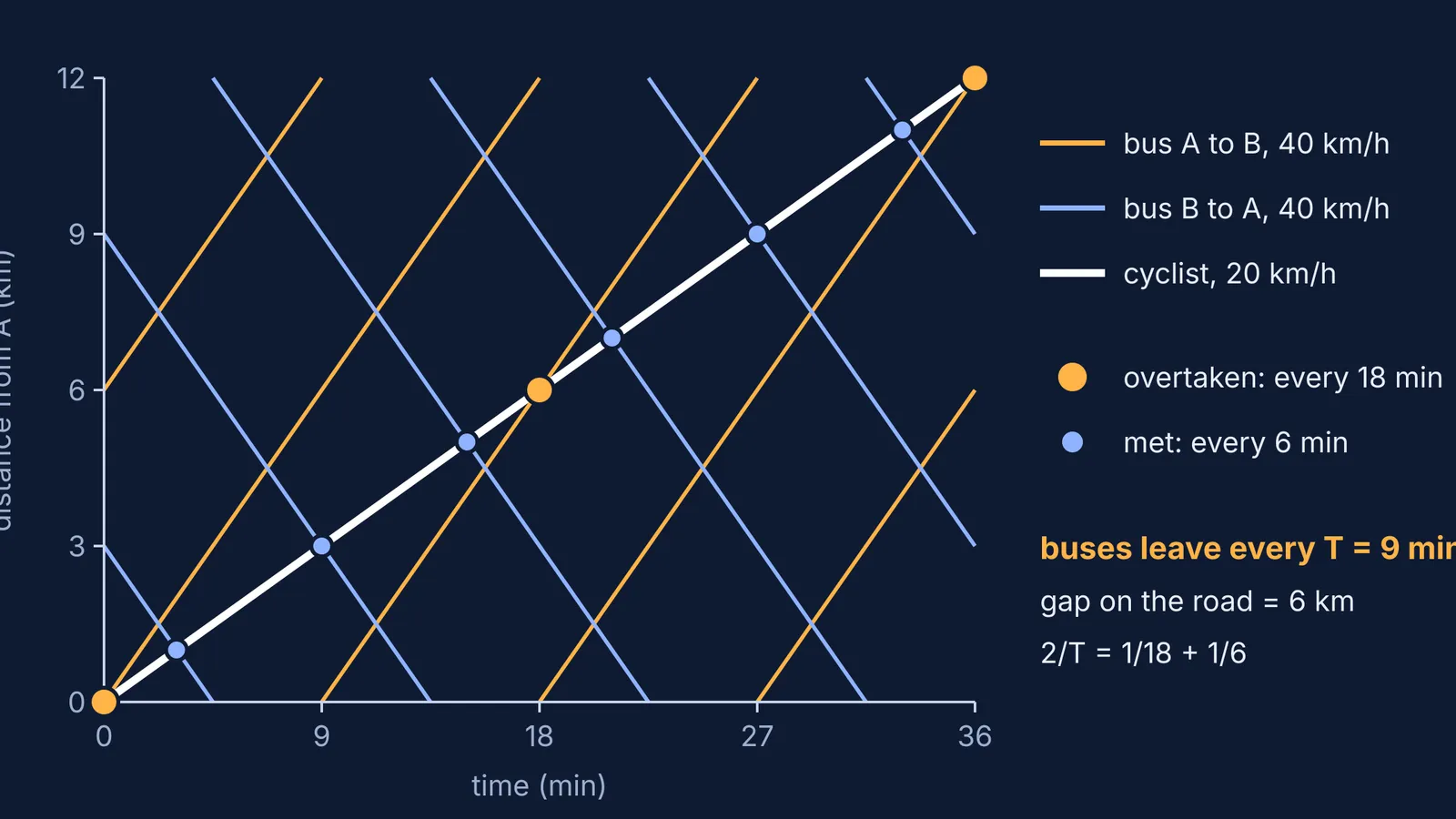
Check with the spacing. The gap is 40 km/h × 9 min = 40 × 0.15 h = 6 km. Closing 6 km at 20 km/h takes 0.3 h = 18 min. Closing 6 km at 60 km/h takes 0.1 h = 6 min. Both match the data.
So the buses travel at 40 km/h and leave each town every 9 minutes, 6 km apart on the road.
Why is T the harmonic mean of 18 and 6 minutes?
Write the two equations as rates. In the overtaking case, the number of buses passing the cyclist per minute is 1/18 = (v − 20)/(v × T). In the oncoming case it is 1/6 = (v + 20)/(v × T). Add the two:
1/18 + 1/6 = 2v/(v × T) = 2/T.
The cyclist's speed cancels. So T = 2 × 18 × 6 ÷ (18 + 6) = 9 minutes, the harmonic mean of the two intervals. That gives a fast check in an exam: you can find T without finding the bus speed at all.
Subtracting the rates instead gives the speed ratio. 1/6 − 1/18 = 2 × 20/(v × T), and dividing one equation by the other gives v/20 = (18 + 6)/(18 − 6) = 2. So the bus is twice as fast as the cyclist.
The harmonic mean also makes physical sense. A person standing still at the roadside would see a bus every 9 minutes in each direction. Riding towards oncoming buses makes them arrive more often; riding away from the buses behind makes them arrive less often. The two effects pull the intervals to opposite sides of 9 minutes.
What assumptions does the problem need?
The problem only works because of three assumptions. Say them in your answer.
Same interval T from both towns. If the towns used different intervals, there would be three unknowns and only two equations.
Same speed for all buses. If buses in one direction were faster, the two gaps would differ.
Steady service. Buses are already running along the whole road when the cyclist starts, so the gaps are evenly filled.
Two things you do not need: the distance between A and B, and the time the cyclist set off. The answer depends only on speeds and intervals. The cyclist's speed must also be less than the bus speed, or no bus would ever overtake him.
How does a position–time graph show this?
Plot position against time. Each A-to-B bus is a straight line of slope 40 km/h, and neighbouring lines are 9 minutes apart along the time axis. Each B-to-A bus is a line of slope −40 km/h, also 9 minutes apart. The cyclist is a shallower line of slope 20 km/h. Each time his line crosses a bus line, a bus passes him. The crossings with the rising lines are 18 minutes apart and those with the falling lines are 6 minutes apart, exactly as the hero graph shows.
Graphs like this help when the words of a problem get tangled. The same relative-velocity idea also works in two dimensions, for example in the angle at which to hold an umbrella while walking in rain. If you get stuck setting up equations like these, the Fermi Problem Library has a step-by-step solver that explains the reasoning at each step.
Quick checklist
Spacing between buses is v × T, a ground-frame distance.
Overtaking: v × T = (v − 20) × 18. Oncoming: v × T = (v + 20) × 6.
Solve: v = 40 km/h, T = 9 min, spacing 6 km.
Fast check: 2/T = 1/18 + 1/6, independent of the cyclist's speed.
Never average 18 and 6.
State the assumptions: same T and same speed both ways.


