

On this page
Chase, overtaking and meeting questions in Class 11 physics and JEE Main rest on one idea: two objects meet when they are at the same place at the same time. The free OpenStax textbook University Physics calls these two-body pursuit problems and solves them by setting the two positions equal at the same time t.
How do you set up the position equations?
For constant acceleration, position is x = x₀ + v₀t + ½at² (OpenStax, section 3.4).
Use one origin and one positive direction for both objects.
Start one clock. If an object starts later, use (t − t₀) in its equation, valid only for t ≥ t₀.
Write x_A(t) and x_B(t) with signs: braking means negative a, and moving towards the origin means negative v.
Set x_A(t) = x_B(t), solve for t, then substitute to find the place.
In the textbook's own example, a cheetah starts from rest at 4 m/s² just as a gazelle runs past at a steady 10 m/s. Setting their displacements equal gives 5 s, with both animals 50 m from the start (OpenStax Example 3.13).
When will one car catch up with another? A worked example
A truck moves at a steady 10 m/s down a straight highway. It is 24 m past a toll booth when a car there starts from rest with an acceleration of 2 m/s². When and where does the car catch the truck?
Put the origin at the booth, with t = 0 when the car starts:
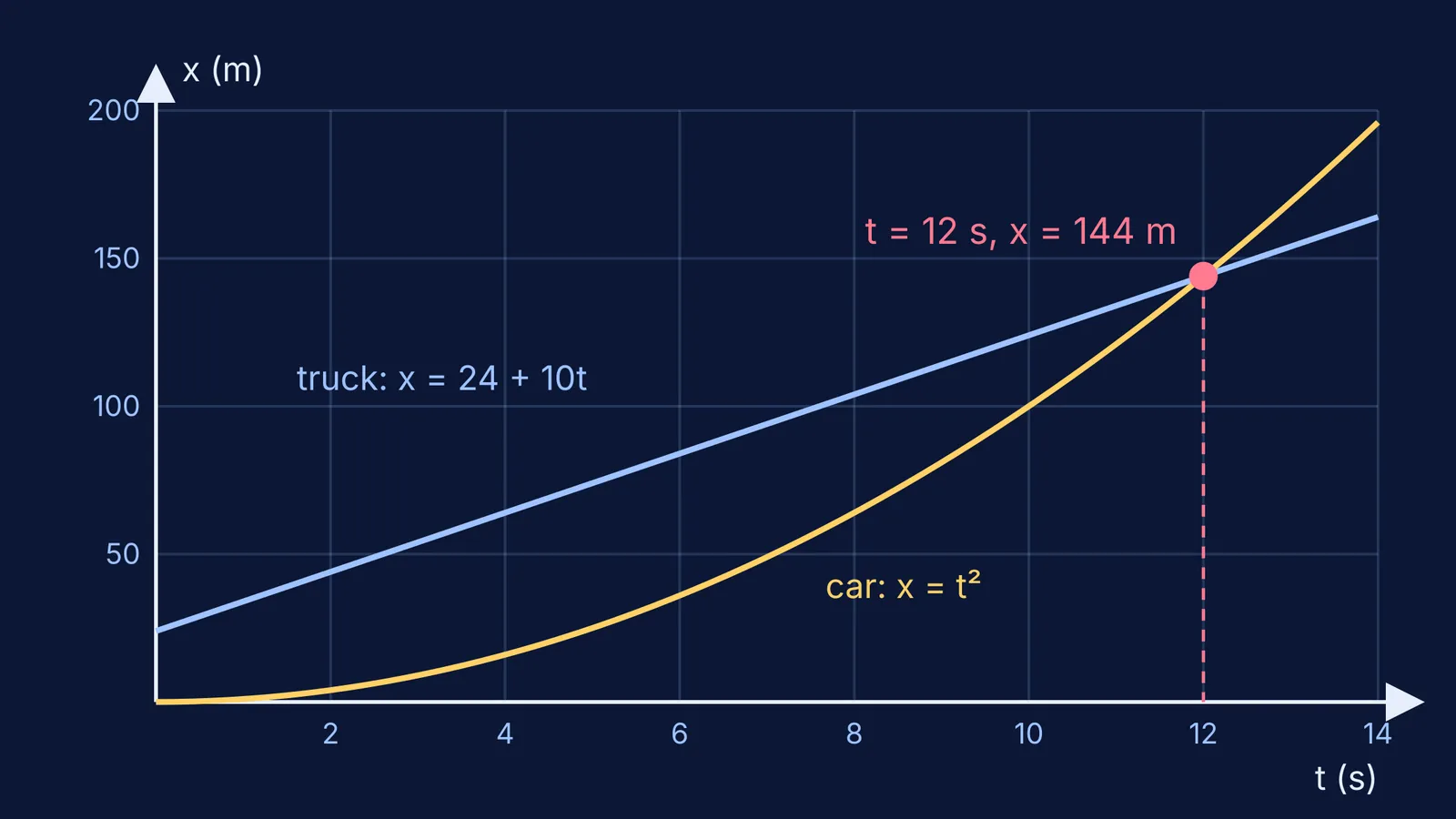
Car: x_c = 0 + 0·t + ½(2)t² = t²
Truck: x_t = 24 + 10t
Set them equal: t² = 24 + 10t, so t² − 10t − 24 = 0, which factorises as (t − 12)(t + 2) = 0.
The car catches the truck at t = 12 s, 144 m past the booth. The other root, t = −2 s, would only count if the car's equation held before it started, which it doesn't, so throw it away. The graph at the top shows the two curves crossing.
Is there a relative-velocity shortcut?
Yes. Velocities combine as v_AC = v_AB + v_BC (OpenStax section 4.5), so A's velocity as seen from B is v_A − v_B. Ride along on one object, and the problem becomes a single gap closing.
Meeting head-on: two cyclists 1.2 km apart ride towards each other at 5 m/s and 7 m/s. The gap closes at 12 m/s, so they meet after 100 s, 500 m from the first cyclist's start.
Overtaking a whole train: a 200 m train at 20 m/s passing a 100 m goods train at 15 m/s must gain both lengths, 300 m, at 5 m/s. That takes 60 s.
With acceleration: subtract accelerations too. Seen from the truck, the car starts 24 m behind at −10 m/s with relative acceleration 2 m/s², so 24 = −10t + t² and t = 12 s again.
The shortcut gives the time. For the place, return to the ground frame.
How do you spot an impossible answer?
Negative time. A root from before the motion started is not a meeting. Reject it.
Negative discriminant. No real root means no catch-up. A bus 40 m ahead starts from rest at 1 m/s² as you run after it at 6 m/s: 6t = 40 + 0.5t² gives t² − 12t + 80 = 0, with discriminant 144 − 320 < 0. The gap is smallest when your speeds match, at t = 6 s: 40 + 18 − 36 = 22 m. Our guide to closest approach in relative motion covers this kind of question.
Something stopped first. A braking object's equation holds only until it stops. A car 30 m ahead of a cyclist does 20 m/s and brakes at 4 m/s²; the cyclist rides at 5 m/s. Solving 5t = 30 + 20t − 2t² gives t ≈ 9.1 s, but the car stopped at t = 5 s after 50 m. It is parked at 80 m, so the cyclist arrives at 16 s.
Two positive roots. A steady car chasing one that speeds up from rest can overtake and then be passed back. Check which meeting the question wants.
Units. Every term must be a length. A quick dimensional analysis check catches a missing ½ or km/h mixed with m/s.
How should you practise chase problems?
Sketch both x-t graphs before any algebra: no crossing means no meeting, two crossings mean overtaking twice. If single-object equations still trip you up, start with solving equations of motion problems.
The Fermi Problem Library has worked problems with a step-by-step solver that explains the reasoning rather than printing an answer, so you can compare your setup line by line. If relative velocity feels shaky, the Fermi Concept Library gives every physics concept its own lesson.


